
Trust as Reinforcement: Bridging Cognitive Agency and Social Dynamics
Representing Trust in Cognitive Social Simulations
The paper proposes a novel computational framework to represent human trust and belief revision within cognitive social simulations. By integrating Q-learning with a dynamic social network and the Public Commodity Game, the authors demonstrate how trust mechanisms emerge and influence cooperation at a macro-societal level.
TL;DR
This research presents a framework for modeling trust within cognitive social simulations using Reinforcement Learning (RL). By situating agents in a Public Commodity Game, the study explores how individuals learn to value information sources and how "Norm Penalties" influence the stability of societal beliefs. The result is a system that can be tuned to replicate human-like social structures such as cliques and fluctuating social norms.
Background: The Infrastructure of Trust
In any society, trust is the "invisible fabric" that allows for market economies and democratic governance. In the context of computer simulation, trust acts as a selective attention filter. The authors argue that trust isn't just a number; it’s a two-pass decision process:
- Actionability: Is this information worth considering based on the sender?
- Belief Revision: Based on the topic and sender history, should I update my internal state?
The fundamental challenge is that simple agents tend to drift toward a "singular hive mind" (high centralization) or complete non-cooperation (the Nash equilibrium of the Public Commodity Game).
Methodology: Q-Learning in a Fluid Social Matrix
The core of the methodology lies in the dual-layered network graph. Every relationship has a static component (Homophily – "birds of a feather flock together") and a dynamic component (the fraction of time an agent chooses to invest in another).
The Reward Mechanism
To prevent the network from collapsing into a single central node, the authors introduced a Second-Order Reward. If Agent A and Agent B share a mutual "friend" in Agent C, they receive a bonus. This mirrors real-world social "cliques."
```latex
2nd-Reward = \min(E_H \cdot \min(E_{A 	o C}, E_{C 	o A}), E_H \cdot \min(E_{A 	o C}, E_{C 	o A})) / D
```
The Reinforcement Learning component uses Q-Learning to approximate the value of trusting a specific sender on a specific topic. The Boltzmann distribution (Softmax) governs the transition between exploring new relationships and exploiting high-trust ones.

Experimentation: The Public Commodity Game
To test the model, agents played a variation of the Public Commodity Game. Theoretically, rational agents should contribute zero (free-riding). However, by tying an agent's "Faith in the Public Commodity" to their belief structure, the authors observed how communications—and the trust behind them—could drive cooperation.
The Norm Penalty Paradox
The researchers introduced a Norm Penalty (), which penalizes agents for moving too far from their original beliefs.
- Low F: Leads to a stable, albeit static, equilibrium.
- High F: Paradoxically leads to instability.
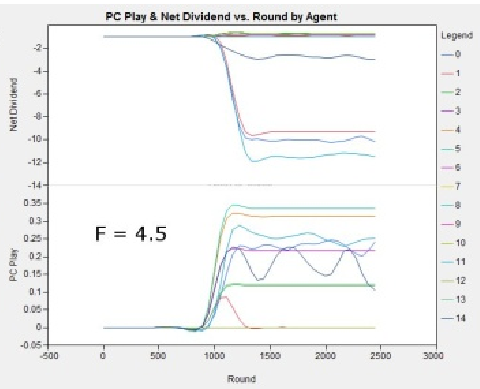 Figure 2: The relationship between the penalty for belief revision and the stability of cooperation in the simulation.
As seen in the results, higher norm penalties cause social "factions" to challenge the status quo, creating brief periods of instability before returning to a baseline—a behavior remarkably similar to historic human social movements.
Critical Insight: Tuning the Social S-Curve
A key find was the Distribution Factor (). By varying between 14 and 24, the researchers discovered an "S-curve" that controls Closeness Centrality. At , the simulation achieved a centrality of 0.30, which aligns with empirical human social network data. This implies that developers can "tune" the simulation to match specific cultural or professional environments.
Summary & Future Outlook
The study proves that trust can be modeled not as a static attribute, but as a dynamic learned behavior. The most striking takeaway is the relationship between individual cognitive limits (the penalty for changing one's mind) and macro-level societal stability.
Future Work will involve:
- Integrating Metacognitive elements, giving agents more conscious control over their belief revision.
- Building Mental Models where agents track the perceived beliefs of others to proactively assess trust.
This research moves us closer to "Cognitive Architectures" that can predict how misinformation or new institutional norms might propagate through a fragile social ecosystem.