
SWORD: Balancing Reputation and Congestion in the Crowdsourcing Economy
A reputation-aware decision-making approach for improving the efficiency of crowdsourcing systems
This paper introduces SWORD (Social Welfare Optimizing Reputation-aware Decision-making), a centralized task assignment approach for crowdsourcing systems. It models task delegation as a congestion game and utilizes Lyapunov drift theory to balance worker reputation with system-wide workload distribution, significantly outperforming traditional trust-based models in social welfare.
TL;DR
Crowdsourcing platforms face a paradoxical "efficiency trap": everyone wants the best workers, but the best workers have limited time. The SWORD (Social Welfare Optimizing Reputation-aware Decision-making) approach solves this by treating task assignment as a congestion game. By utilizing Lyapunov drift, it optimizes the entire system's social welfare, ensuring high-quality results without crashing the system under the weight of uncoordinated over-utilization.
The Problem: The High-Reputation Bottleneck
In most multi-agent systems, the standard advice for a requester is simple: "Find the most trustworthy worker and hire them."
However, human workers are not scalable computer programs. They have finite processing capacities. When thousands of requesters independently chase the top 1% of workers, two things happen:
- Congestion: Highly reputable workers develop massive backlogs, leading to missed deadlines and negative ratings.
- Under-utilization: Competent (but slightly lower-ranked) workers sit idle, reducing the total volume of business the platform can handle.
Current SOTA either focuses purely on reputation estimation (getting the score right) or load balancing (getting the speed right), but rarely both.
Methodology: Crowdsourcing as a Stochastic Network
The authors reframe the crowdsourcing platform as a congestion game. To solve this, they look toward control theory—specifically Lyapunov Drift.
The Objective Function
The core of SWORD is a "drift-minus-reward" expression:
- (The Drift): Represents the change in the level of congestion. The goal is to keep workers' queues near a "target length" () to minimize both idling and overcrowding.
- : The utility gained from high-quality results, weighted by the worker's reputation ().
- : A control parameter that allows system administrators to trade off between waiting time and result quality.
The Desirability Score
Instead of just looking at reputation, SWORD calculates a Desirability Score () for every potential worker:

This score effectively says: "How much better is this worker's quality compared to the cost, and how much capacity do they have left compared to their ideal workload?"
Experiments: Performance Analysis
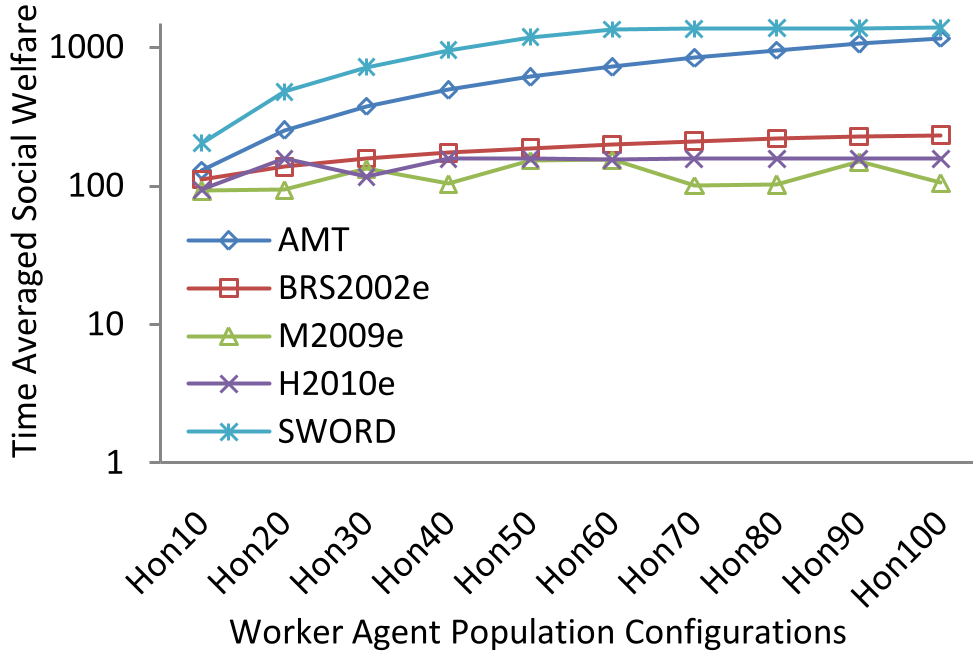
The authors validated SWORD through extensive simulations against self-interested trust models.
Key Findings:
- Social Welfare: SWORD consistently outperformed other benchmarks. By discouraging the "herd behavior" toward top workers, it increased the total number of successfully completed tasks (Human Intelligence Tasks, or HITs).
- Throughput vs. Quality: While a purely reputation-based model might yield slightly higher average quality per task, it completes far fewer tasks. SWORD maximizes the aggregate value created by the platform.
Critical Insight & Outlook
The genius of SWORD lies in its recognition that Trust is a resource constraint. In a digital economy where human attention is the bottleneck, we cannot ignore the physical limits of the "trustees."
Limitations:
- Homogeneity: The current model assumes all tasks (HITs) require the same level of effort, which rarely happens in real-world scenarios like Amazon Mechanical Turk.
- Centralization: The HIT broker is a central entity. In the era of Web3 and decentralized autonomous organizations (DAOs), a distributed version of this congestion game would be a significant leap forward.
Future Work: The authors aim to incorporate heterogeneous effort levels and explore distributed decision-making, where requesters can reach social-welfare-optimizing decisions without a central coordinator.