
SWORD: Balancing Reputation and Throughput in Crowdsourcing Systems
Bringing reputation-awareness into crowdsourcing
The paper introduces SWORD (Social Welfare Optimizing Reputation-aware Decision-making), a novel HIT allocation approach for crowdsourcing systems. It utilizes a constraint optimization framework based on Lyapunov drift to balance worker reputation (quality) with system-wide task throughput (timeliness), achieving a significant improvement in social welfare compared to greedy reputation models.
TL;DR
In crowdsourcing, we usually pick the "best" workers based on reputation. However, this paper argues that being too "greedy" creates bottlenecks. The researchers propose SWORD, a situation-aware allocation mechanism that uses Lyapunov Drift to ensure high-quality results without overwhelming top workers, effectively maximizing the "social welfare" of the entire system.
The "Winner's Curse" of Crowdsourcing
In platforms like Amazon Mechanical Turk (AMT), requesters naturally want the most reliable workers. Most existing trust models follow a Greedy Strategy: find the worker with the highest reputation and give them the task.
However, human workers are not servers; they have finite capacity. If everyone sends tasks to the top 1% of workers:
- Congestion: Top workers' queues explode, leading to massive delays (low timeliness).
- Under-utilization: 99% of the workforce remains idle, killing the "mass collaboration" potential of the platform.
The authors identify this as a fundamental mismatch: existing trust models assume infinite capacity, but crowdsourcing involves capacity-constrained humans.
Methodology: Risk vs. Drift
The core innovation of SWORD is treating HIT (Human Intelligence Task) allocation as a Stochastic Optimization problem. The goal is to minimize a combination of Risk (potential for low quality) and Drift (potential for system congestion).
1. The Undesirability Score
Instead of just looking at reputation (), SWORD calculates an Undesirability Score ():
- : Represents the quality risk.
- : Represents the workload drift. If a worker's queue () exceeds their target workload (), their score goes up, making them less desirable for new tasks.
2. System Architecture
The algorithm ranks workers by this score. Tasks are only allocated to workers with a "negative" undesirability score—meaning their combined reputation and current queue status make them an efficient choice.

Experimental Results: Moving to the "Golden Quadrant"
The authors tested SWORD against several baselines, including AMT's standard FCFS (First-Come-First-Served) and the Beta Reputation System (BRS).
The Performance Landscape
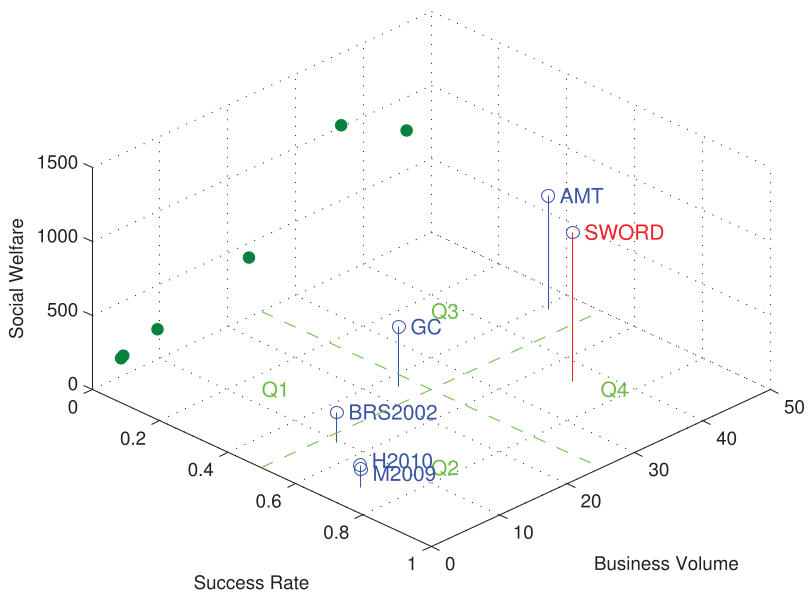
The results are plotted across two axes: Success Rate (Quality) and Business Volume (Quantity).
- AMT (Q3): High volume, but terrible quality.
- Greedy Models (Q2): High quality, but low volume (bottlenecks).
- SWORD (Q4): High quality AND high volume. By distributing tasks more intelligently, SWORD hits the sweet spot of productivity.
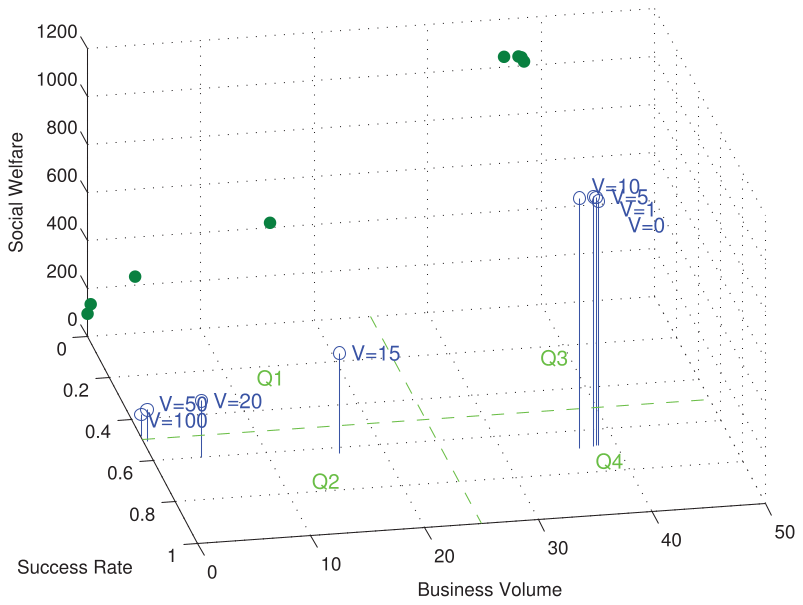
The Power of Variable 'V'
The control variable acts as a "knob" for system administrators. As increases, the system prioritizes reputation. However, the study shows that if is too high (e.g., >10), the system regresses into a greedy state, and social welfare drops because of congestion.
Critical Insight & Conclusion
The genius of SWORD is that it doesn't just ask "Who is the best worker?" but "Who is the best worker right now considering the wait time?"
By introducing Lyapunov stability into reputation management, the authors prove that we can have our cake and eat it too: high-quality results and a fast, scalable crowdsourcing ecosystem. For future platform designers, the takeaway is clear: Reputation is meaningless without context of capacity.
Limitations: The model assumes we can accurately estimate a worker's (maximum capacity). In reality, human availability fluctuates due to external life factors, which might require a more Bayesian approach to capacity estimation.