
Reputation-Based Regional FL: Securing Knowledge Trading in the Blockchain-Enhanced IoV
Reputation-Based Regional Federated Learning for Knowledge Trading in Blockchain-Enhanced IoV
This paper introduces a Reputation-Based Regional Federated Learning (RFL) framework combined with a blockchain-enhanced knowledge trading market for the Internet of Vehicles (IoV). It leverages decentralized model training to transform raw data into "knowledge" (model parameters) and employs a non-cooperative game theory approach for optimal knowledge pricing.
TL;DR
As the Internet of Vehicles (IoV) transitions from simple data sharing to sophisticated "Knowledge-as-a-Service" (KaaS), issues of data redundancy and security become paramount. This paper proposes a Regional Federated Learning (RFL) framework that uses a reputation mechanism to ensure the reliability of shared model parameters. To facilitate fair exchange, the authors integrate a blockchain-based trading market where knowledge pricing is optimized through a non-cooperative game, achieving higher accuracy (+18%) and better economic utility.
Problem & Motivation: Beyond Raw Data Sharing
Modern Intelligent Transportation Systems (ITS) are drowning in data. Sharing raw sensor logs between vehicles leads to network 24/7 congestion and exposes user privacy. While Federated Learning (FL) allows nodes to share model updates instead of raw data, it faces two critical hurdles:
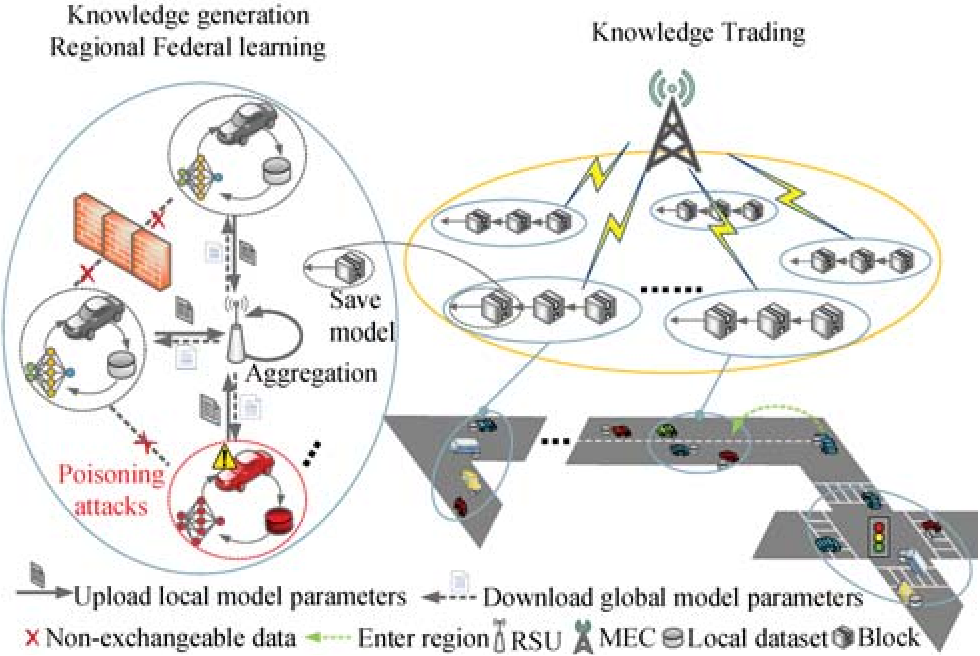
- The Honesty Problem: Malicious nodes can perform "poisoning attacks" by sending fake updates.
- The Trading Problem: How do we monetize these trained models in a decentralized, untrusted environment without a central authority?
The authors argue that "Knowledge" (well-trained model parameters) is the true unit of value. Their insight is to divide the IoV into regions, filter contributors by reputation, and use blockchain to verify and trade this knowledge.
Methodology: The RFL and Trading Framework
1. Reputation-Based Selection
The core of the "Regional" aspect is clustering vehicles by mobility nodes. Within each region, an RSU (Road Side Unit) acts as a leader. To prevent poisoning, the leader calculates a Reputation Score for each vehicle based on:
- Honesty Degree (HD): Ratio of positive to negative interactions.
- Accuracy Contribution (Ac): How much the specific update reduced the global loss function.
- Interaction Timeliness (It): A weighted function that prioritizes recent, high-quality contributions.
Only vehicles surpassing a dynamic threshold () can participate in the next training round.
2. Blockchain-Enhanced Trading Market
Once a region has a robust model, it can sell this "knowledge" to other regions.
- MEC Servers as Agents: Mobile Edge Computing servers handle the heavy lifting of blockchain consensus and execution.
- Smart Contracts: Protocols automatically handle requests, responses, and payments, ensuring no single point of failure.
3. Optimal Pricing via Game Theory
Knowledge providers compete for a requester's budget. This is modeled as a non-cooperative game. The utility function considers:
- Knowledge Value: The richness of the dataset.
- Competitive Priority (CP): A metric involving transmission quality, cost, and pricing.
The paper proves the existence of a Nash Equilibrium, where no provider can improve their utility by changing their price unilaterally.
Experiments & Results
The authors tested their framework using the MNIST dataset on a simulated IoV network with 50 vehicles.
- Accuracy Boost: By using reputation filtering, the model achieved an 18% improvement in accuracy compared to standard FL. This proves the mechanism's ability to effectively ignore malicious or noisy updates.
- Pricing Convergence: The gradient-descent-based algorithm for finding the Nash Equilibrium converged in just 12 iterations, showing the feasibility of real-time trading.
- Social Welfare: Competitive pricing led to lower costs for requesters while maintaining high utility for providers, as it encouraged more transactions.
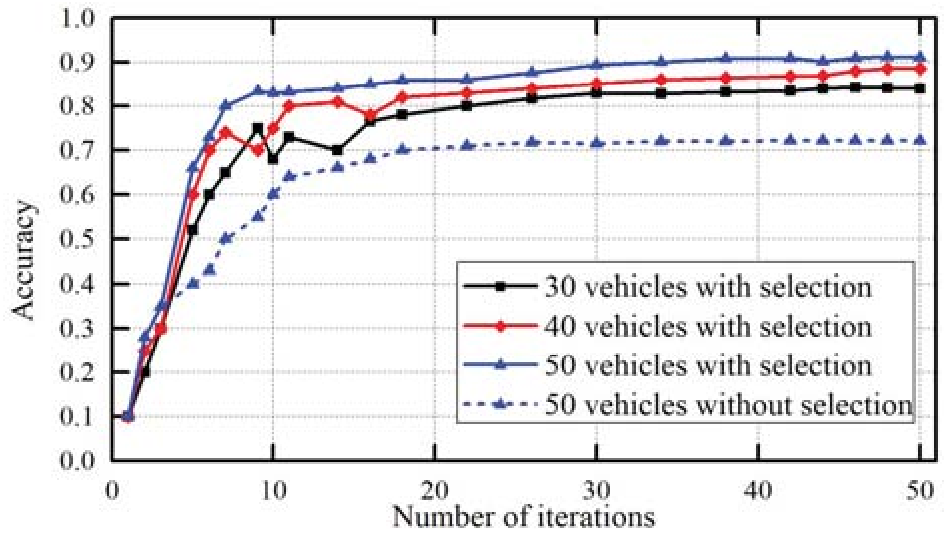 Fig 3: Reputation selection significantly outperforms traditional FL in accuracy.
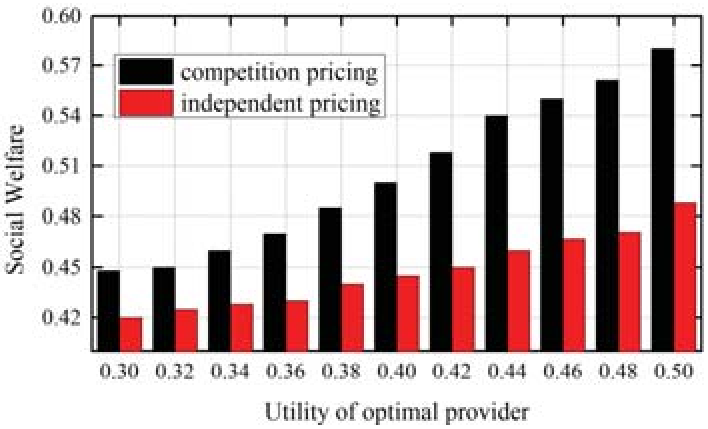 Fig 4: Competitive pricing reaches a stable equilibrium quickly, optimizing market efficiency.
Critical Insight & Conclusion
The true value of this work lies in the formal mathematical integration of social trust (reputation) and economic incentives (game theory) within a decentralized technical architecture (blockchain).
Takeaway: Future IoV systems should move away from being mere data pipes and instead become intelligent "Knowledge Markets." By applying Regional FL, we can reduce global bandwidth requirements while maintaining high-quality local intelligence.
Limitations: The mobility model assumes relatively stable clustering, which may struggle in high-speed highway scenarios where vehicle membership changes second-by-second. Future work should explore how "Knowledge" can be incrementally updated as vehicles transit between multiple regions at high velocity.