
PWRM: Navigating Social Network Uncertainty via Knock-Out Tournaments
Extracting Reputation with Knock-Out Tournament-Based Pairwise Elicitation in Complex Social Networks
The paper introduces PWRM (Pairwise Elicitation Reputation Mechanism), a decentralized system that extracts reputation rankings from qualitative preference comparisons. By utilizing a Knock-Out Tournament structure and a Rank Centrality scoring algorithm, it bypasses the subjectivity common in numerical rating systems, achieving high accuracy in ranking objects (SOTA performance on MovieLens dataset).
TL;DR
The paper proposes a decentralized reputation mechanism, PWRM, which shifts from "how many stars do you give this?" to "which one is better?". By structuring these qualitative choices into Knock-Out Tournaments and applying spectral ranking algorithms, the authors solve the persistent problem of subjectivity bias in social networks, achieving superior ranking accuracy over traditional quantitative methods.
Background: The Subjectivity Trap
In Complex Social Networks (CSNs), trust is the currency. Most platforms (eBay, Amazon, TripAdvisor) use central servers to average out numerical ratings. However, a "4-star" rating from a pessimistic user might mean something entirely different from an optimist's "4-star."
The authors argue that this quantitative aggregation is fundamentally flawed because:
- Scale Misinterpretation: Users use numerical scales inconsistently.
- Information Disclosure: Users may not want to reveal their exact internal utility values.
- Accuracy: High-grain scales (e.g., 1-100) are harder for humans to use reliably than simple binary choices.
Methodology: The Tournament of Preferences
The core innovation is treating reputation extraction as a Voting Protocol structured as a tournament.
1. Pairwise Elicitation
Instead of asking for a score, the system asks: Is Movie A better than Movie B? This is cognitively easier and removes the "scale" entirely.
2. The Knock-Out Structure
To evaluate a set of objects , the mechanism schedules a binary tree tournament. Winners of pairwise "matches" (determined by a Plurality vote of queried nodes) move to the next round. This creates a rich set of implicit and explicit relationships.
3. Rank Centrality Aggregation
To turn match results into a global ranking (), the authors use a Markov Chain model.
- The Graph: Objects are nodes; edges represent matches.
- Transition Probability: The probability of moving from Node to Node is proportional to how often defeated .
- The Result: The stationary distribution of this random walk provides the "score" for each object. An object ranks high if it beats other high-ranking objects.
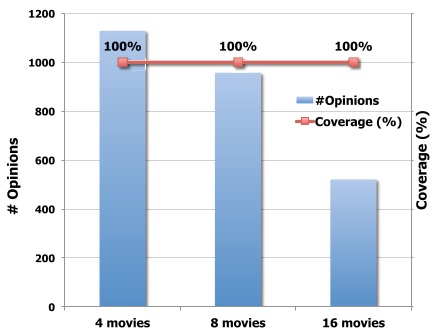 Figure 1: Performance metrics (nDCG@3) showing how tournament size and user query volume affect ranking quality.
Experiments & Results
The authors tested PWRM using the MovieLens 100k dataset, defining the "Ground Truth" as the average of all original user ratings.
Key Findings:
- Efficiency: The mechanism reaches near-perfect rankings using relatively few queries. Interestingly, querying 4 users per match was nearly as effective as querying 15, suggesting the "wisdom of the crowd" saturates early in binary choices.
- Robustness to Subjectivity: This is the "Killer App" for PWRM. When the researchers introduced "Optimistic" (scores 4-5) and "Pessimistic" (scores 1-2) users, traditional averaging failed to recover the correct ranking. PWRM, focusing only on the relative order (A > B), remained unaffected.
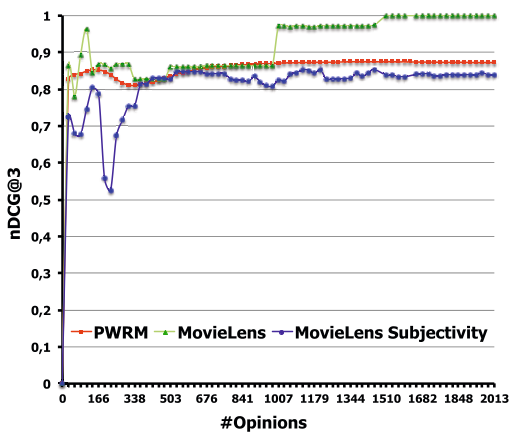 Figure 2: PWRM vs. Subjective MovieLens Data. Notice how PWRM (solid line) maintains high nDCG while traditional quantitative aggregation (dashed line) drops significantly.
Critical Insight & Future Outlook
The move from cardinal utility (numbers) to ordinal utility (rankings) is a classic economic pivot, yet its application in decentralized social networks via tournaments is novel.
Limitations: The current model assumes "truth-telling" users. In real-world adversarial environments (like Sybil attacks or biased reviewers), the mechanism would need Incentive Compatibility (rewards for honest voting).
Summary: PWRM proves that in the messy, subjective world of social networks, less is more. By limiting user input to simple binary preferences, we can extract more accurate and objective collective truths than we ever could with complex star-rating systems.