
Social Participatory Sensing: Bridging the Trust Gap with Fuzzy Logic and PageRank
A Reputation Framework for Social Participatory Sensing Systems
The paper proposes an application-agnostic reputation framework for Social Participatory Sensing (SPS). It integrates data quality metrics with social network-derived participant trustworthiness using a fuzzy inference system and adapts a weighted PageRank algorithm to maintain global reputation scores.
TL;DR
Sensing the world through the pockets of ordinary citizens is powerful, but how do we know if a geotagged photo or a noise reading is legitimate? This paper introduces a robust reputation framework that leverages the "social fabric" of participants. By combining Fuzzy Logic to handle the ambiguity of human trust and PageRank to quantify community standing, the authors achieve a 15% boost in system-wide data reliability.
The Core Challenge: The "Sandy" Effect
The motivation for this research is rooted in real-world chaos. During Hurricane Sandy, social media was flooded with fake photos (sharks on NYC streets). In participatory sensing—where we ask people to collect data—the "open" nature is a double-edged sword. We need participants, but we can't always trust their output.
Prior works focused on hardware solutions (like Trusted Platform Modules) or simple data consistency checks. However, they ignored a vital metric: Social Accountability. If a friend provides data, your trust in them is a blend of their expertise and your relationship history. The challenge is: How do you automate this human intuition at scale?
Methodology: The "Brain" and the "Rank"
The framework operates on a tripartite architecture:
1. The Evaluator (Calculating ToP and QoC)
The system independently measures:
- Quality of Contribution (QoC): Is the data accurate? (Using outlier detection/image processing).
- Trust of Participant (ToP): A weighted sum of Personal Factors (Expertise, Timeliness, Locality) and Social Factors (Friendship duration and Interaction frequency).
2. The Fuzzy Inference System (The Decision Maker)
Trust isn't binary. Using linguistic variables (Low, Med, High), the Fuzzy Engine uses 16 "If-Then" rules to determine the Trust of Contribution (ToC).
- Insight: This mimics human judgment—e.g., if the data quality is "Medium" but the friend is "High Trust," the system might still accept the contribution.
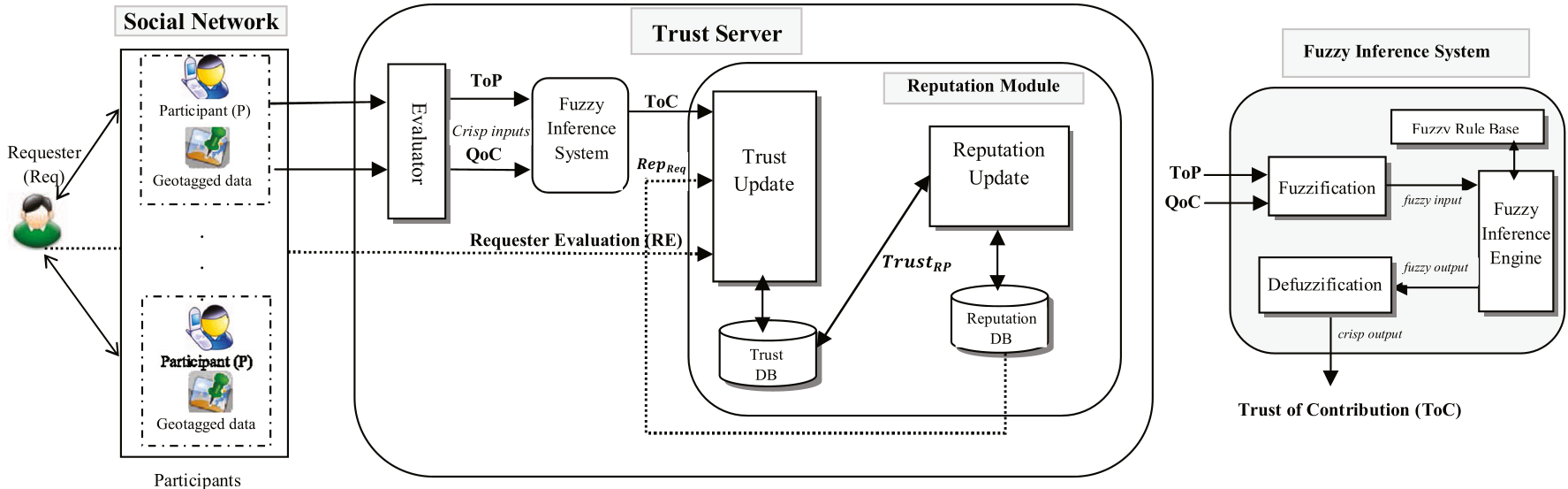
3. The Reputation Module (Global Ranking)
To prevent "one-hit wonders" or malicious actors, the system calculates a global reputation () using a weighted PageRank algorithm. Your reputation isn't just about how many people trust you, but how reputable the people are who trust you.
Experimental Insights: Catching the "Turncoats"
The authors simulated 100 members over 5000 campaigns. The most compelling part of the study is the Transition Scenario.
They modeled a participant (Participant No. 9) who was initially reliable but suddenly began submitting low-quality data.
- Result: The Fuzzy-PageRank hybrid detected the drop significantly faster than the "Baseline-Rep" or "Average" methods.
- Recovery: Once the participant resumed honest behavior, the reputation score recovered, demonstrating the system's "forgiveness" and elasticity.
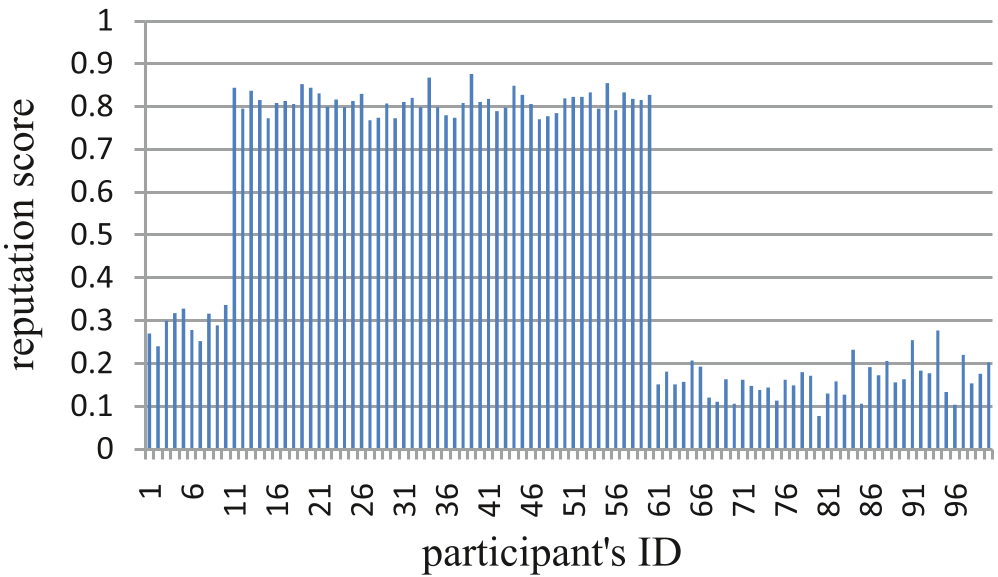 Figure: The system shows a distinct "dip" and "recovery" in reputation, proving its ability to track behavioral shifts in real-time.
Critical Analysis & Conclusion
Why this matters
The genius of this paper lies in its application-agnostic nature. Whether it's a "PetrolWatch" app for gas prices or "Ear-Phone" for noise pollution, the social trust layer remains consistent.
Limitations
- Computation Overhead: Running PageRank repeatedly is intensive. The authors suggest a "period " update, but in a million-node network, this remains a bottleneck.
- Privacy: The authors admit that using social data (expertise, location) raises massive privacy concerns, which are slated for "future work."
Final Takeaway
Trust in the digital age is as much about who sent the data as it is about what the data says. By mathematicalizing social relationships, Amintoosi and Kanhere have provided a blueprint for more resilient, human-centric crowdsensing.