
Shielding Mobile Social Networks: A Virgin/Non-Virgin Reputation Defense Mechanism
Using reputation measurement to defend mobile social networks against malicious feedback ratings
This paper introduces a robust reputation measurement approach for mobile social networks consisting of "virgin" (direct experience) and "non-virgin" (aggregated feedback) reputation scores. Using Bayesian inference and filtering mechanisms, the method effectively mitigates the impact of malicious feedback ratings (ballot-stuffing and bad-mouthing) to ensure accurate service recommendation.
TL;DR
To combat the epidemic of "fake reviews" and collusive feedback in mobile social networks, this paper proposes a dual-layer reputation framework. By distinguishing between Virgin Reputation (personal experience) and Non-Virgin Reputation (community feedback), and filtering the latter through a strict similarity threshold, the system provides a tamper-resistant trust score that outperforms traditional global averaging models.
Problem & Motivation: The "Dishonesty Premium"
In mobile social networks (MSNs), reputation is the currency of choice. Higher reputation means more service requests and more influence. However, this creates a "Dishonest Provider" incentive:
- Positive Malicious Feedback (Ballot-Stuffing): Colluding with agents to inflate one's own rating.
- Negative Malicious Feedback (Bad-Mouthing): Lowering a competitor’s ranking through false negative reports.
Earlier solutions like EigenTrust are mathematically elegant but computationally expensive for mobile devices. Other models rely too heavily on direct observation, leaving "cold-start" nodes vulnerable. The authors identified that we need a way to trust the community without being blinded by its malicious minority.
Methodology: The Dual-Score Engine
The core of the paper is the hybrid measurement of trust using the Beta distribution, which models the probability of a node being "good" based on binary (1/0) feedback.
1. Virgin Reputation (The "I Know You" Factor)
This is first-hand data. The system uses a Bayesian reference where current feedback () updates the existing parameters (). A time-discounting factor () is applied to ensure the system prioritizes recent behavior over ancient history.
2. Non-Virgin Reputation (The "They Say" Factor)
When a node has no direct experience, it broadcasts a query. To prevent drowning in malicious noise, the authors implement an aggregation algorithm:
- The Buchegger Filter: If the incoming feedback is too different from the node's local baseline, it is discarded immediately.
- Time-Weighted Aggregation: Recent recommendations carry more weight than older ones.
3. Synthesis with Confidence Value
The final score isn't just the average—it incorporates a Confidence Value (). If the variance of the Beta distribution is high (meaning inconsistent or sparse data), the confidence is low.
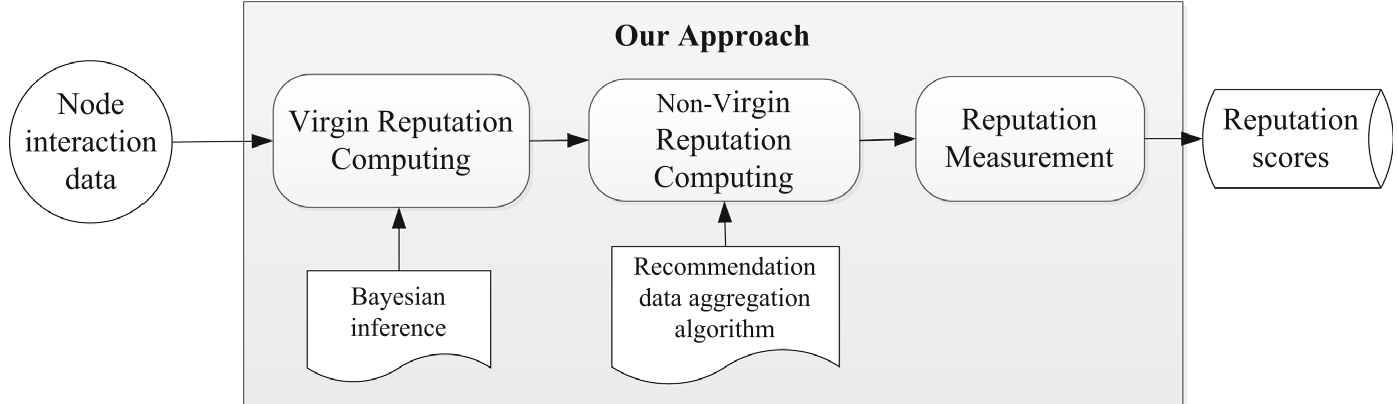 Fig 1: The overall workflow of reputation measurement and malicious rating prevention.
Experiments & Results: Resilience Under Pressure
The authors used NetLogo to simulate a hostile network environment. They benchmarked their model against TRAD (Traditional averaging) and OMTF (Objective Trust Management Framework).
Resilience to Collusion
As the percentage of malicious nodes increased from 10% to 50%, the Reputation Computation Error (RCE) of TRAD and OMTF spiked significantly. In contrast, the proposed approach remained relatively flat, effectively "filtering out" the attackers.
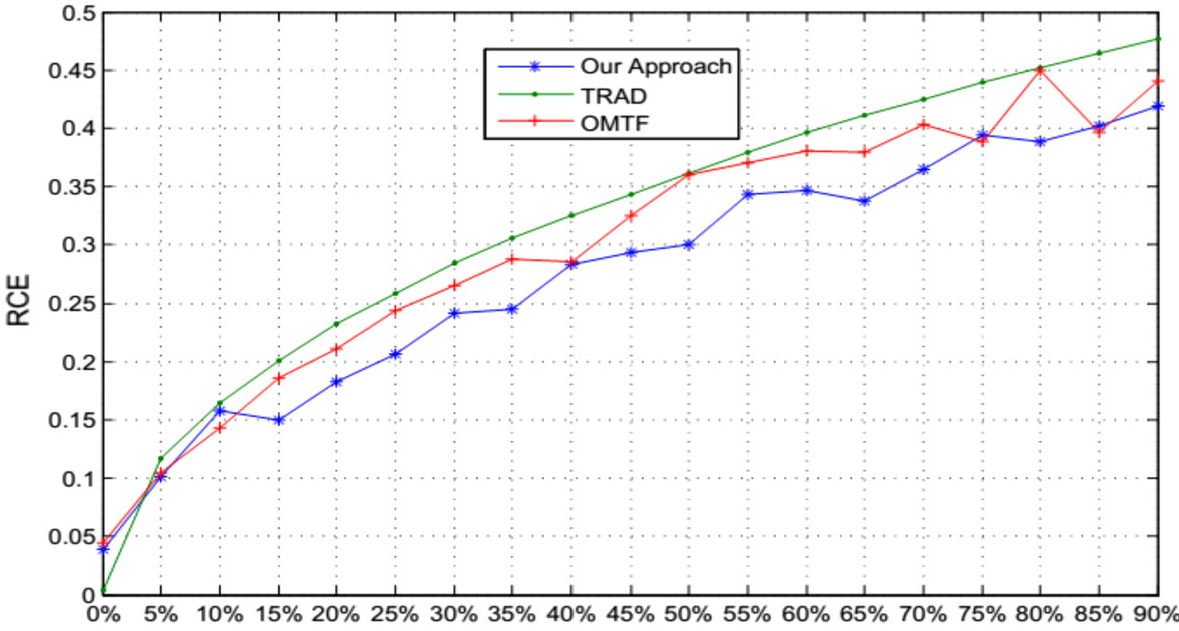 Fig 2: Comparison of accuracy (RCE) as the percentage of malicious nodes increases.
The "Six Degrees" Effect
A fascinating finding in the parameter study was the impact of Query_depth. The error dropped significantly as the depth reached 5 or 6, validating the "Six Degrees of Separation" theory—allowing the network to access a wider, more diverse pool of feedback improves the stability of the reputation score.
Critical Analysis & Conclusion
Takeaway
The genius of this work lies in the similarity verification step. By requiring that "second-hand" information aligns somewhat with "first-hand" intuition before being accepted, the system creates an Inductive Bias that favors consistency over sheer volume.
Limitations
- Network Overhead: The flooding query mechanism, while effective for accuracy, can consume significant bandwidth and battery in a mobile setting.
- Initial Cold Start: If a node has no virgin reputation, the Buchegger filter becomes difficult to calibrate, potentially allowing early-stage manipulation.
Future Outlook
This approach lays the groundwork for more sophisticated "Zero Trust" architectures in social computing. Future iterations might replace the flooding mechanism with Selective Forwarding or State-Space Models to reduce the communication footprint while maintaining the same robust defense against malicious actors.