
Synergizing Human Wisdom and Machine Logic: A Hybrid Approach to Requirement Dependency Extraction
Requirements Dependency Extraction by Integrating Active Learning with Ontology-Based Retrieval
The paper introduces a hybrid framework for automatically extracting requirements dependencies (such as "requires" and "refines") from natural language documents. It combines an Ensemble-based Active Learning (AL) approach with Ontology-Based Retrieval (OBR) to achieve high classification accuracy while significantly reducing manual annotation effort.
TL;DR
In the complex world of industrial software engineering, missing a single requirement dependency can derail a release. This paper presents a breakthrough hybrid method that integrates Active Learning (AL) with Ontology-Based Retrieval (OBR). By using domain ontologies to either act as an "Oracle" or provide high-quality training data, the authors achieved up to an 82.6% F1 score while cutting human expert workload in half.
The "Hidden Connection" Problem
Requirement Engineering (RE) practitioners face a daunting reality: upwards of 80% of requirements are interdependent. However, because these are documented in natural language, finding them manually is "laborious, cognitively exhaustive, and error-prone."
The authors identify a critical gap in current SOTA methods:
- Active Learning is powerful but requires a human "Oracle" to constantly label data.
- Ontologies provide deep domain knowledge but are expensive to build and can be too "conservative" (missing subtle connections).
The research intuition here is brilliant: Why not use the ontology to teach the machine, reducing the human burden?
Methodology: The Best of Both Worlds
The study proposes a variant of Active Learning called RD-AL, which uses an Ensemble of classifiers (Naive Bayes, RF, SVM) to ensure robust predictions. The real innovation lies in the two "Hybrid" architectures:
1. Hybrid1: The Ontology as the Oracle
In standard AL, when the model is "uncertain" about a pair of requirements, it asks a human. In Hybrid1, the model asks the OpenReq-DD tool (the ontology) instead. This automates the feedback loop entirely.
2. Hybrid2: The Ontology as the Teacher
Here, the dependencies extracted via the ontology are used as the initial "seed" training set. This gives the Active Learner a massive head-start before any human intervention is needed.
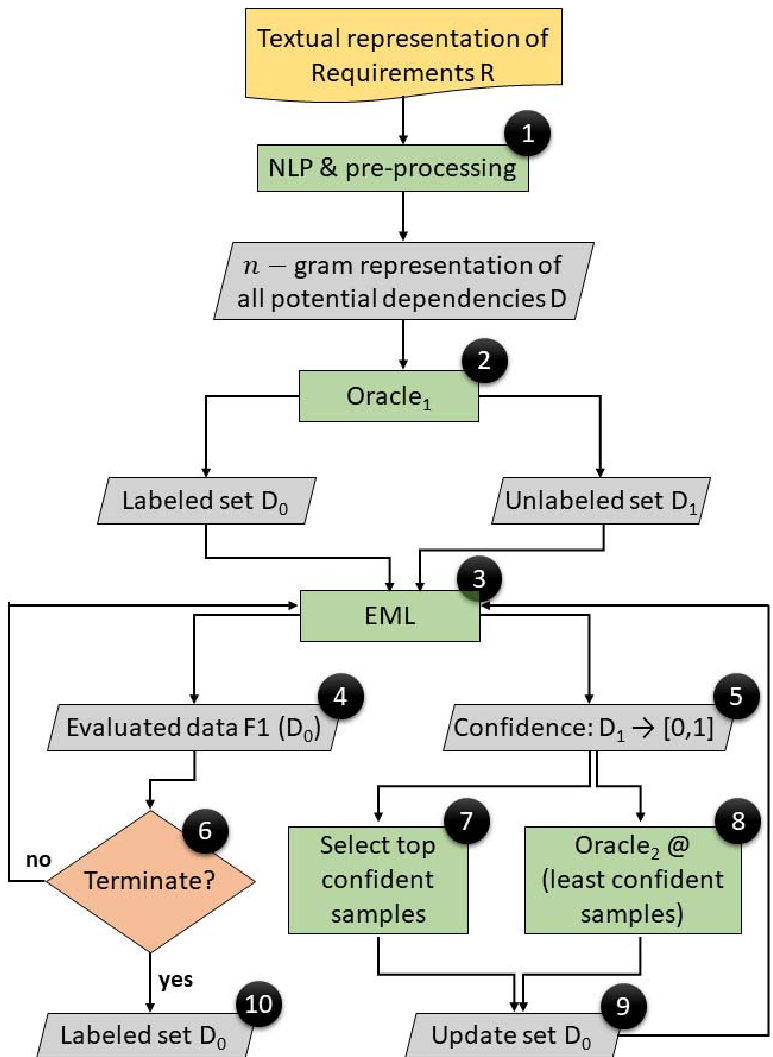 Figure 1: The workflow of the Ensemble-based AL method showing how the model queries for labels.
Industrial Evidence: Siemens & Blackline Safety
The methods were tested on two distinct datasets:
- Company A (Siemens): Railway domain (Radio Block Center).
- Company B (Blackline Safety): Wireless safety products involving hardware/firmware/software.
Performance Gains
The results confirm that Hybrid methods outperform individual baselines:
- Company B Success: The F1 score jumped from 49.9% (AL Baseline) to 82.6% (Hybrid1).
- Company A Efficiency: Hybrid2 improved the F1 score while leveraging an ontology that took only 5 hours to construct—a significant ROI boost.
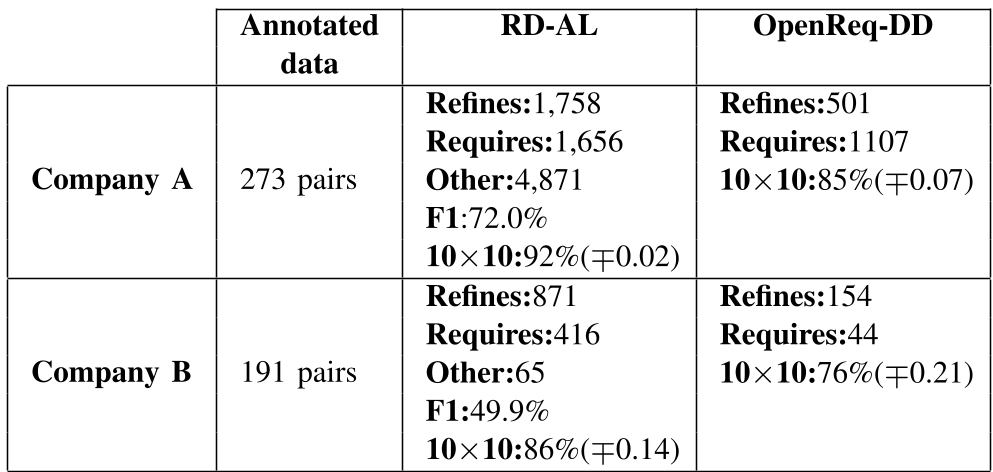 Table: Comparison of RD-AL and OpenReq-DD across industrial datasets.
Critical Insight: The "Other" Category
One sophisticated aspect of the paper is the handling of Requires and Refines relations. Interestingly, the model also identifies an "Other" category. While this sounds like a catch-all, in an industrial context, it acts as a "safety net," highlighting potential dependencies that need further human review, thereby preventing dangerous false negatives.
Takeaways and Future Outlook
This paper proves that we don't need to choose between "symbolic AI" (Ontologies) and "statistical AI" (Machine Learning). By integrating them:
- Effort Reduction: Human labor was reduced by 50%.
- Reliability: Hybrid approaches captured dependencies that either baseline alone would have missed.
- Scalability: Ontologies, once built, can be reused across multiple projects in the same domain.
Limitations: The success of this method depends heavily on the quality of the initial ontology. Future work will likely look at using LLMs to automatically generate these ontologies, potentially removing the last remaining bottleneck in the pipeline.
Summary by Senior Academic Editor / Tech Lead