
Scaling Under Fire: Lessons in Architecture Evolution from Instagram's Hyper-Growth
Understanding Requirements Driven Architecture Evolution in Social Networking SaaS: An Industrial Case Study
This paper presents an industrial case study on the architectural evolution of Instagram, a major Social Networking SaaS (SNS). It identifies the driving forces behind structural changes, focusing on the interplay between scaling requirements and architectural adaptations across various growth phases.
TL;DR
Building a social network is a race against your own success. This paper analyzes how Instagram evolved its architecture from a single-server setup to a global SaaS powerhouse. The core insight: Scalability and Real-time performance are the only requirements that force you to tear down and rebuild your architecture; everything else is just an "add-on."
The "Success" Problem: Why SNS Architecture is Unique
In the world of Social Networking SaaS (SNS), the scale of users is unpredictable. Unlike Business Utility SaaS (like HR or Accounting tools) where growth is often linear and planned, SNS applications face "explosive" growth. The paper highlights the Twin Peaks Model, where requirements and architecture must be woven together in a spiral. In Instagram's case, failing to evolve meant a "catastrophic" failure of service.
Motivation: Identifying the "Redesign" Triggers
The authors wanted to answer a crucial question for engineers: Which requirements actually matter for the long-term structure of a system? Many teams spend too much time on feature flexibility and not enough on the "structural" requirements that eventually break the system under load.
Methodology: The Architecture Evolution Roadmap
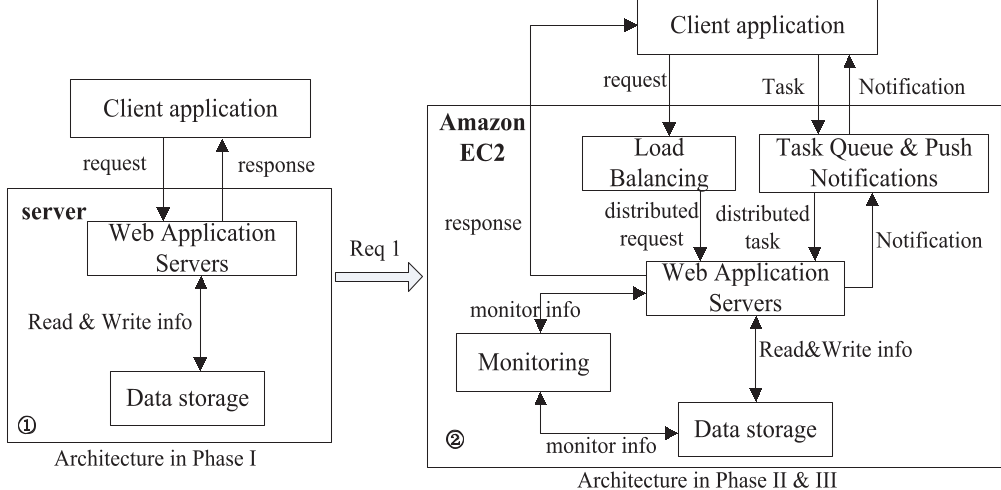
The paper categorizes Instagram's growth into three phases:
- Starting Stage: Survival on a single machine.
- Focus on iOS: Vertical and horizontal sharding.
- Extending to Android: Massive concurrency and read-slaves.
1. Overall Layered Evolution
Initially, everything was on one box. The first major move was to Amazon EC2. This transition allowed Instagram to remain stable even when user counts increased 1,000x. The final architecture settled into a clean, layered stack:
2. Data Storage Layer (DSL) Evolution: The Sharding Journey
The database is often the "heart and soul" and the primary bottleneck. Instagram's DSL evolved through four stages:
- Phase A: Single DB.
- Phase B: Vertical Partitioning (moving photo data to its own machine).
- Phase C: Horizontal Partitioning (sharding 68GB+ tables into logical shards).
- Phase D: Read-Slaves (supporting 40k+ requests/sec).
The Lessons Learned: Three Pillars of Success
I. Scalability vs. Features
The study found a clear pattern: Scalability and Real-time requirements caused "Layer Redesigns." New business features (like adding hashtags or Android support) usually only required "Component Additions."
II. Monitoring as a Requirement Source
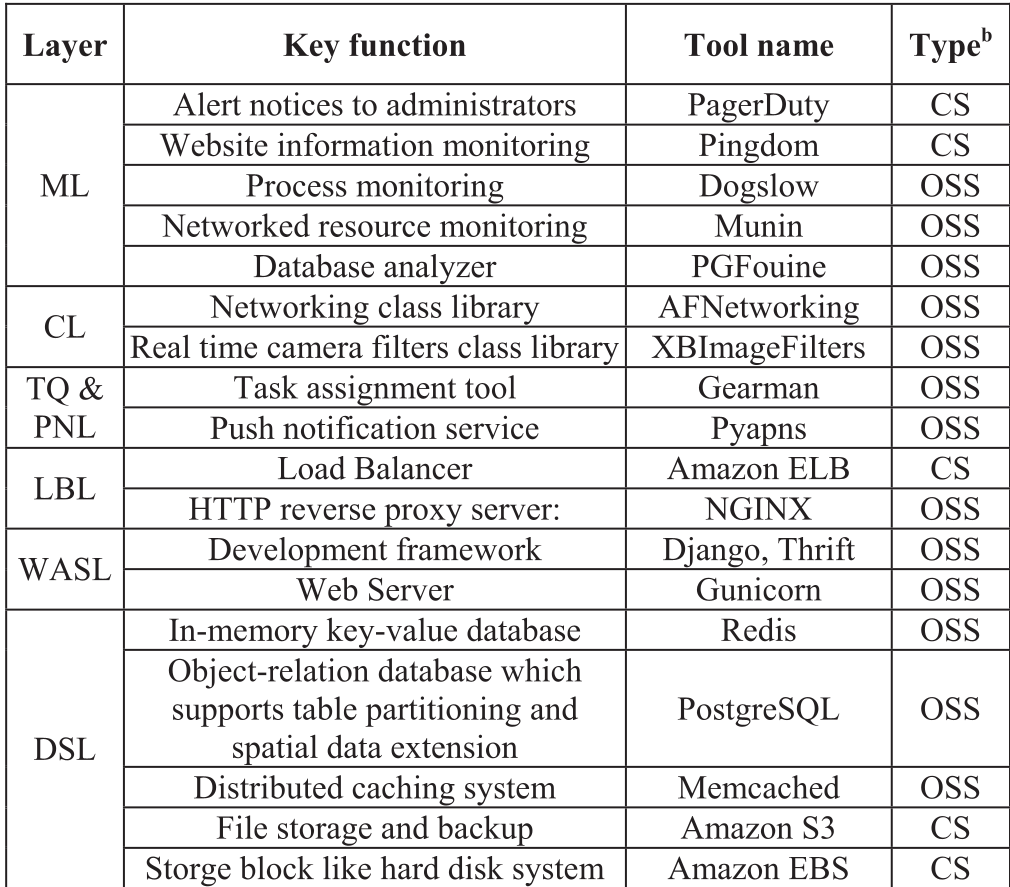
You can't fix what you can't see. Instagram used a "Monitoring Layer" (incorporating tools like Munin, Pingdom, and Sentry) to identify bottlenecks. Data from these monitors served as more important "Requirement Documents" than any PM-written spec.
III. Reusing the "Collective Intelligence"
Instagram’s secret weapon was not building everything in-house. By leveraging Open Source Software (OSS) like Redis, PostgreSQL, and Django, and Commercial Services (CS) like Amazon ELB, they focused their limited headcount on core logic rather than infrastructure.
External Validation: Facebook and Twitter
To ensure these weren't just "Instagram quirks," the authors looked at Facebook and Twitter.
- Facebook: Rebuilt its storage (Haystack) and compilers (HHVM) multiple times to handle scale.
- Twitter: Moved from a simple CMS-style architecture to a heavy middleware-cached architecture (using Memcached and Kestrel) to handle the "fan-out" of tweets.
Critical Insight & Conclusion
The paper concludes that for any SNS, the Architecture is never "done." It is a living entity that must co-evolve with user behavior.
The Takeaway for Developers:
- Design for Monitoring from Day 1.
- Don't over-engineer for business features; over-engineer for Scalability.
- Use OSS to move fast; buy what you can't (or shouldn't) build.
Limitations: The paper focuses on the early 2010s era of Instagram. Modern SNS architecture has moved further toward Microservices and Serverless, which might change how "Layer Redesign" manifests today, though the core logic of scaling-driven evolution remains valid.