
Social Media as a Force Multiplier: Deriving Requirements for OSN-Based Community Policing
Deriving requirements for social media based community policing: insights from police
This paper explores the role of Online Social Networks (OSN) in facilitating community policing within developing nations, specifically India. By interviewing 20 senior Indian Police Service (IPS) officers, the study identifies four functional pillars for OSN adoption and derives a set of socio-technical requirements to bridge the gap between police authorities and citizens.
TL;DR
In many developing nations, the thin blue line is stretched significantly thinner than international standards suggest. This research investigates how Online Social Networks (OSN) can act as a bridge, transforming citizens from passive observers into an active "human sensor network." By interviewing elite Indian Police Service (IPS) officers, the authors identify key requirements for a system that doesn't just broadcast news but builds authentic, two-way community relationships.
The Resource Gap: Why Traditional Policing is Failing
The motivation behind this study is rooted in a stark demographic reality: India has roughly 130 police officers per 100,000 citizens—less than half of the United Nations' recommended guideline. This scarcity necessitates Community Policing, a strategy that relies on the "eyes and ears" of the public.
However, the transition from physical neighborhoods to digital spaces is fraught with challenges. Previous efforts often failed because they treated social media as a digital billboard rather than a conversational platform. The authors sought to understand how senior law enforcement leaders perceive this digital shift and what they actually need from a technology perspective to make it work.
Methodology: Insights from the Top Brass
The researchers interviewed 20 senior officers of the Indian Police Service (IPS). This is a critical cohort because these individuals lead massive intelligence and jurisdictional organizations.
The methodology employed a limited Grounded Theory analysis, which allowed the researchers to distill raw qualitative data into actionable technical requirements. The diversity of the interviewees—covering different states and special branches—provided a holistic view of the social and cultural nuances affecting policing in India.
The Four Pillars of Digital Community Policing
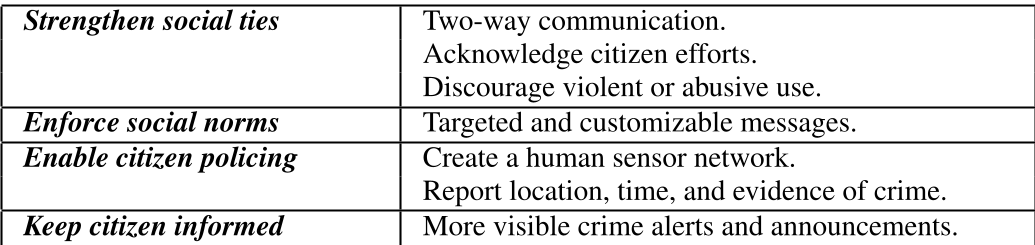
The core of the paper is the identification of four thematic areas where OSN serves community policing:
1. Strengthening Social Ties
Existing media (TV, Newspapers) are one-way streets. OSN allows for a "mass opinion" gathering.
- Requirement: Systems must include feedback loops. Officers expressed a fear that without acknowledgment, OSN pages would become "repositories of complaints" where citizens feel ignored.
2. Enforcing Social Norms
Policing varies by geography. What is a priority in Northeast India (e.g., witch-hunting awareness) differs from North India (e.g., women’s safety).
- Requirement: The ability to send targeted, customizable messages to specific demographies or regions.
3. Enabling Citizen Reporting (The Human Sensor Network)
This is perhaps the most "SOTA" application—turning thousands of smartphones into a distributed sensor array.
- Insight: The Delhi Traffic Police page was cited as a success story where citizens post photos of violators, leading to official fines (challans).
4. Keeping Citizens Informed
Real-time alerts for jewelry snatching, natural disasters, or traffic diversions.
- Requirement: An alert system that prioritizes high-impact, instant information over general feed noise.
Critical Analysis & Conclusion
This paper provides a rare "inside-out" view of police technology requirements. While most HCI (Human-Computer Interaction) research focuses on the user/citizen, this study focuses on the authority’s constraints.
Takeaway for Tech Developers: If you are building tools for public safety, "Social Media Monitoring" is not enough. You must build "Social Media Engagement" tools. This includes:
- Automated Acknowledgment: To let the citizen know their report was seen.
- Abuse Filters: To protect the professional decorum of the official channel.
- Contextual Categorization: To sort through the "volume and velocity" of data during riots or crises.
Limitations: The study primarily focused on male officers (only one female participant), and the authors acknowledge that the specific needs of women in the force and the broader citizen perspective are areas for future exploration.
Future Outlook
As we move toward 2026 and beyond, the integration of AI into these "Human Sensor Networks" will likely be the next frontier—automatically validating citizen-reported evidence and prioritizing critical alerts during large-scale events.