
Precise Identification of Influential Nodes: A Resampling-Based Gap Analysis
Resampling-based gap analysis for detecting nodes with high centrality on large social network
The paper introduces a "Resampling-Based Gap Analysis" method to identify high-centrality nodes (closeness and betweenness) in large social networks using limited node samples. It proposes an efficient sorting-based algorithm to detect statistical boundaries (gaps) between node rankings with a specified confidence level (e.g., 95%).
Executive Summary
TL;DR: This paper tackles the challenge of identifying top-ranked nodes in massive social networks without exhaustive computation. By employing a Resampling-Based Framework, the authors can detect "statistically significant gaps" in node centrality rankings. This allows researchers to confidently say, "Node A is definitely more central than Node B," even when only looking at a fraction of the network.
Academic Positioning: This work bridges the gap between approximate graph algorithms and statistical reliability. It moves the conversation from "how close is our estimate to the true value?" to "how confident are we in the relative ranking of nodes?"
The Problem: The Fog of Sampling
In social network analysis, measures like Betweenness Centrality are vital for finding "bridge" nodes that control information flow. However, calculating these for millions of users takes an eternity. Sampling is the obvious solution, but it introduces a new risk: Ranking Noise.
If Node A has an estimated centrality of 0.5 and Node B has 0.45, can we be sure Node A is truly more important? Standard statistical errors (SE) often overestimate uncertainty because they assume nodes are sampled from an infinite population. This "lazy" estimation leads to overly cautious results, failing to highlight clear leaders in the network.
Methodology: Detecting the Statistical Gap
The core innovation lies in the Resampling Error (RE) calculation and an efficient identification algorithm.
1. The Resampling Advantage
Unlike Standard Error, the Resampling Error converges to zero as the sample coverage reaches 100%. This is critical. The authors use a coefficient that accounts for the finite size of the network: This provides a tighter confidence interval, meaning we can distinguish between nodes more easily as we gather more data.
2. The Two-Pass Algorithm
To find gaps without a brute-force comparison, the authors propose a approach:
- Forward Step: Sort nodes and compute the progressive minimum of lower confidence bounds.
- Backward Step: Compute the progressive maximum of upper confidence bounds.
- Detection: A gap exists where the lower bound of the "high group" is strictly greater than the upper bound of the "low group."
 Note: The algorithm ensures that if a gap is detected at index , every node in is superior to every node in with 95% confidence.
Experimental Insights
The authors tested their method on three datasets: Ameblo (56k nodes), Cosme (45k nodes), and Enron (19k nodes).
Key Finding: Closeness vs. Betweenness
The study reveals that identifying gaps in Betweenness Centrality is easier than in Closeness Centrality. Top-tier nodes in betweenness tend to be much more "distinctive" statistically, leading to clearer gaps even at low sampling ratios.
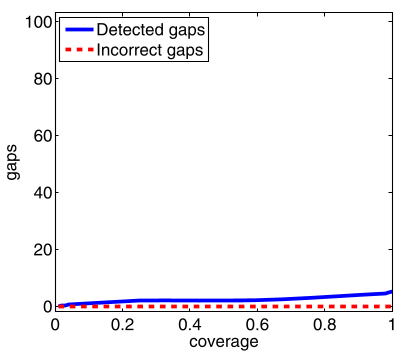 Figure: The Resampling method (RE) significantly outperforms the Standard Error (SE) method in "Gaps Detected" as coverage increases, while keeping "Incorrect Gaps" (red line) at virtually zero.
The "Naive" Trap
The "Naive" method (ranking simply by estimates) identifies many gaps, but a huge percentage of them are incorrect (ranking inversions compared to the ground truth). The RE method's conservative nature ensures that when it identifies a gap, it is almost certainly correct.
Critical Analysis & Conclusion
Takeaway
Identifying high-centrality nodes is not just about point estimates; it's about the statistical interval. The resampling-based approach is a "must-use" for practitioners who need to justify their selection of "Influencers" or "Top Nodes" in a mathematically rigorous way.
Limitations
- Global Knowledge: The method currently requires the standard deviation of the whole population or a very good estimate of it, which might still be expensive for truly massive graphs.
- Static Nature: The analysis is performed on static snapshots; performance on dynamic or streaming graphs remains an open question.
Future Outlook
This framework could be extended to community detection or link prediction, where quantifying the "certainty" of a structural feature is just as important as the feature itself.