
Inside Renren: Deciphering the Structural DNA of China's Largest Student Social Network
Rese aRch Fe aTURe
This paper presents a large-scale empirical study of Renren, a prominent Chinese real-name social network. By analyzing a dataset of 8.7 million nodes and 107 million edges, the authors characterize its structural properties and temporal evolution, identifying a unique exponentially truncated power law in degree distribution and rapid assimilation of disconnected components into the Giant Connected Component (GCC).
TL;DR
This empirical study dives into the massive social graph of Renren, often referred to as the "Facebook of China" during its prime. Analyzing over 8.7 million users, the research reveals that while Renren shares typical "Small World" characteristics with its Western counterparts, it exhibits unique exponentally truncated power laws and a highly aggressive Giant Connected Component (GCC) that swallows smaller isolated groups almost instantly.
Problem & Motivation: Beyond the Western Social Graph
While much is known about the structures of Facebook and Twitter, Chinese social networks present a different cultural and demographic landscape. Renren was unique because it was real-name based and heavily centered on college student populations.
The authors sought to answer:
- Does a student-centric, real-name network follow the same "Power Law" distribution as global platforms?
- How do "Disconnected Components" (the outsiders of the main network) behave? Do they grow into rival clusters, or are they destined to merge?
Methodology: Snapshot and Temporal Analysis
The researchers analyzed an anonymized dataset provided by Renren, consisting of 8,754,959 nodes and 107,147,829 edges, spanning a two-year period. Their approach was two-fold:
- Static Analysis: Mapping the final state of the network to measure degree distribution, clustering coefficients, and average node distances.
- Evolutionary Analysis: Replaying the 771-day history of the network to observe how the diameter changes and how edges are formed over time.
 Figure 1: The anatomy of a Renren homepage, showing status messages and friend broadcasts.
Methodology Highlights: The Disconnected Components (DCs)
A unique contribution of this paper is the focus on Disconnected Components (DCs). The authors tracked three states for these small clusters:
- Newborn: Small components appearing for the first time.
- Alive: Components that grew but remained isolated from the GCC.
- Dead: Components that were either absorbed by the GCC or merged into other small clusters.
Key Findings & Visual Evidence
1. The Truncated Power Law
Unlike many networks that follow a strict power law, Renren’s degree distribution (the number of friends per user) is exponentially truncated. This means that while a few "hubs" have massive influence, the tail of the distribution drops off faster than expected due to the real-name and campus-bound nature of the platform.
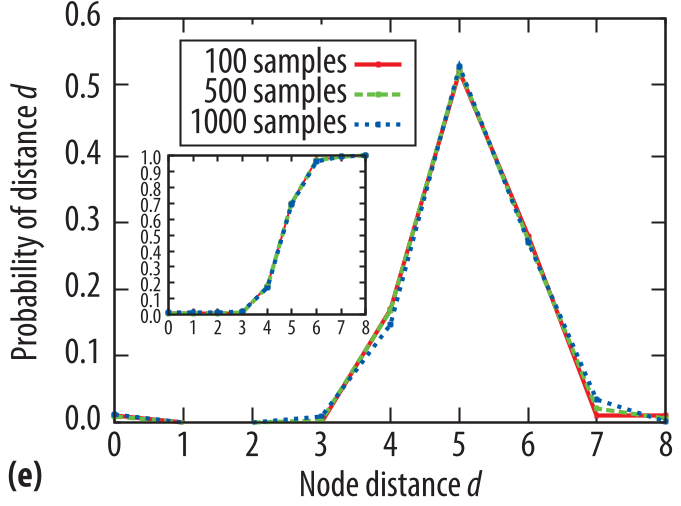 Figure 2: (a) Degree distribution showing the exponential truncation; (e) Pairwise distance distribution confirming the Small-World effect.
2. The Shrinking Diameter
Consistent with the "Forest Fire" model of network growth, the effective diameter of Renren actually decreased as the network grew. As more students joined and added friends, the "degrees of separation" between any two random users became smaller, stabilizing at about 5-6 hops.
3. The Short Life of Outsiders
The study found that DCs are incredibly fragile. Most "isolated" groups never grow beyond 12 nodes. As the network stabilizes, the GCC typically absorbs 90% of all nodes. The longevity of these isolated components follows a power-law distribution: most "die" (merge) within a few days of creation.
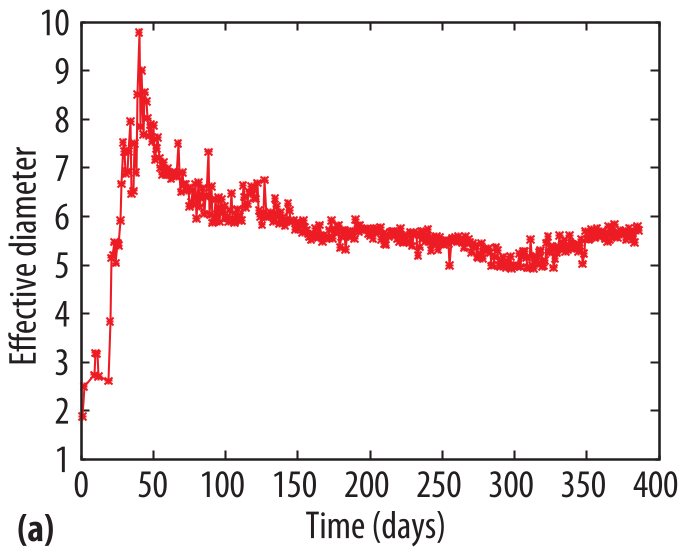 Figure 3: Growth of the node fraction in the Giant Connected Component over time.
Critical Insight: Why Does It Matter?
The Inductive Bias of a campus network is "density." Because students are physically co-located and share real-world affiliations, Renren scales as a "heterogeneous user group."
The discovery of the multiscaling pattern (reversed slopes compared to networks like Cyworld) suggests that Renren contains distinct sub-network types. For example, popular "public pages" behave differently than individual student accounts, creating "node heterogeneity" that traditional power-law models fail to capture.
Conclusion & Future Outlook
Renren’s structure confirms that real-name, student-focused networks are highly efficient at information propagation due to their small-worldness and rapid GCC absorption. However, the study also hints at abnormal node detection: because natural disconnected components have very short lifespans, any isolated cluster that remains "alive" and unmerged for a long time likely represents bot behavior or virtual accounts.
Takeaway: In the evolution of social networks, the "Giant" always wins—it's not a matter of if a group will join the main network, but how fast.