
Decoding Online Habits: Mining Micro-blog Insights via Behavior Matrices
Research on the Micro-blog User Behavior Model Based on Behavior Matrix
This paper introduces a Micro-blog User Behavior Model built upon dual behavior matrices (Original and Individual). By applying Principal Component Analysis (PCA) to these matrices, the method extracts representative behavioral fingerprints to identify unique user disciplines and habits.
TL;DR
This research presents a structured approach to modeling micro-blog user behavior by converting raw activity logs into Behavioral Matrices. By utilizing Principal Component Analysis (PCA), the model distills irregular posting habits into "characteristic behaviors," allowing for the mathematical comparison of user disciplines and the identification of unique behavioral signatures.
Background & Motivation
Micro-blogging platforms like Sina Weibo and Twitter generate massive amounts of fragmented data. While previous research has looked at what people say (keywords) or who they follow (topology), there is a gap in understanding the temporal discipline of the users—the "rhythm" of their digital lives.
The authors argue that authenticity and service quality can be improved if we can accurately model these rhythmic patterns. The challenge lies in the stochastic (random) nature of human posting; however, the authors hypothesize that underneath the randomness lies a steady "behavioral discipline" that can be captured through matrix modeling.
Methodology: The Behavior Matrix Framework
The core innovation lies in the transition from raw logs to a structured vector space.
1. Dual-Layer Matrix Construction
The model employs two distinct levels of data representation:
- Original Behavior Matrix: Captures user over time steps (e.g., hours) across observation days. This serves as the high-resolution raw data store.
- Individual Behavior Matrix: Aggregates the days into a single "typical" behavioral cycle. This smooths out daily anomalies to reveal long-term habits.
2. PCA for Feature Extraction
Since the resulting behavior vectors inhabit a high-dimensional space, the authors use Principal Component Analysis (PCA) to find the eigenvectors (the most representative behaviors). This mathematical transformation determines which time slots carry the most weight in defining a user's identity.
 Figure 1: Conceptual overview of the behavior modeling process.
Experimental Results & Critical Analysis
The researchers tracked 9 Sina Weibo users over several weeks, dividing each day into twenty-four 60-minute intervals.
Key Findings:
- Behavioral Clusters: Users U1 and U4 exhibited a correlation coefficient of 0.82, indicating nearly identical activity patterns, likely reflecting similar work environments or time zones.
- Outlier Detection: User U8 showed almost no correlation with the rest of the group (all coefficients below 0.3). This effectively isolates "unique" or potentially non-human/bot behaviors that do not follow standard social rhythms.
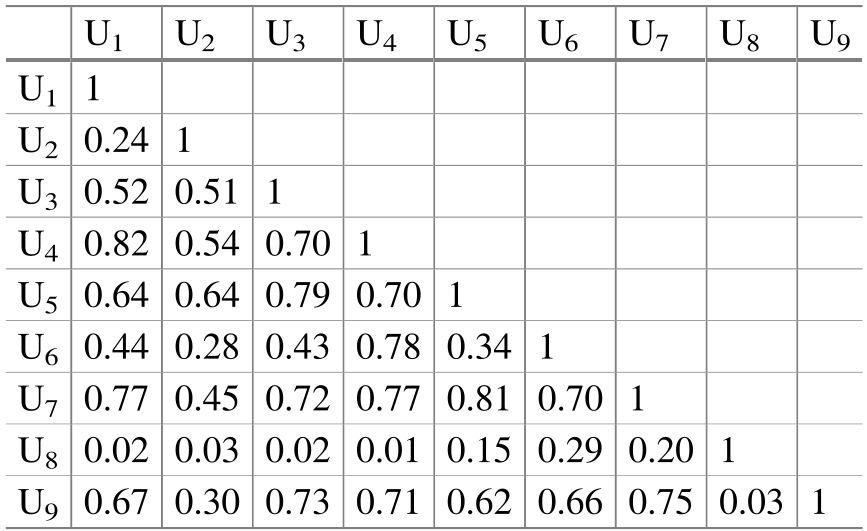 Table 1: The correlation coefficient matrix showing user-to-user behavioral similarity.
Critical Insight & Conclusion
While the study is relatively small in scale (9 users), its value lies in the Inductive Bias it introduces: that time is as important as content.
Limitations: The model currently treats all actions (post, repost, comment) as a single behavioral trigger in the matrix. Future iterations could benefit from a Tensor-based approach (adding a third dimension for "action type") to capture even more nuanced disciplines.
Future Outlook: As AI-generated content makes "what" we say harder to distinguish, "when" and "how often" we interact (our behavioral fingerprint) will become the primary metric for verifying human authenticity in the digital age.