
SADREM: Leveraging Social Ties to Neutralize Selfish Attacks in Wireless Mesh Networks
RESEARCH PAPER . SCIENCE CHINA Information Sciences
The paper proposes a secure routing scheme for Wireless Mesh Networks (WMNs) to combat "social selfish attacks" where nodes refuse to forward packets to save resources. It introduces two models: the Dynamic Reputation Evaluation Model (DREM) and its social-aware extension, SADREM, achieving significant improvements in packet delivery rates and reduced latency.
TL;DR
Wireless Mesh Networks (WMNs) often fail not because of external hackers, but because of "socially selfish" internal nodes that refuse to forward data for those they don't "know." This paper introduces SADREM, a secure routing scheme that applies Social Network Analysis (SNA) and Bayesian reputation modeling to identify and bypass these selfish nodes, significantly boosting reliability and reducing latency in congested environments.
Problem & Motivation: The "Social" Failure of Distributed Networks
Most routing protocols (like AODV) are built on the naive assumption of total cooperation. However, in real-world scenarios, nodes (representing users or specific devices) exhibit social selfishness. They act rationally to save their own battery and bandwidth, preferring to help "neighbors" or "friends" while ignoring others.
Prior works like RFSN (Reputation-based Framework for Sensor Networks) attempted to track node behavior but treated all nodes as socially isolated entities. This paper argues that social status is not uniform. Nodes with weak social ties become "outcasts" in standard incentive systems, leading to network fragmentation and catastrophic packet loss that traditional security metrics ignore.
Methodology: Beyond Simple Trust
The authors tackle the problem through a two-tiered architectural approach:
1. Dynamic Reputation Evaluation Model (DREM)
Instead of a static score, DREM uses a Bayesian estimation based on a Beta distribution () to predict the probability of successful forwarding.
- Timeliness: It introduces a weighting factor to ensure that recent behavior impacts reputation more than distant history, preventing a previously "good" node from suddenly turning selfish without penalty.
- Role-Based Updates: Reputation updates are differentiated based on whether a node is a Cluster Head (CH) or a standard member, recognizing the higher responsibility of the CH.
2. Social Associated Dynamic Reputation Evaluation Model (SADREM)
This is the core innovation. The authors model the network as a Two-Dimensional Continuous Time Markov Chain.
- Characteristic Vectors: Each node is assigned an M-dimensional vector representing its "social traits."
- Social Similarity: The strength of a relationship is calculated using the Cosine Similarity () of these vectors.
- Group Construction: Nodes form groups based on similarity and reputation. A node will only select a next-hop if the product of the node's Reputation and its Willingness to Forward () is high.
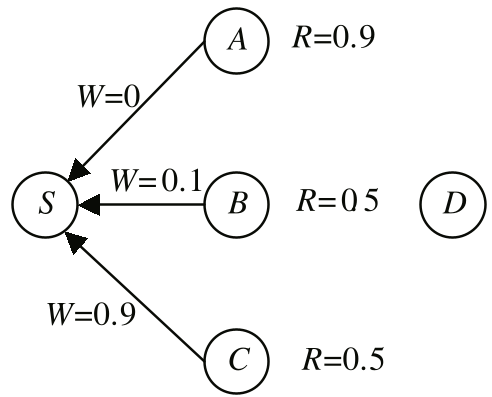 Figure 1: Traditional protocols might pick node A for its high reputation, but SADREM picks node C because node A has zero willingness to cooperate with the source.
Experiments & Results: Resilience Under Pressure
The researchers tested the system against AODV and RFSN using NS-2 simulations.
Performance vs. Selfishness
As the number of selfish nodes increases, the average delay in standard AODV and RFSN protocols grows exponentially. In contrast, SADREM’s delay remains remarkably stable, staying near 1 second even when nearly 10% of the network is selfish.
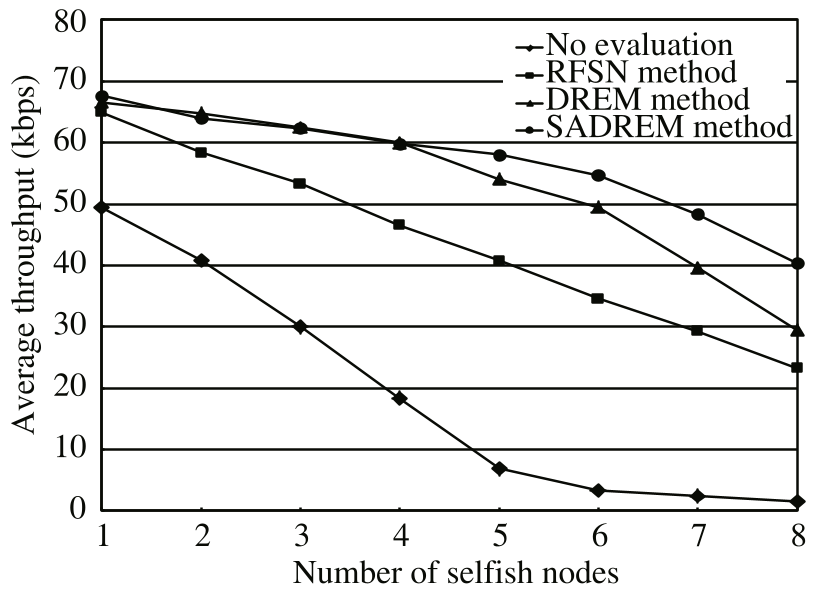 Figure 2: Analysis of network delay showing the superior stability of SADREM (bottom curve) compared to AODV (top curve).
Mobility and Cost
The study also reveals that while SADREM has a slightly higher overhead (computation cost) due to its complex social discovery at low speeds, it becomes much more efficient than simpler models at high speeds because it avoids the high "re-routing" costs associated with failed deliveries from selfish nodes.
Critical Analysis & Conclusion
Takeaway
The genius of this work lies in quantifying "willingness" as a product of social similarity. By shifting the perspective from "Is this node malicious?" to "Is this node socially compatible with the sender?", the authors provide a more realistic framework for mobile ad-hoc security.
Limitations & Future Work
The current model assumes that reputation data shared between nodes is objective and true. However, in highly adversarial environments, nodes might engage in reputation deception (lying about others). The authors identify this as the next frontier for their research—integrating defense mechanisms against false reputation claims to further harden the WMN against sophisticated internal threats.