
Monitoring Student Mental Crises: Bridging Online Social Footprints and Offline Intervention
Research on Students' Mental Crisis Monitoring and Intervention Mechanism Based on Online Social Network
This paper proposes a Student Mental Crisis Monitoring and Intervention Mechanism that leverages Online Social Networks (SNS). By utilizing web robots for real-time data collection and data mining for behavioral analysis, the system identifies psychological distress patterns to trigger synchronized online and offline interventions.
TL;DR
As social networking becomes the primary medium for emotional expression, student mental health crises are increasingly leaving "digital breadcrumbs." This research proposes a systematic framework to harvest these signals from school-domain networks using web robots and data mining, facilitating a synchronized online/offline intervention mechanism to prevent tragic events.
Background & Motivation: The Invisible "Digital Cry"
The shift to Web 2.0 has created a paradox: while students are more connected than ever via SNS (Social Networking Services) and micro-blogs, their psychological distress has become harder to detect through traditional means. The authors highlight a tragic example where a student posted a "DIE" signature on her blog—a clear warning sign that was ignored due to the sheer volume of digital noise.
The core motivation here is timeliness. In a world where 70% of students inhabit SNS communities, the "online persona" is often the first to express crisis. The research aims to turn the internet from a potential source of isolation into a proactive diagnostic tool.
Methodology: The Monitoring-Intervention Loop
The paper outlines a structured cycle to transform raw SNS data into actionable mental health support.
1. Automated Data Harvesting
The system utilizes Web Robots (crawlers) designed specifically for campus-centric social sites. Since these sites use dynamic templates, the robots analyze page structures to extract status updates, moods, and posts into a centralized database.
2. Formal Characterization of Crisis
Instead of broad sentiment analysis, the paper categorizes student crises into four types to refine mining accuracy:
- Situational Crisis: Sudden external shocks (e.g., loss of a relative).
- Development Crisis: Issues arising from growth (e.g., family conflict).
- Inner Crisis: Subconscious outbreaks (e.g., extreme inferiority).
- Existing Crisis: Conflict over life's meaning and value.
3. Data Mining & Identification
By utilizing a "Psychological Crisis Keyword Table" curated by professionals, the system scans collected data for high-risk markers across emotional, cognitive, and behavioral dimensions.
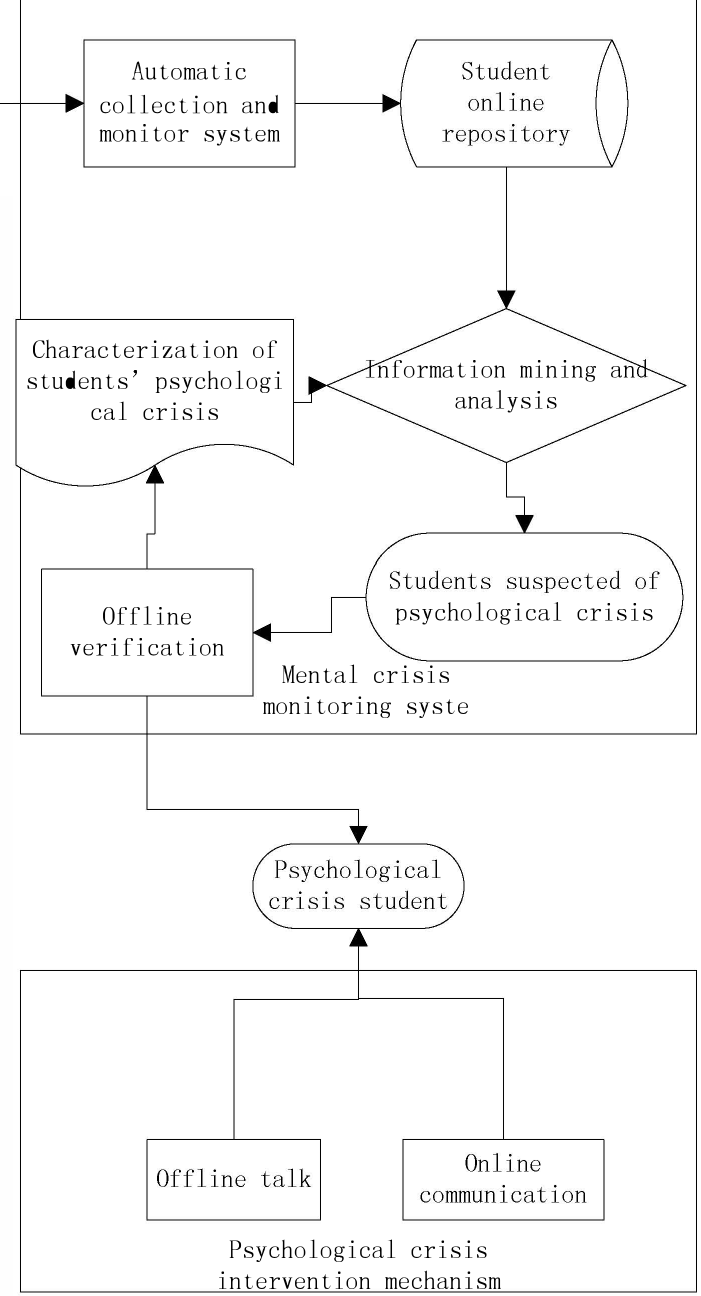 Note: The flow chart demonstrates the transition from raw network monitoring to feature extraction and eventual intervention.
Dual-Channel Intervention: Online and Offline Parallelism
Once a "suspected" crisis is identified, the authors advocate for a hybrid response:
- Online Intervention: Leveraging the anonymity and comfort of the digital space. Instant messaging and psychological emails allow students to express themselves without the pressure of face-to-face interaction.
- Offline Intervention: Integrating the "Human Touch." This involves campus hotlines, peer associations, and trained counselors who engage with the student's real-world environment (teachers and classmates) to confirm the crisis and provide physical support.
Critical Insight & SOTA Positioning
This work represents an early but foundational step in predictive mental health monitoring. In the context of 2026 AI standards, while the "keyword matching" described in the paper may seem primitive compared to modern LLM-based sentiment analysis, the architectural logic remains highly relevant.
The real value lies in its Inductive Bias: it assumes that psychological crises are not sudden, isolated events but processes that manifest through specific linguistic and behavioral patterns. By narrowing the scope to "School Domain Networks," it solves the massive data noise problem found on the open internet, making the monitoring "highly targeted."
Conclusion & Future Outlook
The paper concludes that a scientific, operational mechanism is essential for modern campus health. However, there are inherent limitations:
- Privacy Ethics: The use of robots to monitor "private" or "semi-private" SNS spaces raises significant ethical questions.
- Technological Evolution: Future iterations would benefit from moving beyond keywords toward deep learning behavioral modeling to capture the "vibe" of a post rather than just specific words.
By bridging the gap between digital manifestation and physical rescue, this mechanism provides a blueprint for a more responsive and empathetic educational environment.