
Deciphering Resilience: Connectivity Thresholds in Interest-Based Social Networks
Analyzing Resilience of Interest-Based Social Networks Against Node and Link Failures
The paper investigates the resilience of interest-based social networks, modeled as the intersection of a Uniform d-Intersection Graph and an Erdős-Rényi Graph. It establishes a zero-one law and asymptotically exact probability results for network connectivity under both node and link failures.
TL;DR
This research provides the first "asymptotically exact" probability analysis for the connectivity of interest-based social networks under simultaneous node and link failures. By modeling these networks as intersections of diverse random graphs, the author identifies the precise mathematical "tipping point" (phase transition) where a network moves from being disconnected to becoming highly resilient.
The Core Challenge: Interdependent Failures
In modern digital ecosystems (like Anobii or Google+ circles), social ties are rarely one-dimensional. They are a product of social friendship (who you know) and shared interests (what you like).
The author defines a model where:
- Friendship is an Erdős-Rényi graph .
- Interest Sharing is a Uniform -intersection graph where users share common objects.
- Link Failures are modeled by another layer .
The resulting structure is the intersection of these three layers. Analyzing the connectivity of such a system is notoriously difficult because, unlike standard random graphs, the presence of an edge between nodes A-B and B-C increases the probability of an edge between A-C. This dependency breaks standard independence assumptions used in graph theory.
Methodology: The Power of Graph Coupling
To tackle the dependency issue, the author utilizes a technique called Graph Coupling. The intuition is to prove that the complex interest-based network "contains" a simpler, independent Erdős-Rényi graph as a spanning subgraph.

The proof pipeline follows these steps:
- Lower Bound: Show that with high probability (), our social network is at least as connected as an Erdős-Rényi graph with a slightly lower edge probability.
- Upper Bound: Use the fact that for a graph to be -connected, every node must have a degree of at least . By proving the probability of minimum degree , the author sets a ceiling on total connectivity.
- Poissonization: Demonstrating that the number of nodes with a specific degree follows a Poisson distribution as the network size approaches infinity.
Experimental Validation: From Theory to Anobii
The author doesn't rely solely on math. The theory was tested against a real-world dataset from Anobii.com, comprising 60,000 users and their book collections.
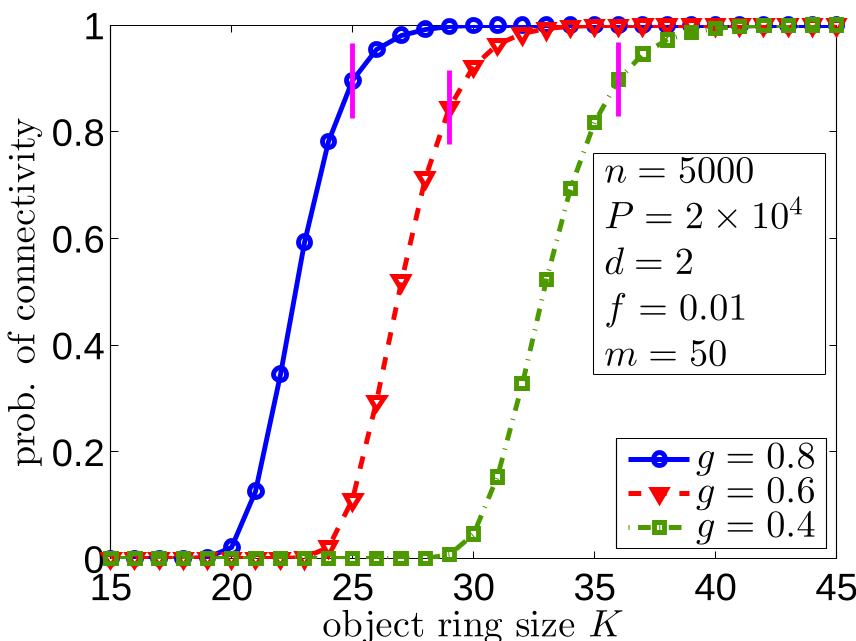
The results (shown in Figure 1 above) confirm a sharp Zero-One Law. As the link-active probability crosses a critical threshold, the probability of the network remaining connected after node failures jumps from 0 to 1 almost vertically. This "phase transition" matches the predicted theoretical scaling:
Critical Insight & Application
This work is a significant milestone for designing reliable publish-subscribe services. It tells a system architect exactly how many "interest objects" () a user needs to pick, or how dense the friendship probability () must be, to guarantee that a message from a publisher will reach all subscribers even if an adversary deletes accounts.
Limitations: The current Erdős-Rényi model for friendship is simplified; real social networks often exhibit "Power Law" degree distributions. Future research should apply these resilience proofs to scale-free network models.
Conclusion: By mapping social interests to intersection graph theory, Jun Zhao has provided a rigorous health-check tool for the next generation of social platforms, proving that network resilience is not just a hope—it’s a calculable parameter.