
Virtualizing Resilience: How ML Transforms Low-Cost Sensors into Industrial-Grade Monitors
Resilient Environmental Monitoring Utilizing a Machine Learning Approach
This paper introduces a machine learning framework for "resilient environmental monitoring" by creating virtual sensors from a network of low-cost Nova SDS011 sensors. By utilizing Nonlinear Autoregressive Networks with Exogenous Inputs (NARX), the system compensates for hardware malfunctions and provides PM10 concentration forecasts that approximate high-performance instrument standards.
TL;DR
To address the fragility and inaccuracy of low-cost air quality sensors, researchers have developed a machine learning approach that creates "Virtual Sensors." By training Recurrent Neural Networks (NARX) on data from clusters of cheap sensors, the system can self-correct during hardware failure and provide reliable PM10 forecasts that mimic high-end industrial equipment.
Background Positioning: This work bridges the gap between Citizen Science (high density, low quality) and Governmental Monitoring (low density, high quality) by using ML-driven resilience as a software layer.
The "Broken" Reality of IoT Sensors
Environmental monitoring currently faces a paradox. We need fine-grained data to protect public health, but high-performance sensors like the Dr. Födisch FDS155 are prohibitively expensive. Consequently, official maps (like those from the German UBA) are full of spatial gaps.
Citizen science projects like Luftdaten.info fill these gaps using $30 IoT sensors. However, these devices are "noisy," prone to drifting, and fail frequently. Regulators often discard this data entirely because it lacks resilience.
Methodology: Borrowing from Robotics
The core insight of this paper is treating an environmental sensor network like a robot's proprioception system. In robotics, if one joint sensor fails, the robot can often estimate its position using other available data.
The Virtual Sensor Architecture
The authors deployed multiple Nova SDS011 sensors on Raspberry Pi platforms. Instead of treating each sensor as an independent data point, they used a NARX (Nonlinear Autoregressive Network with Exogenous Inputs) architecture.
- Loop Closure: Unlike standard feed-forward networks, NARX feeds its current prediction back into the input. This creates a "smoothing" effect that protects the system from sudden noise spikes or sensor glitches.
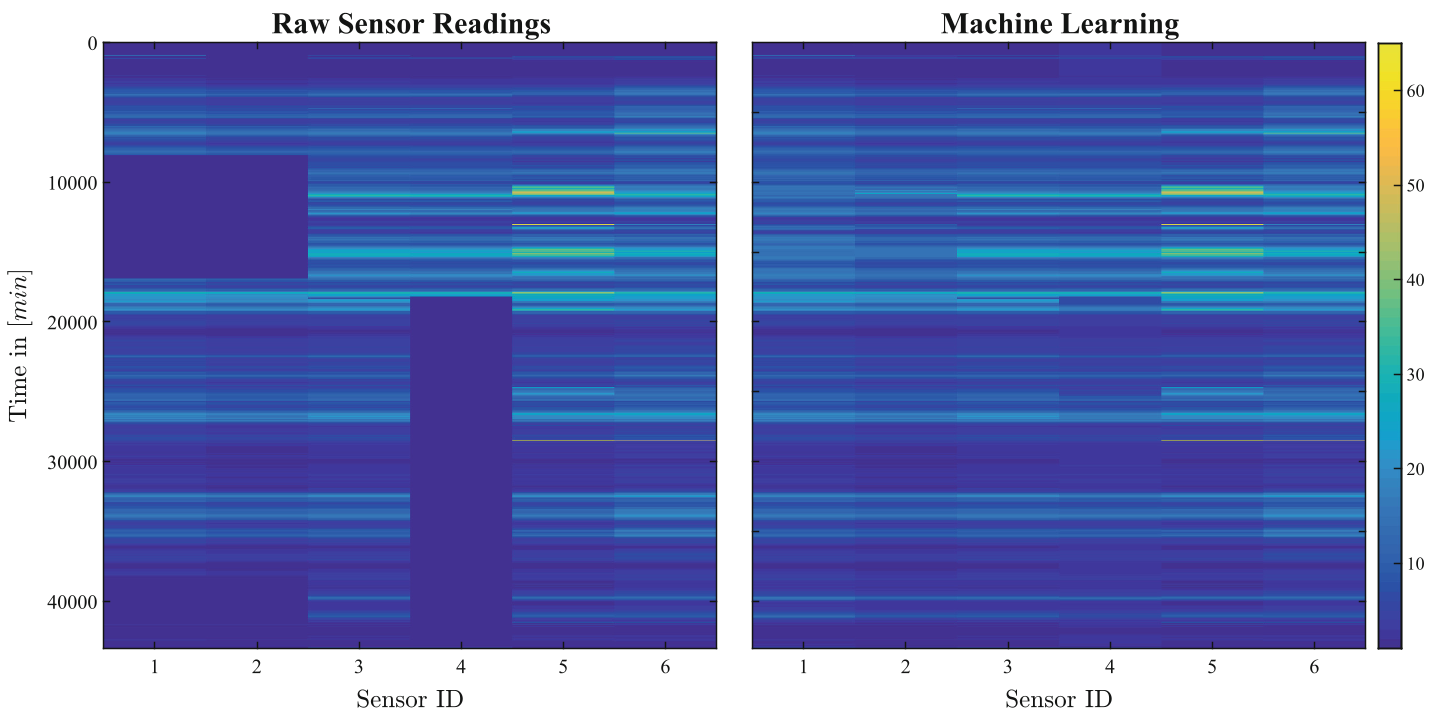
- Redundancy Mapping: If "Sensor A" fails, the virtual model uses "Sensors B, C, and D" from the surrounding network to reconstruct the missing data with high fidelity.
Experimental Results: High-End Hardware on a Budget
The researchers compared their virtualized low-cost cluster against a professional FDS155 device (which is ~100x more expensive).
1. Robustness Against Failure
When hardware malfunctions occurred, the NARX model's virtual counterpart stepped in. The error (MSE) remained below 0.5 µg/m³, meaning the software-generated data was virtually indistinguishable from a functioning physical sensor.
2. Predictive Power
Can we see the pollution coming? The model was tested on its ability to forecast PM10 levels up to 6 hours into the future.
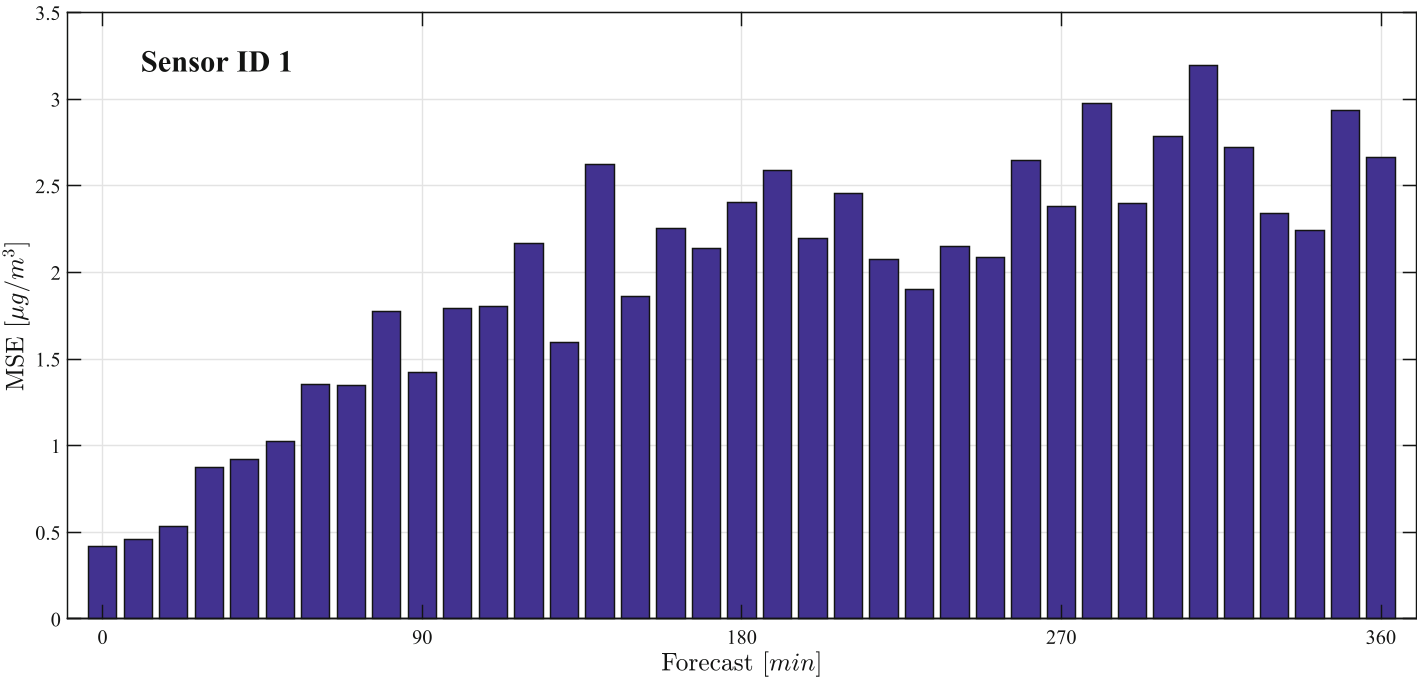
As shown in the charts, the error increases as the time horizon grows, yet even at 360 minutes, the error is only ~3 µg/m³. For city-wide early warning systems, this accuracy is more than sufficient.
Deep Insight & Conclusion
This paper proves that Resilience is a Software Property. We don't necessarily need more expensive hardware; we need smarter aggregation of cheap hardware.
Takeaway: By virtualization, we can "emulate" the performance of a 30 sensor and a robust ML model.
Limitations & Future Work: While NARX is efficient, the authors acknowledge that LSTMs (Long Short-Term Memory) could better capture long-term environmental correlations. Furthermore, the "stationary" nature of these sensors is a limit; the next frontier is mounting these "resilient virtual sensors" on mobile objects like trams or bicycles to create a truly living map of urban air quality.