
Beyond Greed: How Sympathy and Rewiring Save Social Networks from Exploitation
8588_Resisting Exploitation Through Rewiring in Social Networks Social Welfare Increase using Parity, Sympathy and Reciprocity.
This paper explores how socially motivated traits (Sympathy, Reciprocity, and Parity) enable autonomous agents to resist exploitation in dynamic social networks using the Prisoner's Dilemma framework. By allowing agents to "rewire" their connections, the study demonstrates that cooperative traits can outperform pure selfishness, leading to significantly higher social welfare.
TL;DR
Can "good" agents survive in a world of "greedy" ones? This research reveals that when agents are endowed with traits like Sympathy, Parity, and Reciprocity, and—more importantly—the freedom to rewire their social connections, they don't just survive; they thrive. While selfish agents win small battles, they lose the social war by ending up isolated in a "network of one."
The Problem: The Self-Interest Trap
In classical multi-agent systems, "rationality" is often equated with maximizing one's own immediate utility. However, in a social context, this leads to the Exploitation Trap. If everyone plays a minimax strategy or purely defects (as in the Prisoner's Dilemma), the collective outcome is suboptimal. Prior work often struggled to explain how altruistic traits persist when they seem to offer a local disadvantage. The authors argue that the missing link is Network Dynamics: agents are not stuck with their neighbors; they can change them.
Methodology: The Anatomy of a Social Agent
The researchers defined a sophisticated utility function that goes beyond simple payoff. For an agent receiving payoff while an opponent receives , the utility is:
The Four Personalities:
- Selfish (): Maximizes own gain.
- Sympathetic (): Values the opponent's happiness.
- Parity (): Despises inequality (prefers over ).
- Reciprocal (): Rewards help and punishes slights.
The Rewiring Mechanism
Instead of a static grid, agents use a Watts-Strogatz small-world network. If an interaction yields unsatisfactory utility, the agent can pay a "connection cost" to sever the tie and look for a new partner among "friends-of-friends."
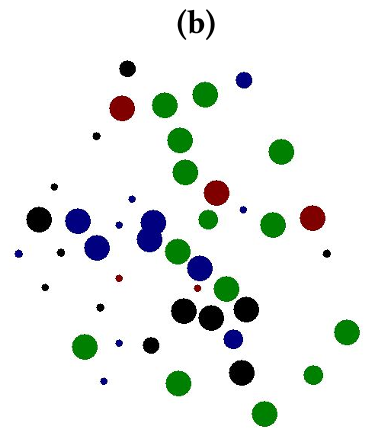 Figure 1: Emergent network topologies under different connection costs. Lower costs (a) lead to dense cooperation, while higher costs (d) create sparse, selective clusters.
Experimental Results: The Weakness of Selfishness
The study yielded a surprising counter-intuitive result: Sympathy is a winning strategy in a crowd.
- Head-to-Head (The Micro View): In a vacuum, Selfish agents outperform Sympathetic ones because they can "leech" off the other's kindness.
- The Social Ecosystem (The Macro View): When all types are mixed, Sympathetic agents gain the highest average payoff.
Why? Because Selfish agents are eventually "unfriended." Once their neighbors (Parity or Reciprocal types) realize they are being exploited, they rewire. The Selfish agents are left with no one to play with but other Selfish agents, leading to a "mutual defection" spiral.
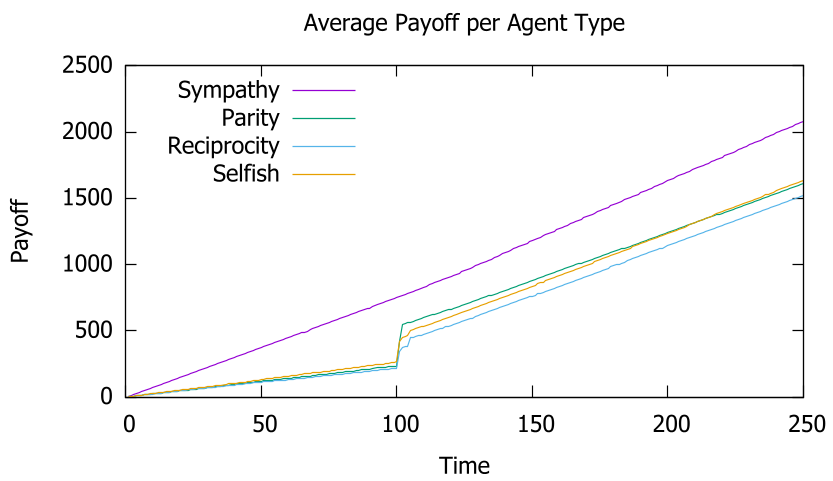 Figure 2: Average payoffs in a mixed network. Sympathetic agents (blue) rise to the top as they form stable, high-trust clusters.
Critical Analysis & Conclusion
The Takeaway
This paper provides a powerful argument for Social Network Engineering. It suggests that we can incentivize cooperative behavior not just by changing the agents, but by changing the cost of mobility. If it is easy to leave a bad relationship (low rewiring cost), "bad" agents lose their power to exploit.
Limitations
- Search Scope: Research was limited to "friends-of-friends." In a modern digital world, search is global, which might introduce different dynamics (e.g., "social hopping" where exploiters constantly find new victims).
- Simplified Game: The Prisoner's Dilemma is a deterministic 2x2 matrix. Real-world social interactions involve nuanced, continuous values and stochastic noise.
Future Outlook
The concept of "introducing" specific agent types to steer social configurations is a nascent field. Imagine AI-assisted platforms designed to detect and isolate exploitative bots while fostering clusters of "sympathetic" human-agent interactions. This isn't just theory; it's a blueprint for healthier digital ecosystems.