
Unifying the History Bound: A Structural Resolution of Recombination Limits
A Resolution of the Static Formulation Question for the Problem of Computing the History Bound
This paper resolves a long-standing open question in computational biology by proving that the "History Bound" for Ancestral Recombination Graphs (ARGs) is equivalent to the minimum number of reticulation nodes in a phylogenetic network. The authors bridge the gap between the ARG and reticulation network literatures and propose a new top-down algorithm that improves the efficiency of computing this lower bound.
TL;DR
For decades, the "History Bound" (a crucial lower bound for recombination events in genetic history) existed only as an algorithmic procedure. This paper finally provides the "Static Formulation," proving it is exactly the minimum number of reticulation nodes required to represent the data. Additionally, a new top-down algorithm significantly speeds up its calculation by pruning the search space.
Problem & Motivation: The Gap Between Two Worlds
In evolutionary biology, describing how species relate is simple when they split (trees), but messy when they merge (recombination or hybridization). Two distinct communities have studied this:
- The ARG Community: Focused on Ancestral Recombination Graphs, looking for the minimum number of recombinations () required for SNP data.
- The Network Community: Focused on Reticulation Networks, modeling clades and clusters.
The History Bound is one of the most effective lower bounds for , but it was "procedural"—defined by whatever a specific algorithm (CHB) outputted. The field lacked a proof that this number corresponded to a physical property of the evolutionary network.
Methodology: Bridging the Gap with ST-Sets
The authors utilize the concept of ST-sets (subsets of taxa with tree-like properties). They demonstrate that the steps of the History Bound algorithm are essentially identifying and removing these ST-sets backwards.
The Core Proof Logic
- Mapping Steps to Structure: Every row deletion in the History Bound algorithm (the
Dtrule) corresponds to the creation of a reticulation node in a network. - The NETWORK.BUILD Algorithm: The authors provide a constructive algorithm that takes a History Bound execution and builds a valid physical network.
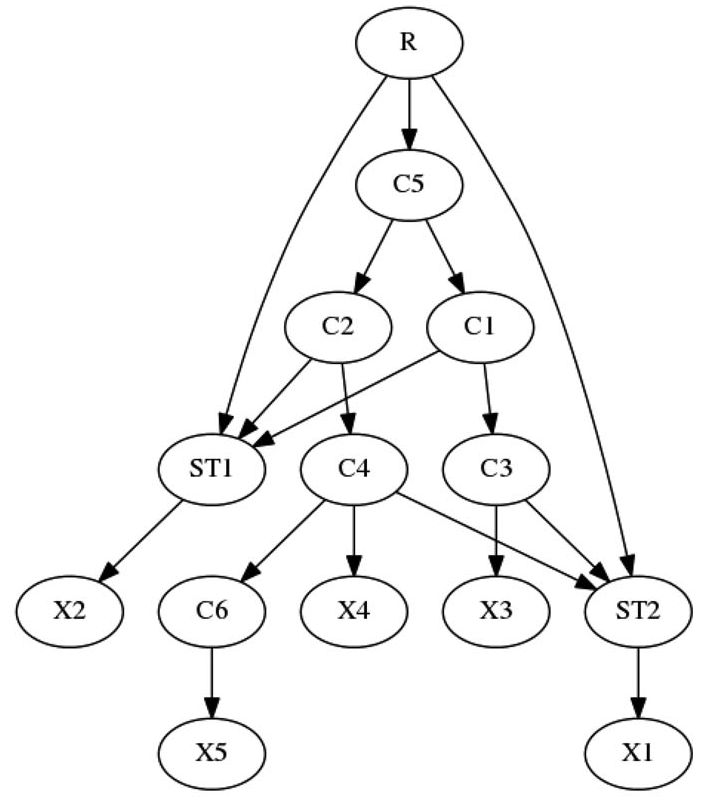 Figure: The internal logic of adding ST-sets to maintain a valid reticulation network.
A Faster Algorithm: HB_TOPDOWN
The traditional way to calculate the History Bound is via Dynamic Programming (HB_DP), which is . It is "pessimistic" because it solves every possible sub-problem.
The authors propose HB_TOPDOWN. By recognizing "p-equivalence" (where different sequences of deletions result in isomorphic networks), they drastically prune the search space.
Key Algorithmic Insight:
By enforcing a total order on maximal ST-sets, the algorithm only explores one "representative" path for each equivalence class, preventing the exponential explosion typically seen in these NP-hard problems.
Experiments & Results: Real-World Efficiency
The authors compared their top-down approach against the standard DP on biological datasets:
- Drosophila Dataset: HB_TOPDOWN examined only 127 nodes compared to 502 for the DP approach.
- Fungi RNA Dataset: The node count was halved (63 vs 120).
 Figure: The search tree of HB_TOPDOWN compared to the exhaustive DP approach, illustrating how the algorithm reaches the "red" optimal endpoint faster.
Critical Analysis & Conclusion
This paper is a "decoder ring" for the phylogenetic community. By proving that the History Bound is a reticulation count, it allows researchers to stop treating the bound as a black-box number and start treating it as a structural constraint.
Takeaway: The resolution of the Static Formulation Question means we can now use structural optimization techniques (like branch-and-bound) to find recombination limits, rather than relying purely on row-deletion heuristics.
Limitations: While faster, the problem remains NP-hard. For extremely high-conflict data where no row collapses (Rule Dr) occur, the algorithm still defaults to the worst-case exponential complexity. However, for most biological data, this is a major leap forward.