
Scaling D2D Efficiency through Asymmetric Social Awareness and Cluster Games
Resource Allocation for D2D Wireless Networks With Asymmetric Social Weighted Graph
This paper introduces a novel asymmetric social weighted graph model for R2D (Device-to-Device) resource allocation, proposing a Social-Aware Cluster-based Game (SCG) scheme. It utilizes a new "weighted social interference degree" to cluster nodes and optimize channel access through an altruistic potential game.
TL;DR
This research tackles the inefficiency of D2D (Device-to-Device) resource allocation by introducing asymmetric social weighting—recognizing that "follower-leader" relationships in apps like Facebook or YouTube impact network interference differently than reciprocal friendships. By combining this with a cluster-based potential game, the authors achieve a 40%+ faster convergence and superior interference mitigation compared to standard social-unaware methods.
The "Symmetry" Trap in Social Wireless Networks
In traditional D2D resource allocation, social ties were treated like a two-way street. If User A is connected to User B, they presumably influence each other rewards/interference equally. However, the researchers point out a critical flaw: social influence is rarely equal. If Alice downloads content from Bob's feed but Bob doesn't follow Alice, Bob's interference impacts Alice's experience much more than the reverse.
Existing SOTA (State Of The Art) methods often ignore this directionality, leading to suboptimal channel allocation where high-influence "social hubs" are treated as ordinary nodes, causing cascading interference across the social graph.
Methodology: The Weighted Social Interference Degree
To bridge the gap between physical reality and social influence, the authors propose two distinct graphs:
- Physical Interference Graph (): Defines which nodes physically clash on the same channel.
- Asymmetric Social Weighted Graph (): Defines the "influence strength" () between nodes.
The breakthrough is the Weighted Social Interference Degree (). It essentially "upweights" a node's importance if its interference affects many socially-connected peers.
Architecture & Cluster Formation
Instead of every D2D pair acting as an independent (and often selfish) agent, the model groups nodes into clusters. The node with the highest becomes the Cluster Head. This reduces the complexity of the "Potential Game"—a mathematical framework where individual local improvements lead to a global optimum (Nash Equilibrium).
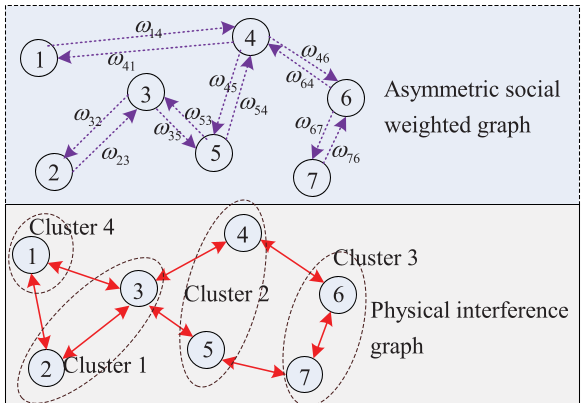 Figure 1: Illustration of the dual-layer physical and social graph coupling.
Taming Complexity through Shrunk Action Spaces
A major hurdle in game-theoretic allocation is the "State-Space Explosion." If nodes have channels, there are possibilities. The authors solve this by:
- Intra-cluster Orthogonality: Mandating that nodes within the same cluster use different channels.
- Priority Selection: Higher nodes pick channels first, shrinking the choices for subordinates.
This turns an NP-hard problem into a manageable distributed algorithm where clusters optimize their utility in an "altruistic" manner—considering not just their own interference, but that of their social neighbors.
Experimental Results: Faster and Sharper
The proposed Best Reply (BR) based cluster algorithm was tested against social-unaware baselines.
Performance Gains
As shown in the Network Social Interference metrics, the cluster-based approach consistently outperformed traditional methods (specifically when the cluster size ). It effectively "shielded" high-value social links from interference.
Convergence Speed
In wireless networks, speed of reconfiguration is everything. The study found that while traditional Best Reply algorithms took over 350 iterations to reach stability, the proposed cluster-based game reached equilibrium in roughly 200 iterations.
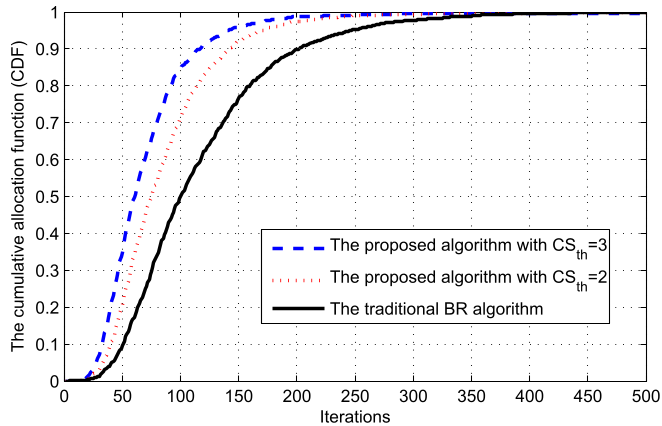 Figure 2: The CDF of iterations shows the proposed SCG (Cluster-based) reaching 100% convergence much faster than individual-node games.
Critical Insight & Conclusion
By moving from a "symmetric" social model to an "asymmetric" one, the paper aligns wireless network optimization with the reality of modern social media usage. The transition from individual agents to cluster-based players in a Potential Game demonstrates a scalable way to implement D2D in dense 5G/6G environments.
Takeaway: Future resource management shouldn't just ask "who is near whom," but "who values whose content." Asymmetry is not a complexity to be simplified, but a feature to be exploited for better network efficiency.