
Engineering Collective Intelligence: From Passive Collaboration to Algorithmic Orchestration
A resource allocation framework for collective intelligence system engineering
This paper introduces a systematic framework for engineering Collective Intelligence (CI) systems, aimed at coordinating web communities through optimized resource allocation. By integrating human expertise with machine intelligence, it transforms passive collaboration into a self-regulating "Insert-Review-Revise" spiral, demonstrated through a simulated enhancement of Wikipedia.
TL;DR
The success of Web 2.0 platforms like Wikipedia is often tempered by inconsistent quality and slow content maturation. This paper proposes a formal engineering framework for Collective Intelligence (CI) that uses machine intelligence to actively allocate human expertise to where it is needed most. By treating community collaboration as a resource allocation problem, the authors demonstrate via simulation that active task-matching can significantly boost the quality and timeliness of collaborative content creation.
The Problem: The Chaos of "Unsystematic" Contributions
While the "Wisdom of the Crowds" is powerful, it is often inefficient. Traditional collaborative systems suffer from two main drawbacks:
- Passive Coordination: Systems wait for volunteers to find tasks, often leaving critical but "boring" areas neglected.
- Swarm vs. Human Intelligence: Most CI research focuses on "Swarm Intelligence" (like ants or simple agents), which assumes actors are interchangeable. In reality, human users have unique, non-interchangeable skills (Inductive Bias) and complex motivations.
The authors argue that we need a system that doesn't just collect knowledge but coordinates it.
Methodology: The "System Engine" Framework
The core of the proposal is a three-component architecture: the Human Community, the Information Base, and the System Engine.
The Self-Regulating Spiral
Instead of a linear edit history, the framework proposes an Insert-Review-Revise-Release spiral. The System Engine uses machine learning to:
- Learn the expertise profile of every community member.
- Identify articles with the lowest quality-to-potential ratio.
- Actively suggest specific tasks to the most "appropriate" experts (Expert-based policy).
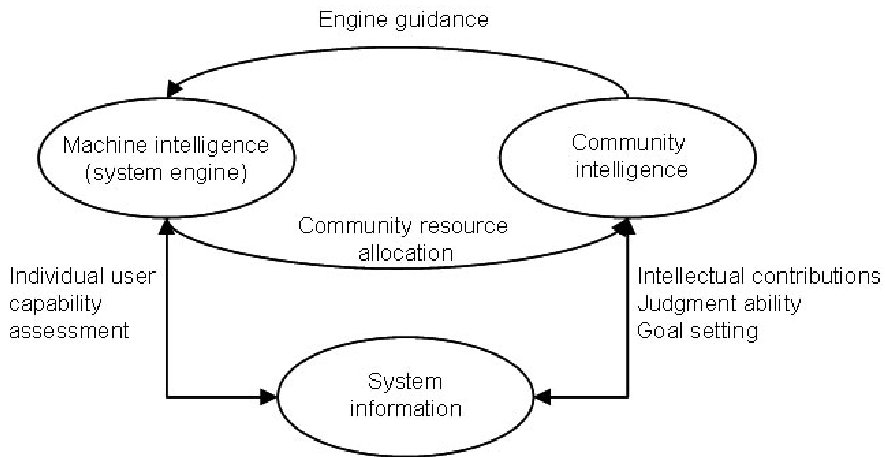 Figure 1: The architecture of the proposed CI system, illustrating the interplay between the human community and the system engine.
The "Intelligence" here is emergent: individual users perform simple, localized tasks (reviewing a paragraph), but the engine ensures these actions aggregate into high-quality global results.
Experimental Results: Proving Efficiency through Simulation
To validate the framework, the authors simulated a community of 10,000 users. They compared a "Benchmark" model (simulating current Wikipedia) against their "CI-enabled" model.
1. Superior Quality
The CI-enabled model consistently outperformed the benchmark in terms of final article quality. By directing experts to their specific domains, the system avoided the "too many cooks" problem where non-experts might inadvertently degrade content.
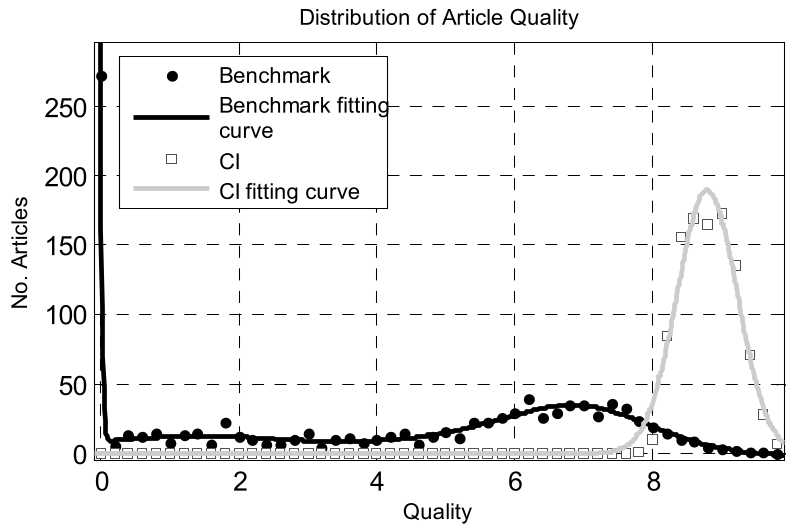 Figure 2: Performance comparison showing the CI-enabled model achieving higher quality across the article base.
2. Timeliness and Efficiency
Crucially, the CI model reached "satisfactory" quality levels faster than the benchmark. In an era where information spreads rapidly, the "timeliness" of quality content is a competitive necessity.
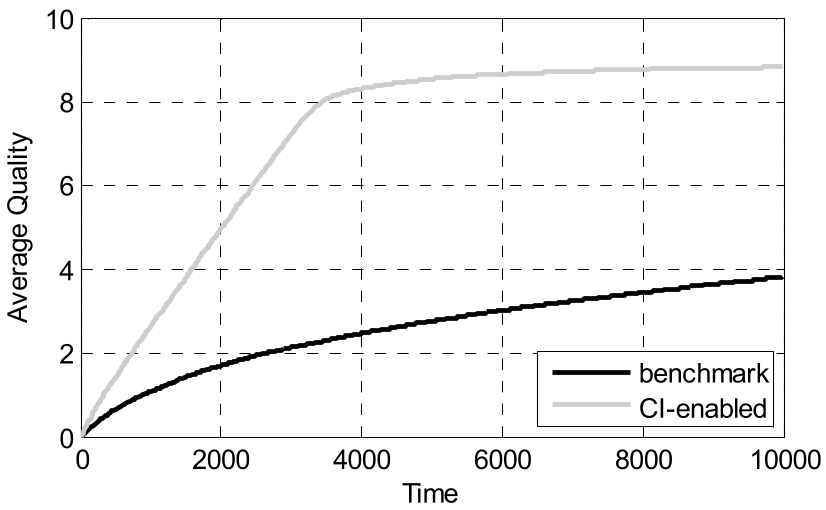 Figure 3: Article quality evolution over time, demonstrating that CI-enabled systems reach quality thresholds with fewer revisions.
Critical Analysis & Conclusion
Takeaways
The framework's strength lies in its Self-Organization. The engine doesn't "command" users; it "facilitates" them based on the community's own implicit feedback (ratings and activity). This balances algorithmic efficiency with the voluntary nature of web communities.
Limitations
- The "Cold Start" Problem: The engine requires significant data to "learn" user expertise.
- Determinism vs. Human Will: While the simulation assumes users will accept suggestions at a fixed probability, real-world "suggestion fatigue" might occur.
- Subjectivity of Quality: The paper relies on a numerical expertise-quality formula, which may not capture the nuanced, often controversial nature of "quality" in social or political articles.
Future Outlook
This work paves the way for "Smart Wikis" and AI-augmented DAO (Decentralized Autonomous Organization) governance. As AI agents become better at evaluating text, they can serve as the "Engine" that helps humans focus their limited creative energy precisely where it can have the most impact.