
ECS: Bridging the Gap Between Privacy and Performance in Mobile Social Sensing
Resource-aware broadcast encryption for selective-sharing in mobile social sensing
The paper introduces ECS (Extended Complete Subtree), a resource-aware broadcast encryption scheme designed for selective data sharing in mobile social sensing. Implemented on Nokia N800 handhelds, ECS achieves a balance between computational efficiency and adaptability to dynamic group sizes, a feat traditional schemes like Boneh-Waters or LKH fail to maintain on resource-constrained devices.
TL;DR
Selective sharing in mobile social networks—like sharing health data with family but not colleagues—is computationally expensive for handheld devices. This paper introduces ECS (Extended Complete Subtree), a broadcast encryption scheme that allows users to encrypt data for a dynamic group of friends without the massive overhead of traditional pairing-based cryptography or the rigid limitations of static tree-based schemes.
Background: The Problem with Peer-to-Peer Encryption
In a typical mobile social sensing scenario (e.g., sharing a fitness stream), a user might have hundreds of friends but only wants to share data with a subset of ten.
- The Unicast Trap: Using standard AES to encrypt a video stream for 10 people separately consumes 10x the bandwidth and CPU.
- The Static Limitation: Standard "Complete Subtree" methods require you to know the maximum number of friends you'll ever have at setup time.
- The Energy Gap: Advanced public-key schemes (like Boneh-Waters) are mathematically elegant but take over 30 seconds to run on a mobile processor—a total "battery killer."
Methodology: The "Block" Breakthrough
The authors propose ECS, which treats the social graph as a collection of smaller, manageable blocks rather than one giant, rigid tree.
1. Dynamic Scaling
Unlike traditional schemes that fail if the number of users exceeds , ECS adds new "blocks" (subtrees of size ) as your social circle grows. Because the root key remains stable, existing friends don't need to be re-keyed when someone new joins—a massive win for intermittent mobile connectivity.
2. Physical Intuition
Imagine a library that adds new shelves as it gets more books. Instead of re-indexing the entire library every time a shelf is added, ECS just adds a new index entry for the new shelf.
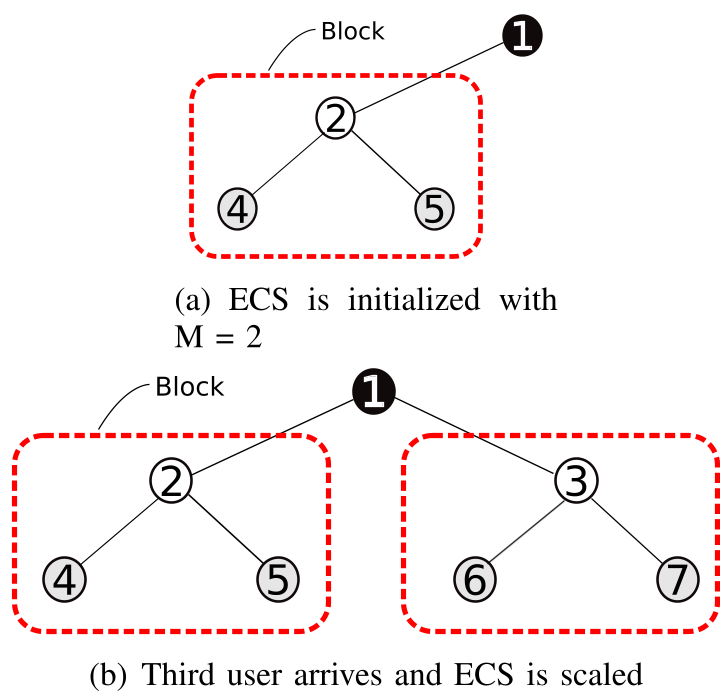 Fig A: Architecture showing how blocks are appended to a common root to allow dynamic scaling.
Experiments & Results
The researchers implemented these algorithms on actual hardware (Nokia N800) to measure real-world performance.
- Storage Efficiency: ECS keeps the receiver-side key storage constant. No matter if you have 100 or 1,000 friends, the memory footprint on your phone stays the same.
- Energy Consumption: As shown in the table below, ECS (using symmetric encryption) is orders of magnitude more efficient than pairing-based Boneh-Waters.
| Scheme | Energy Consumed (Joules) | Decryption Time |
|---|---|---|
| ECS / Symmetric | J | < 0.1s |
| Boneh-Waters | J | ~10s |
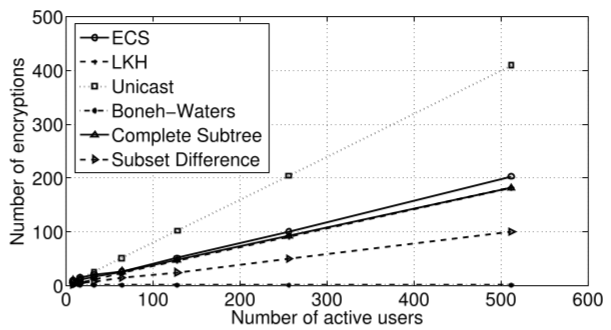 Fig B: Performance comparison showing ECS maintains low ciphertext size even as the number of active users grows.
Critical Analysis & Conclusion
Why it Works
The "magic" of ECS is its Resource-Awareness. By choosing a block size (the authors found to be the "sweet spot"), it optimizes the trade-off between ciphertext size and key storage. It effectively bridges the gap between the efficiency of static symmetric schemes and the flexibility of dynamic stateful schemes.
Limitations
While ECS is excellent for scalability, it still relies on a central "web portal" or authority for initial key distribution. In a truly decentralized/P2P social network, the initial handshake remains a bottleneck.
Final Takeaway
ECS proves that high-level privacy doesn't have to break the battery budget. By restructuring how we represent social hierarchies in cryptographic trees, we can enable fine-grained privacy even on low-power mobile devices.