
Beyond Static Data: Resource-Aware Truth Analysis in Crowdsourcing
Resource-Aware Approaches for Truth Analysis in Crowdsourcing
This paper introduces a resource-aware framework for truth analysis in mobile crowdsourcing, specifically targeting opportunistic networks. It proposes two novel optimization problems: Max-Credibility and Min-Overhead, utilizing a Maximum Likelihood Estimation (MLE) based technique to identify ground truth from noisy, data-limited environments.
TL;DR
Researchers from Penn State University have pioneered a "resource-aware" approach to truth analysis in mobile crowdsourcing. Unlike traditional models that treat data as a fixed input, this framework adaptively collects data through a feedback loop. By balancing user reliability against network reachability, it solves the dual challenge of maximizing data credibility while minimizing the heavy communication overhead inherent in opportunistic networks.
The "Data Silence" Problem in Opportunistic Networks
In scenarios like disaster recovery or battlefield monitoring, we rely on crowdsourced data. However, existing truth-finding algorithms (e.g., TruthFinder, Hubs and Authorities) assume the data is already sitting on a server. This ignores two harsh realities:
- Limited Data: If initial reports are conflicting, you can't find the "truth" without more data.
- Network Scarcity: In Mobile Opportunistic Networks (DTNs), moving data from a user to a server involves multiple "hops" between devices, consuming battery and bandwidth.
The authors argue that truth analysis shouldn't just be a mathematical filter; it should be a active controller that decides which users to query next.
Methodology: The MLE-Network Feedback Loop
The core of the paper lies in its movement away from heuristic-based estimation to a formal statistical model using Maximum Likelihood Estimation (MLE).
1. Modeling Success Probability
The server selects users based on a "Success Probability" (), which is the product of:
- Network Reachability: The probability that a message can perform a round-trip within the time constraint, modeled as a hypo-exponential distribution.
- Source Reliability: The probability that the user's report falls within an error margin , assuming a Normal Distribution .
2. Dual Optimization Problems
- Max-Credibility: Maximize the probability of capturing the truth given a fixed budget of network hops (). This is solved using a dynamic programming approach similar to the 0-1 Knapsack problem.
- Min-Overhead: An iterative approach that stops querying as soon as the Confidence Interval of the estimated truth reaches a target threshold (e.g., 95%).
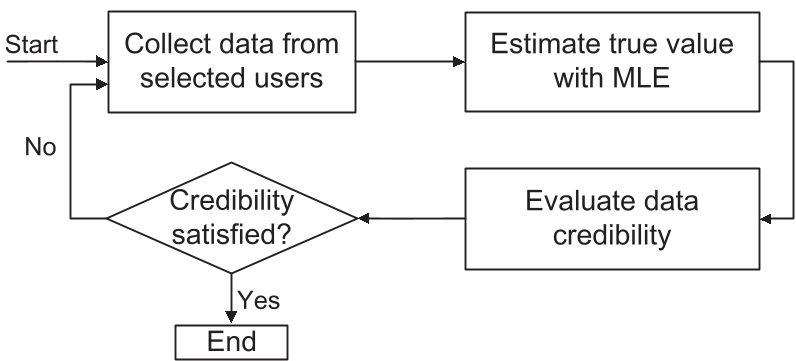 Fig 1: The proposed iterative approach connecting truth estimation with adaptive user selection.
Experimental Validation: From Simulations to Smartphones
The team validated their work using two environments:
- Infocom 06 Trace: A realistic simulation of 98 mobile nodes.
- 20-Smartphone Testbed: A real-world deployment involving graduate students and Bluetooth-enabled Android devices over 7 months.
Results Breakdown
The results confirm that ignoring network constraints leads to "blind" user selection that wastes resources without improving accuracy.
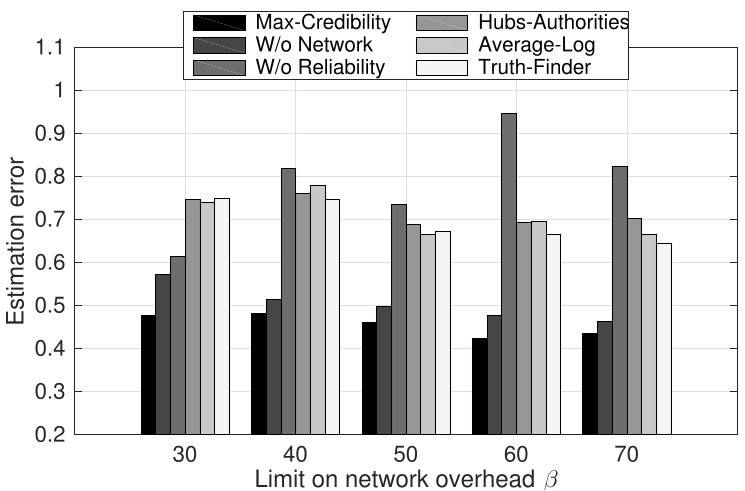 Fig 2: Comparison showing the proposed approach (lowest estimation error) significantly outperforming SOTA truth-finding algorithms.
Key finding: The Iterative Approach (Min-Overhead) achieved a much higher success ratio in meeting data quality requirements compared to non-adaptive methods, because it reacts to data conflicts in real-time by requesting more "votes" from reliable nodes.
Critical Insight & Future Directions
The brilliance of this work is the application of Asymptotic Normality. By treating the estimated truth as a parameter in a distribution, the authors can calculate exactly how "sure" they are about the data quality without knowing the actual ground truth.
Limitations: The model currently assumes numerical data. Extending this to categorical data (e.g., "Is the road blocked?") or multi-modal data (images/video) would require more complex latent variable models.
Takeaway: Future crowdsourcing systems must be "Resource-Aware." As IoT and edge computing scale, the cost of acquiring the "truth" is just as important as the truth itself.