
Predictive Logistics in Healthcare: Leveraging Random Forests and Clustering for Resource Optimization
Resource Frequency Prediction in Healthcare: Machine Learning Approach
This paper presents a machine learning framework for predicting healthcare resource usage frequency using data from Oulu University Hospital. By comparing Random Forest (RF) and Nearest Neighbours (NN) integrated with hierarchical clustering, the study achieves State-of-the-Art (SOTA) forecasting performance measured by Mean Absolute Scaled Error (MASE).
TL;DR
Predicting resource frequency (doctors, X-rays, surgery rooms) is the "holy grail" of hospital management. This study demonstrates that by treating resource usage as a deterministic non-linear system—and applying Random Forest regression combined with Hierarchical Clustering—hospitals can predict demand with significantly higher accuracy than traditional naive methods.
Background Positioning
In the landscape of healthcare informatics, this work sits between traditional Operations Research (OR) and modern Predictive Analytics. While OR focuses on optimization given a distribution, this paper focuses on accurately estimating those distributions from raw historical data, providing the foundational engine for future hospital simulators.
The Core Challenge: Non-Stationarity and Noise
Hospital data is notoriously "noisy" and highly dependent on time. A doctor's schedule in July (holiday season in Finland) looks nothing like their schedule in October. Existing global models often "wash out" these critical local variations.
The authors' intuition was simple yet profound: If the behavior of a resource changes over time, why use one global model? By using unsupervised clustering as a "triage" step for data, they allow models to specialize in specific temporal regimes.
Methodology: From Chaos to Regression
The authors leverage Takens' Theorem to reconstruct the system's state space. Essentially, they transform a single stream of time-series data into a supervised learning matrix where the last observations (lag features) predict the next step.
The Pipeline
- Clustering: Using Euclidean distance and complete-linkage to group similar months and weekdays.
- Local Approximation: Using Nearest Neighbours (NN) where is dynamically tuned via Leave-one-out Cross-validation (LOOCV) using the PRESS statistic.
- Ensemble Learning: Using Random Forest (RF) to reduce variance through bagging and random feature selection.
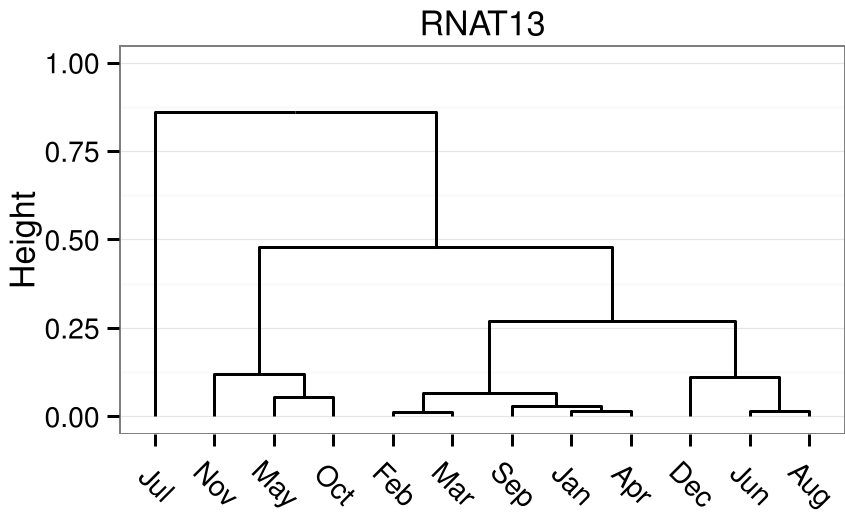 Figure 1: Hierarchical Clustering of an X-Ray Lab (RNAT13), revealing distinct operational clusters like July holidays vs. peak months.
Experimental Insights
The study evaluated 90 active resources from Oulu University Hospital. The authors used MASE (Mean Absolute Scaled Error), a scale-independent metric where a value < 1 means the model is smarter than simply guessing "tomorrow will be like today."
Key Findings:
- High vs. Low Frequency: The 12 most frequented resources (covering 67% of reservations) are much easier to predict because the signal-to-noise ratio is higher.
- The Power of RF: Random Forest was the "gold medalist," showing robust performance even without the clustering step, likely because the trees implicitly learn to split the data by temporal features.
- The Utility of Clustering: While RF was strong alone, clustering was a "force multiplier" for simpler models like Nearest Neighbours and simple averages.
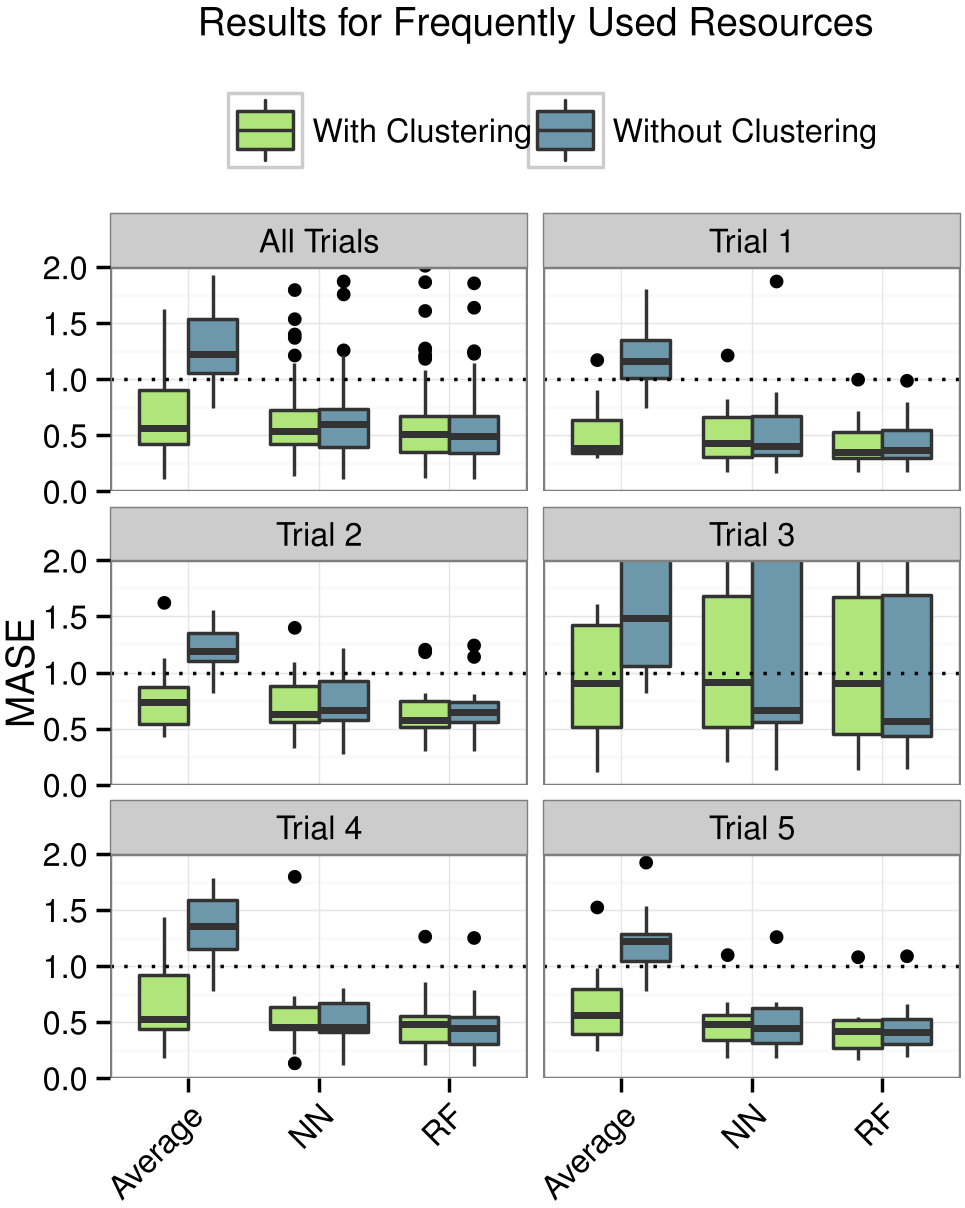 Figure 2: MASE results for top resources. Note how "RF" consistently stays below the 1.0 threshold.
Essential Analysis & Future Outlook
Takeaway: The study proves that ML can move hospital management from reactive to proactive. However, there is a clear "accuracy ceiling" for low-frequency resources due to inherent randomness.
Limitations: The model currently treats every resource as an island. In reality, an X-ray reservation is often a "downstream" effect of a doctor's visit.
The Path Forward: The next frontier is Generative Modeling of the entire patient journey. By modeling the dependencies between resources (e.g., using Graph Neural Networks), we could predict not just that "X-ray will be busy," but "Because Dr. Smith scheduled 10 surgeries, the X-ray lab will be busy in exactly 2 hours."
Summary
By combining the interpretability of clustering with the predictive power of ensemble methods, Vieira and Hollm{' e}n have provided a robust blueprint for the next generation of data-driven healthcare facilities.