
The Power of Play: How Advergaming on Mobile SNS Transforms Brand Value
Responses to an advergaming campaign on a mobile social networking site: An initial research report
This study investigates the impact of mobile "advergames" (branded games) on perceived brand value within Social Networking Sites (SNS). Using a real-world P&G Pringles campaign on Japan's Mobage-town, it validates a model where brand-game fit and SNS engagement drive electronic Word-of-Mouth (eWOM) and brand equity.
TL;DR
Can a simple mobile game about potato chips actually make you value the brand more? This research analyzes a real-world Pringles campaign in Japan to prove that advergames—when they "fit" the brand and are shared through social networks—significantly increase brand favorability, awareness, and uniqueness. It’s not just about playing; it’s about the "fit" and the "buzz."
The Evolution of Branded Entertainment
In an era of ad-blockers and "skip" buttons, marketers are desperate for non-obtrusive ways to reach consumers. Enter advergaming: the use of interactive gaming to deliver embedded brand messages. Unlike standard in-game ads (like billboards in a virtual stadium), advergames are built around the brand.
The authors identify a critical gap: we know games are fun, but we don't fully understand the mechanism of how they translate into Brand Value on mobile Social Networking Sites (SNS).
The "Fit" Factor: Insights from Categorization Theory
The researchers utilize Categorization Theory to explain the cognitive process. When a user encounters an advergame for Pringles, their brain asks: "Does this game 'fit' what I think about Pringles?"
If the "fit" is high (e.g., a fun, social, and quirky game for a snack brand), the positive affect from the game play transfers more effectively to the brand. This perception of fit doesn't just make the brand look better; it gives users a "reason to talk" (eWOM).
Methodology: The "Shaberings" Campaign
The study wasn't conducted in a sterile lab. The authors collaborated with Procter & Gamble (P&G) and the Japanese SNS giant Mobage-town to launch a real campaign for Pringles.
- The Stimulus: A character named "Shaberings" (a penguin-like creature with a potato chip beak).
- The Context: Mobile-only social networking, which allows for instant social sharing.
- The Data: 925 active players who engaged with the game and the social features of the platform.

Key Results: Why Buzz Matters
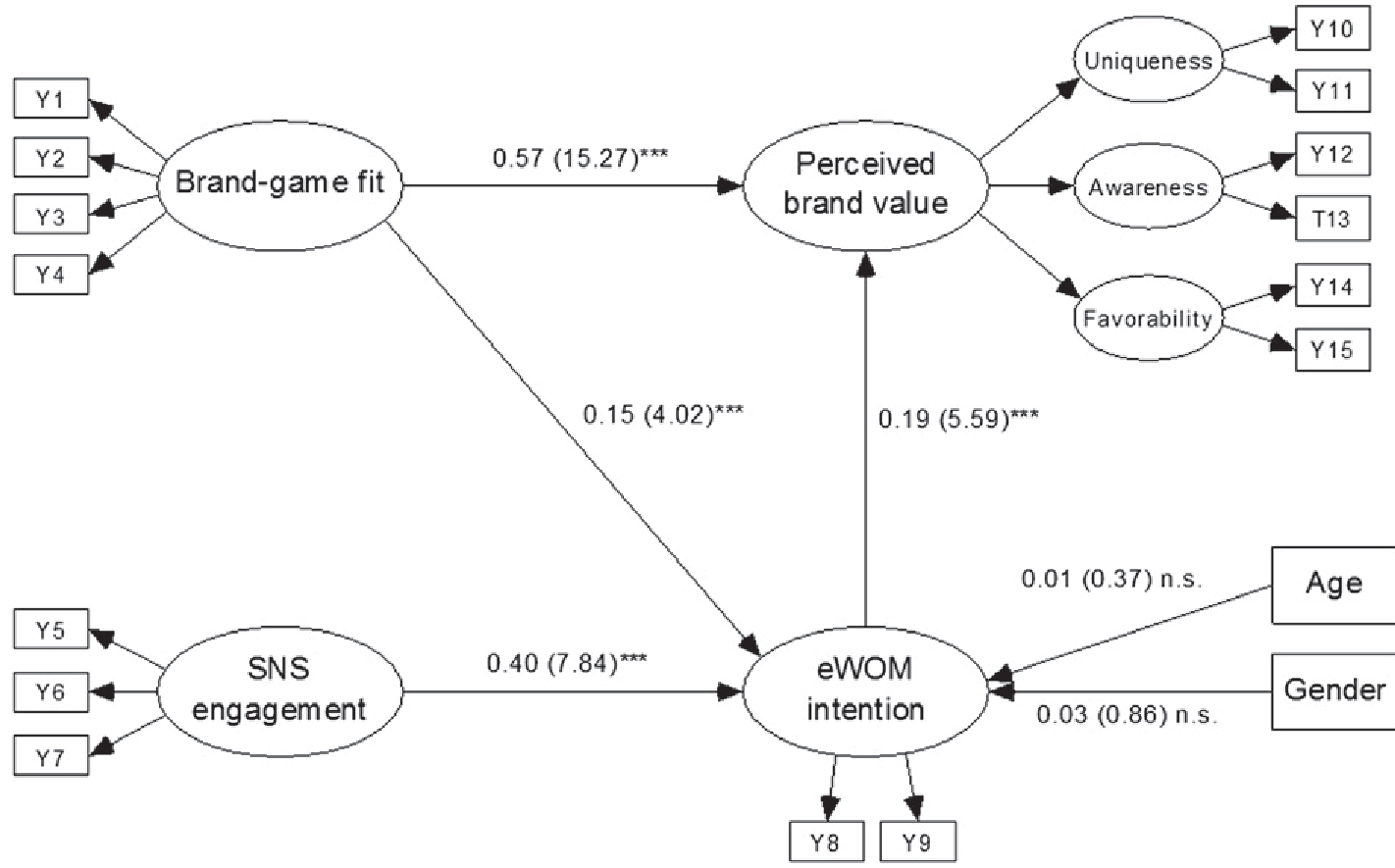
The Structural Equation Modeling (SEM) analysis yielded three major insights:
- Social Displacement: SNS engagement is the primary engine for eWOM (). If you are active on the platform, you are much more likely to spread the word about a brand's game.
- The Fit Link: Perceived brand-game fit directly enhances brand value (). If the game feels "right" for the brand, the brand's uniqueness and favorability ratings soar.
- Buzz to Value: eWOM intention is a significant driver of perceived brand value (). When users talk about the game, they aren't just socializing; they are reinforcing the brand's place in their minds.
Critical Insight & Managerial Implications
For managers, this study provides a clear mandate: Don't just make a game; make a game that reflects your brand's DNA.
- Identify Network Seeds: Focus on "winners" or active social users to act as seeds for viral growth.
- FMCG Advantage: For Fast-Moving Consumer Goods (like snacks), where decisions are made in seconds at a convenience store, the increased "awareness" and "uniqueness" from an advergame can be the deciding factor at the point of purchase.
Conclusion
This research bridges the gap between social interaction and brand equity. By moving beyond simple "recall" metrics, it proves that the synergy of social engagement and thematic congruency creates a powerful cycle of value creation. While limited by its focus on a single Japanese campaign, its framework provides a robust template for the future of mobile branded entertainment.