
Responsible AI: Bridging the Chasm Between Ethics and Legal Enforcement
Responsible AI: A Primer for the Legal Community
This primer introduces the Responsible AI (RAI) framework specifically tailored for the legal community. It synthesizes global ethical principles, such as those from the OECD and HLEG, into actionable dimensions—Strategic, Performance, and Control—to mitigate risks in automated decision-making.
TL;DR
AI is no longer just a technical discipline; it is a socio-technical system with profound legal implications. This primer outlines the Responsible AI (RAI) framework, shifting the focus from mere model performance (accuracy) to a holistic governance model encompassing ethics, fairness, and accountability. It challenges the legal community to move beyond passive observation and become active translators of technical risk into regulatory reality.
The Motivation: Why "Accuracy" is No Longer Enough
In the early days of AI, success was defined by data scientists through metrics like Precision, Recall, and F1-score. However, as AI began deciding who gets a loan, who stays in jail (criminal sentencing), and who passes an exam (the UK A-Level scandal), these metrics failed to capture the human cost.
The authors identify a critical "Principles-to-Practice Gap." While we have hundreds of ethical guidelines (OECD, HLEG, etc.), they are often too high-level for a developer to implement. The "Problem of Many Hands" further complicates this: when a model causes harm, is it the fault of the data provider, the programmer, the business owner, or the legal team?
Methodology: The Three Dimensions of Responsibility
To solve this, the paper deconstructs "Responsibility" into three legal/ethical pillars:
- Blameworthiness: Attributing moral agency and wrongdoing.
- Accountability: Assigning roles to prevent or bring about actions.
- Liability: The duty to compensate for harm, regardless of intent.
The RAI Framework Hierarchy
The authors organize RAI into three manageable dimensions:
- Strategic: Navigating emergent regulations and defining organizational values (the "What should we do?" vs. "What must we do?").
- Performance: Technical rigor in Bias/Fairness, Interpretability (using tools like LIME/SHAP), Robustness, and Security.
- Control & Compliance: Implementing end-to-end governance, transparency registries, and privacy protections (GDPR/CCPA).
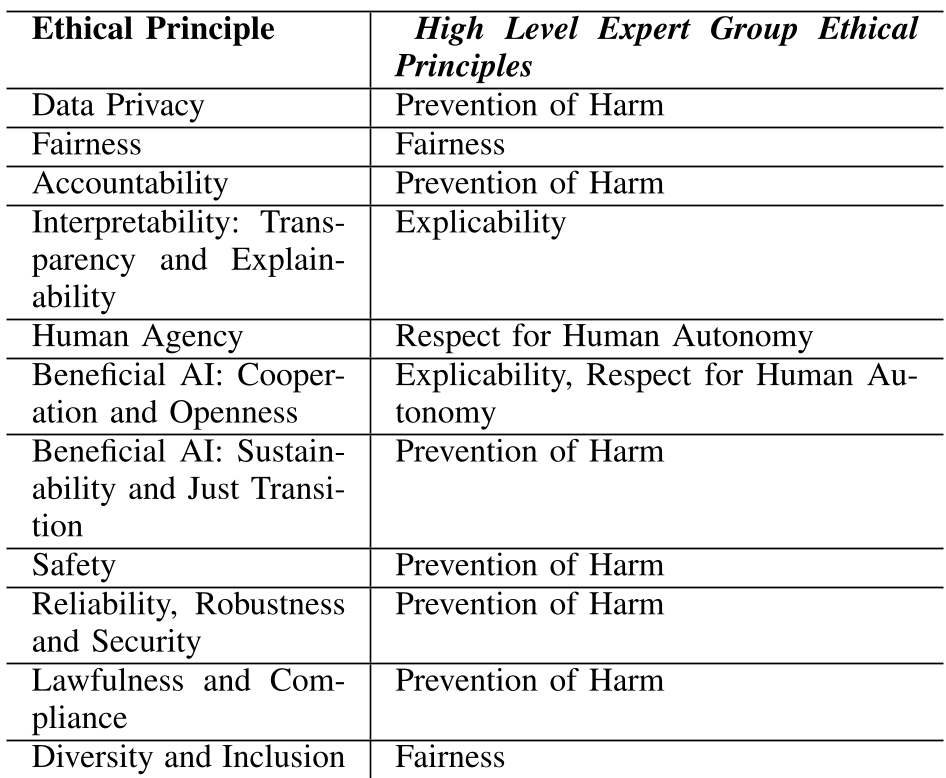 Figure 1: Comparison of global ethical principles against the High Level Expert Group (HLEG) standards.
Critical Insights: Performance vs. Safety
The paper provides a chilling example of the Security-Safety link: researchers manipulated a 'STOP' sign to be read as '30 MPH' by an AI. This isn't just a "bug"—it's a legal liability that requires a new breed of "Red Teaming" and "Threat Bounties" similar to cybersecurity.
Operationalizing the Framework
The authors emphasize that we cannot rely on "self-governance" alone. They categorize active support mechanisms into:
- Software Toolkits: Utilizing Fairlearn or AI Fairness 360 to detect algorithmic bias.
- Institutional Mechanisms: Third-party auditing and "Model Cards" for standardized reporting.
- Hardware Mechanisms: Secure compute to protect data privacy at the silicon level.
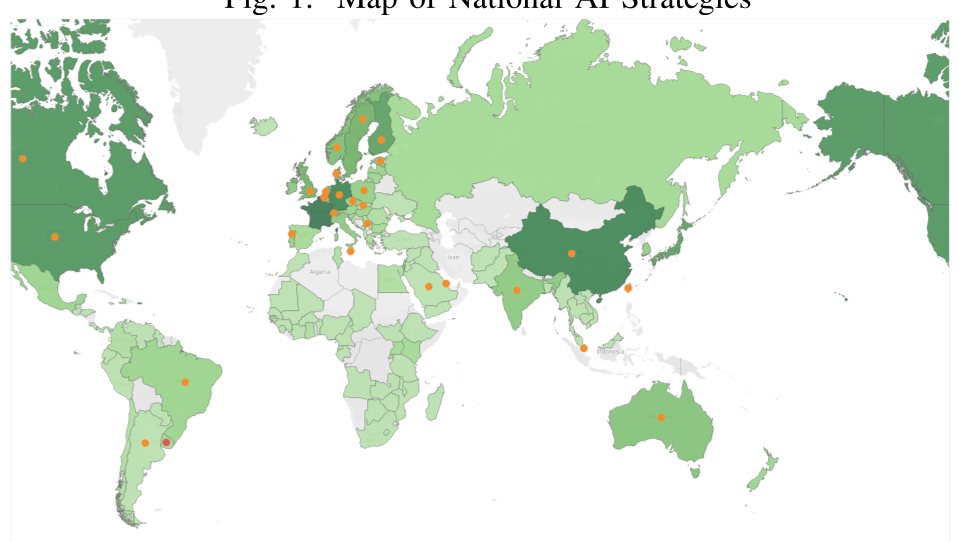 Figure 2: The global landscape showing countries that have established national AI strategies to foster governance.
Conclusion: An Opportunity for the Legal Community
The paper concludes with a call to action. Regulators are not technologists; technologists are not legal experts. This "disciplinary divide" is where AI goes wrong.
The Takeaway: The legal community must engage with developers to:
- Define Controls: Translate "Fairness" from a vague concept into a specific statistical metric for each project.
- Consult Constantly: Understand the actual limitations of technologies like Facial Recognition before drafting bans or permissions.
- Balance Power: Ensure the voices of those impacted by the AI (subjects) are reflected in the governance structure.
RAI is not a "checkbox" at the end of a project; it is an iterative, participatory process that starts at the first line of code and continues through the model's entire lifecycle.