
Cyber Migration: Why Users Abandon One SNS for Another
Retaining and attracting users in social networking services: An empirical investigation of cyber migration
This paper investigates "cyber migration" in Social Networking Services (SNS), developing a research model based on the Push-Pull-Mooring (PPM) framework. It identifies how dissatisfaction with socialization support and entertainment value (Push), attraction of alternatives (Pull), and peer influence vs. continuity costs (Mooring) determine a user's intention to switch platforms.
Executive Summary
TL;DR: This study applies the Push-Pull-Mooring (PPM) framework to explain why users migrate between Social Networking Services (SNS). It reveals that users aren't just "using" a system; they are "residing" in a community. The findings suggest that dissatisfaction with socialization and entertainment, combined with peer pressure from the destination and social continuity costs at the origin, are the true drivers of platform switching—far outweighing technical or information quality.
Academic Positioning: This work bridges the gap between traditional IS success models and human migration theory, positioning the SNS user as a "cyber migrant" rather than a mere consumer.
Problem & Motivation: The Resident vs. The User
In conventional software, switching costs are often financial (licensing) or functional (learning curves). However, in the SNS world—where services are free and interfaces are intuitive—why do platforms like MySpace or Friendster collapse while others thrive?
The authors argue that previous research viewed users as independent decision-makers. In reality, SNS users are tightly knit residents. Switching isn't just a technical change; it’s a geographical move in digital space. The motivation for this study was to move beyond "what" users do and understand the "social physics" of "how" they move between digital territories.
Methodology: The PPM Framework
The researchers utilized the Push-Pull-Mooring (PPM) framework, a cornerstone of demographic migration studies, to categorize the forces at play:
- Push Factors: Negative attributes of the current SNS (e.g., lack of fun or poor social tools) that drive users away.
- Pull Factors: Positive attributes of a competing SNS that attract users.
- Mooring Factors: Personal or situational variables (like "continuity cost"—the social pain of losing contacts) that act as either an anchor or a sail.
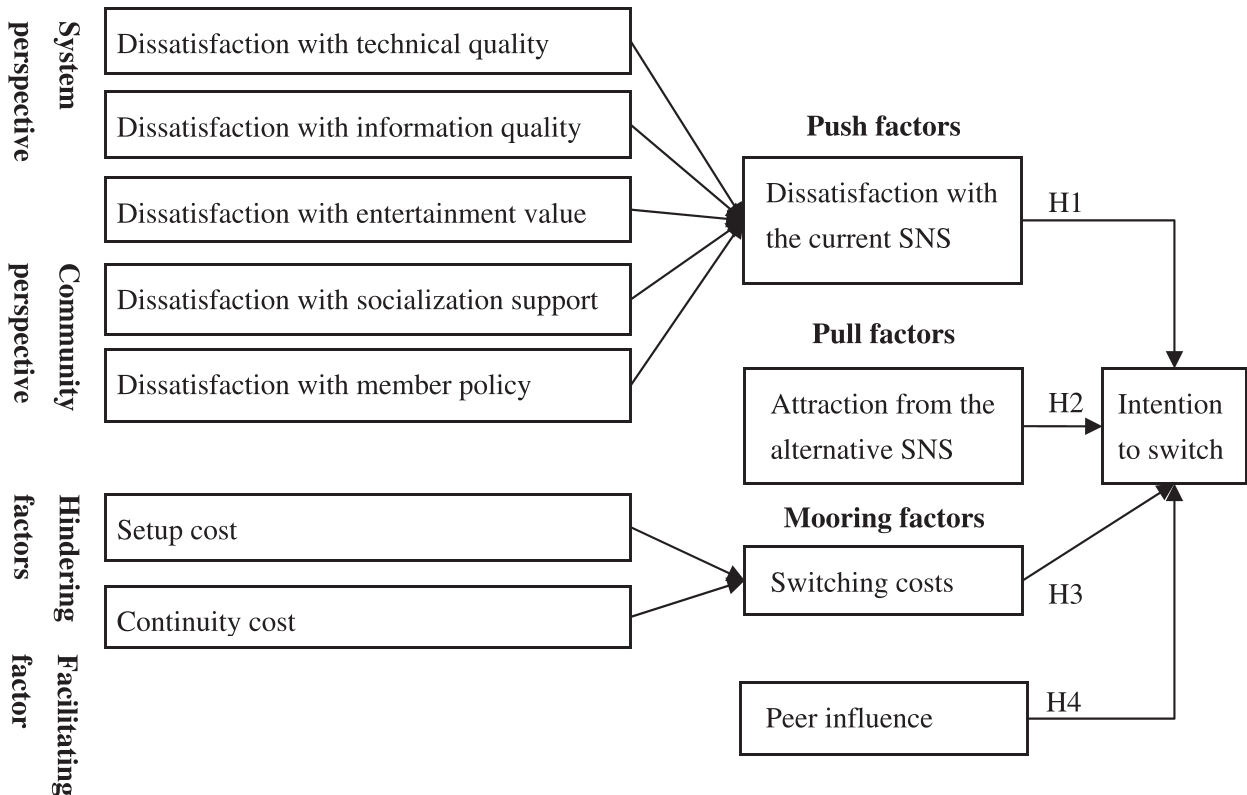
The model treats these as aggregate constructs, specifically looking at Socialization Support and Entertainment Value as the core of the experience.
Key Insights and Results
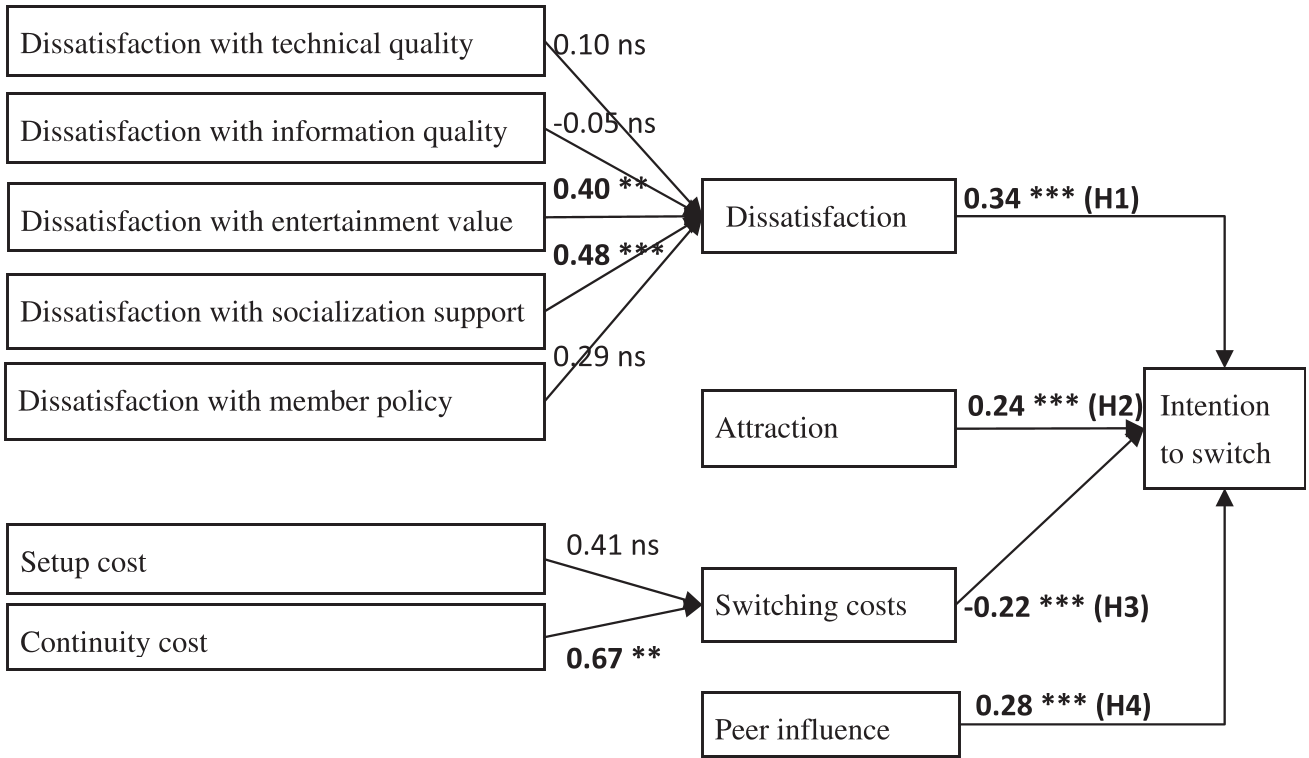
Following a survey of 180 active SNS users, the Partial Least Squares (PLS) analysis yielded striking results:
- The "Hygiene" Trap: Remarkably, Technical Quality and Information Quality had no significant effect on switching intention. Users expect these to work; their presence doesn't make them stay, but their absence is a baseline requirement.
- Socialization is King: Dissatisfaction with how a site supports group management and communication was a primary "Push" factor.
- The Anchor of Continuity: "Continuity Cost"—the effort required to rebuild a network and the fear of losing touch—is the strongest "Mooring" factor preventing users from leaving.
- The Peer Gravity: Peer influence acts as a powerful "Pull" multiplier. If your friends move, the "Pull" of the new site increases while your "Continuity Cost" at the old site paradoxically decreases.
Critical Analysis & Conclusion
Takeaway for Strategy
For SNS providers, the battle isn't won by faster servers or cleaner code. It is won through Community Bond Management.
- Offensive Strategy: Provide superior entertainment and socialization tools to "Pull" users.
- Defensive Strategy: Increase the "Continuity Cost" by making social circles so dense that the cost of leaving becomes psychologically prohibitive.
Limitations
The study is cross-sectional and relies on self-reported "intention" rather than tracking actual migration behavior. Furthermore, the 2009-2014 context (Facebook vs. Windows Live Space) has evolved into a mobile-first "attention economy" (TikTok vs. Reels), where algorithmic "Pull" might now overshadow "Peer Influence."
Future Outlook
As we move toward decentralized social media (Fediverse), the concept of "Continuity Cost" may change. If users can "port" their followers from one platform to another, the primary Mooring factor identified in this paper will vanish, potentially triggering the largest wave of "cyber migration" in history.