
A Faustian Exchange: Rethinking IT Use Through 'Actuality' and the Doraemon Metaphor
Rethinking ‘IT/IS use in a technological mature society’ from the actuality point of view: critical learning in reflection on SSM meeting about ‘IT/IS use’
This paper explores the human-centered implications of IT/IS proliferation in a "technologically mature society" using Soft Systems Methodology (SSM). It introduces the distinction between "Reality" (cognitive/technical) and "Actuality" (action/feeling) to rethink IT usage through a workshop-driven "accommodation" process rather than mere technical consensus.
TL;DR
In an era where technology is "always on, everywhere, and for everyone," we have traded deep human connection for technical efficiency. This paper argues that we must stop asking what technology can do and start asking what it is allowed to do. By applying Soft Systems Methodology (SSM) and the distinction between Reality (Mono) and Actuality (Koto), the authors reveal that even the architects of our digital world feel trapped by their own creations.
Problem & Motivation: The "Abnormal" Reality
The authors argue that since the 1990s, IT dominance has become "abnormal." We have reached a state of "reflective modernization" where the systems we built to free us—like CAD, databases, and SNS—are now expanding uncontrollably, interfering with direct human communication.
The core tension lies in the gap between:
- Reality (Mono): The objective, cognitive world of things, logic, and technical capability.
- Actuality (Koto): The world of action, intuition, and the subjective "feeling" of living.
Current IT/IS development lives almost entirely in "Reality." Developers build because they can, driven by a "greed for self-expansion," without reflecting on the "Actuality" of how these systems consume our life-worlds.
Methodology: SSM and the Power of Accommodation
To solve this, the authors organized an SSM Workshop for IS experts. Unlike a typical "consensus meeting" which seeks a logical middle ground, an Accommodation Meeting seeks to help people with different worldviews "live together" by sharing their subjective "Actuality."
Step 1: Rich Pictures (The "Omoi" of Experts)
Participants drew "Rich Pictures" to express their feelings about IT. The results were startlingly dark for a group of tech veterans:
- Member C: Drew networks as a wall interfering with human communication.
- Member B: Visualized IS as "junk content" hidden behind a mask, powered by "brute force" (energy-heavy stations).
- Member G: Described himself as "caged" by the very theories of automated control he once championed.
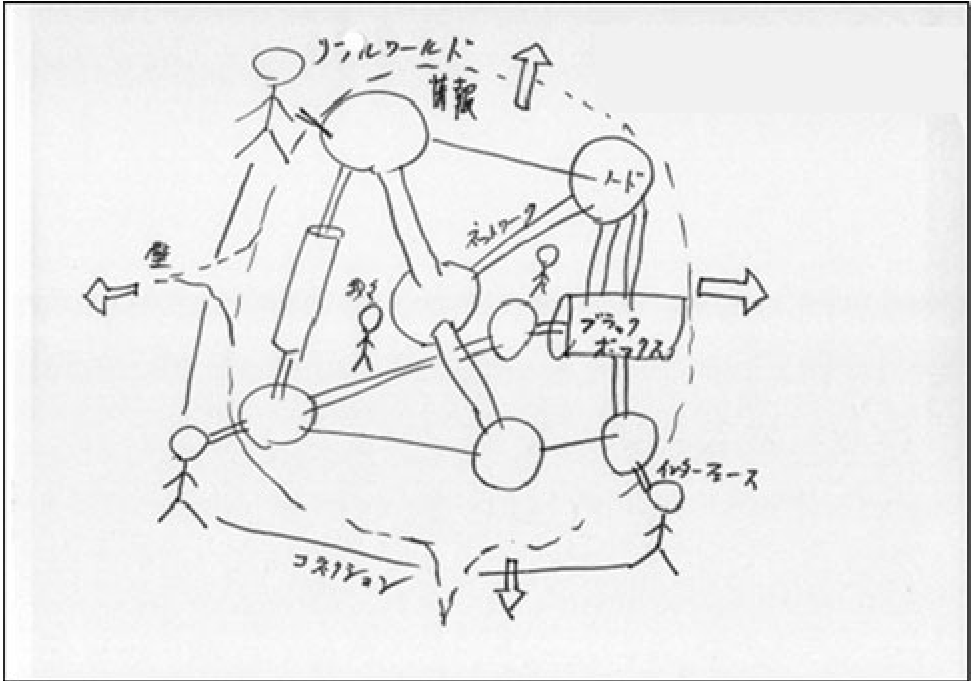 Fig 1: A veteran engineer's view of IT nodes and networks forming a wall that prevents direct human contact.
Step 2: The Doraemon Metaphor
The breakthrough in the workshop came from the metaphor of Doraemon and Nobita. In the manga, the boy Nobita (the User) asks for futuristic tools from Doraemon (the Supplier/Engineer) to satisfy his greed. Almost every story ends in disaster because Nobita ignores the boundaries of the tool's intended use.
The experts realized they are "Doraemons" providing "Nobitas" with tools that satisfy "excessive greed" for self-expansion (e.g., Google allowing instant access to everything), often at the cost of human responsibility.
Experimental Insights: The Boundary of "Can" vs. "May"
The workshop moved through different levels of "Omoi" (feelings) to reach a final accommodation. The most critical takeaway was the definition of two worlds:
- This World: The real, everyday life-world of action.
- The Alternate World: The cyberspace created by IT/IS.
The group reached a state of Accommodation on a new system definition:
"A system to keep relations with 'the Alternate World' from 'this World' by exploring the boundary between what can be done and what may be done."
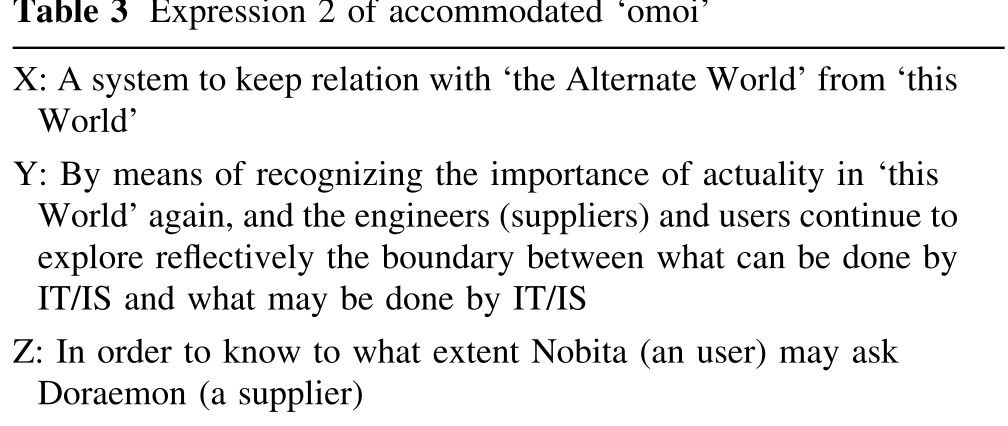 Table 3: The final accommodated worldview where users (Nobita) and suppliers (Doraemon) must recognize the weight of 'Actuality'.
Depth Insight: The "Gatekeeper" Concept
The paper concludes with a call for a "Gatekeeper"—not a physical barrier, but a conceptual device.
- It acts as a standard to decide if IT should be used.
- It creates a temporary stoppage in life to allow for reflection.
This is the antithesis of "ubiquitous computing." While tech giants want technology to vanish into the background (seamlessness), the authors argue we need technology to be visible and questioned (seamfulness).
Conclusion & Future Outlook
This work is a profound critique of the "automatic acceleration" of the tech industry. It suggests that:
- Technical expertise is not enough: Engineers must be trained in "systems theory" and the philosophy of "Actuality."
- Accommodation over Consensus: In a "Risk Society," we cannot wait for objective facts to align; we must find ways to co-exist by sharing our subjective fears and "omoi."
The ultimate takeaway? To remain human in an era of ubiquitous technology, we must re-learn the art of restraint. We must know how much the "Nobita" in us should ask from the "Doraemon" of technology.