
[Microsoft Research] Rethinking Scaling: How HyperP and Hypersphere Optimization Solve LLM Instability
Rethinking Language Model Scaling under Transferable Hypersphere Optimization
The paper introduces HyperP (Hypersphere Parameterization), a novel framework for transferring optimal learning rates (LR) across model width, depth, tokens, and MoE granularity. It utilizes Frobenius-sphere optimization with the Muon optimizer to achieve state-of-the-art compute efficiency (up to 1.58x for dense and 3.38x for MoE models) while ensuring structural training stability.
TL;DR
Scaling Large Language Models (LLMs) used to be a dark art of tuning learning rates (LR) and weight decay while praying to avoid loss spikes. HyperP (Hypersphere Parameterization) changes the game by constraining weights to a fixed-norm hypersphere. This framework allows for a single small-scale LR sweep to transfer perfectly across model size and training tokens, achieving up to 3.38x compute efficiency and providing structural guarantees against activation outliers and logit explosion.
The "Weight Decay" Headache and the Hypersphere Intuition
In the standard AdamW regime, the optimal weight decay is notoriously coupled with model width, learning rate, and even training duration. It is an "ad-hoc patch" more than a principled solution.
The authors of HyperP propose a fundamental shift: Hypersphere Optimization. By projecting weights onto a Frobenius sphere, weight decay becomes a "first-order no-op"—meaning it literally has no effect on the optimization trajectory. This reduces the hyperparameter search space from a 2D plane (LR + Weight Decay) to a simple 1D line (LR only).
Methodology: The Core of HyperP
HyperP is built on four theoretical pillars:
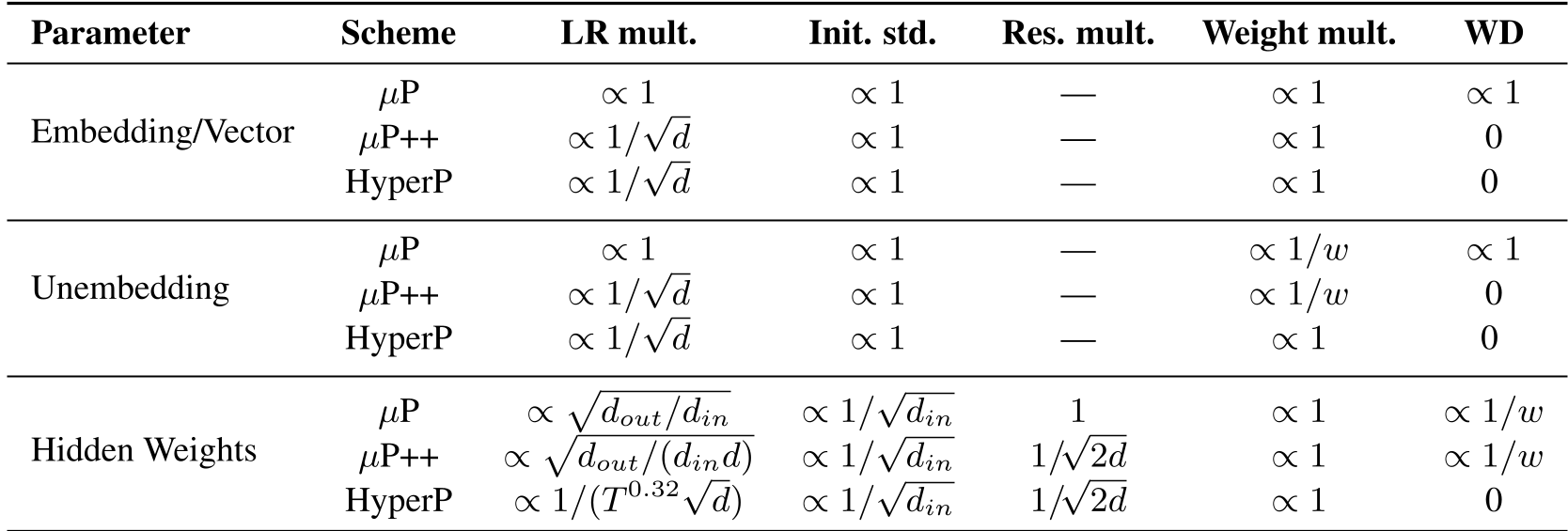
- Native Width Transfer: Frobenius-sphere constraints naturally preserve signal scale without explicit 1/width scaling.
- Depth-µP Necessity: Contrary to previous claims that optimizers like Muon are inherently depth-transferable, the authors prove that depth-dependent scaling is still required to handle cumulative residual drift.
- The "Magic Exponent" (0.32): They discovered that the optimal LR scales with training tokens according to , an exponent that seems universal across different optimizers.
- SqrtGate for MoE: Standard Softmax gating causes signal shrinkage as expert granularity increases. SqrtGate () ensures output RMS remains invariant to the number of experts ().
Transferable Stability: No More Loss Spikes
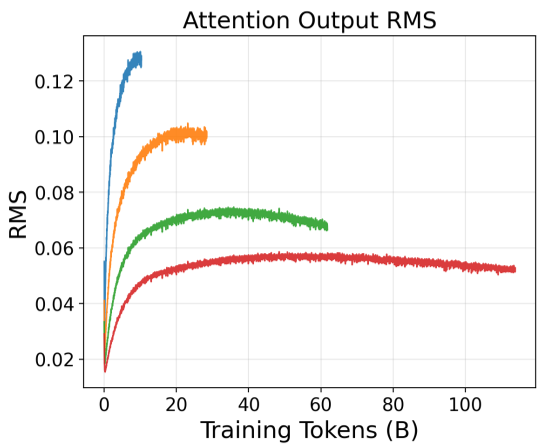
The most striking achievement of HyperP is Transferable Stability. In typical scaling, larger models are more prone to "logit explosion" (Z-values) and "activation outliers."
Under HyperP, stability metrics are not just bounded—they often improve as the model scales.
- Z-values: Logit magnitudes remain constant or decrease.
- Output RMS: Remains stable across depths.
- SqrtGate Effect: Reduces peaks in router Z-values by 5x, preventing the routing mechanism from collapsing.
Experimental Results: Scaling to the Frontier
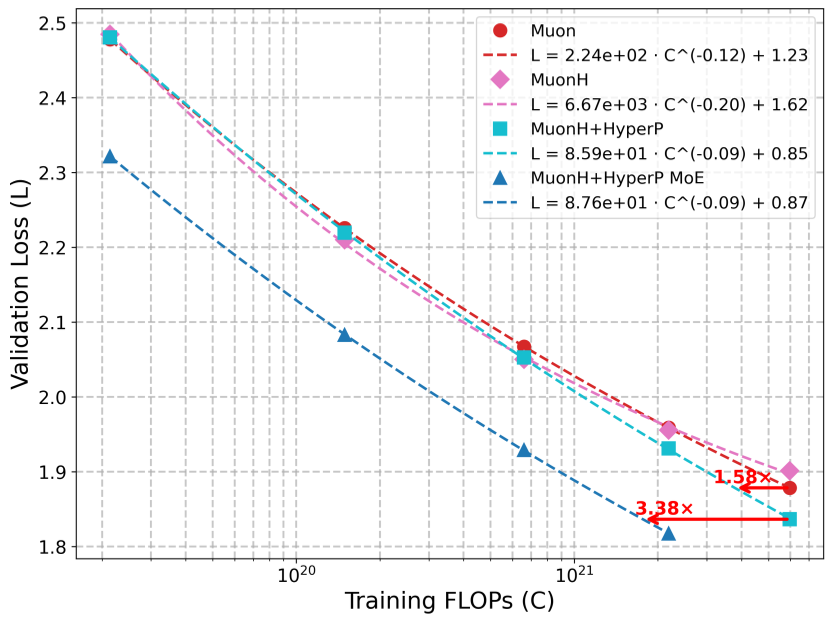
Training on the SlimPajama dataset, HyperP demonstrated massive gains in Compute Efficiency Leverage (CEL). At the largest tested budget of FLOPs:
- Dense Models: MuonH + HyperP achieved 1.58x better efficiency than the strong Muon baseline.
- MoE Models: Using the SqrtGate and shared expert design, HyperP reached a staggering 3.38x leverage.
Crucially, the performance gap between HyperP and baseline methods widened as compute increased, suggesting that HyperP becomes even more valuable at the scale of GPT-5 or Llama-4 class models.
Critical Insight & Conclusion
The true value of this paper isn't just a lower validation loss; it's the Rethinking of the scaling law as a geometry problem. By moving from Euclidean space to Manifold optimization (hyperspheres), we gain structural protection against the numerical instabilities that have plagued LLM pre-training for years.
Limitations: The 0.32 "magic exponent" for tokens is still an empirical observation lacking a "first principles" derivation. However, for practitioners, HyperP provides a robust, zero-shot hyperparameter transfer recipe that could significantly lower the R&D cost of frontier model training.