
Rethinking OPD: Why Your Stronger Teacher is Failing Your Student
Rethinking On-Policy Distillation of Large Language Models: Phenomenology, Mechanism, and Recipe
This paper investigates the training dynamics of On-Policy Distillation (OPD) for LLMs, introducing the "OPD" framework. It identifies two governing conditions for success—thinking-pattern consistency and the presence of genuinely "new knowledge"—and demonstrates that successful OPD is driven by progressive alignment on a small set of high-probability shared tokens.
TL;DR
On-Policy Distillation (OPD) is the "secret sauce" behind many SOTA models like Qwen3 and GLM-5, providing dense rewards that are far more sample-efficient than outcome-based RL. However, it is notoriously fragile. This paper reveals that a teacher's benchmark score is a poor predictor of success. Instead, the secret lies in Thinking-Pattern Consistency. If the student and teacher don't "think" alike, the distillation signal becomes noise.
Background: The "Free Lunch" of Dense Supervision
Unlike traditional Off-Policy distillation (where a student learns from fixed teacher data), OPD lets the student generate its own answers (rollouts) and asks the teacher: "What would you have said at this exact moment?" This provides a reward signal for every single token, effectively solving the "exposure bias" problem. But as the researchers found, this "free lunch" has a steep price if the pairing is wrong.
The Anatomy of Failure: Phenomology & Mechanism
The authors identify two "Laws of OPD":
- Thinking-Pattern Consistency: The student and teacher must share a compatible candidate space. If the student’s top-k tokens don’t overlap with the teacher’s, the gradient signal vanishes.
- Genuinely New Knowledge: A larger model from the same family (e.g., 7B vs 1.5B) often provides no gain because they were trained on the same data. They are "scale-up" copies, not "knowledge-up" upgrades.
Key Evidence: The Shared Token Hook
The researchers found that successful OPD is driven by a "virtuous cycle" in the Overlap Region.
- The 99% Rule: A tiny set of shared tokens (the top-k overlap) accounts for 97-99% of the total probability mass.
- Sufficient Statistics: Optimizing only these shared tokens achieves the same results as optimizing the entire vocabulary.
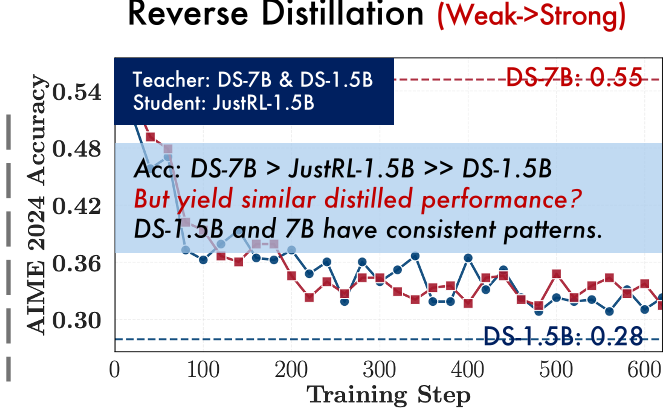 Figure 1: The Overlap Ratio is the heartbeat of OPD. When it stagnates (bottom curve), distillation fails.
A Practical Recipe for Success
If your OPD run is failing, the authors suggest two surgical interventions:
- Off-Policy Cold Start: Before turning on OPD, perform Supervised Fine-Tuning (SFT) on the student using teacher-generated rollouts. This "warms up" the student to the teacher’s thinking style.
- Teacher-Aligned Prompts: Use the exact prompt templates the teacher was trained on. Even small changes in the prompt (e.g., "Think step by step" vs "Reason carefully") can break thinking-pattern consistency.
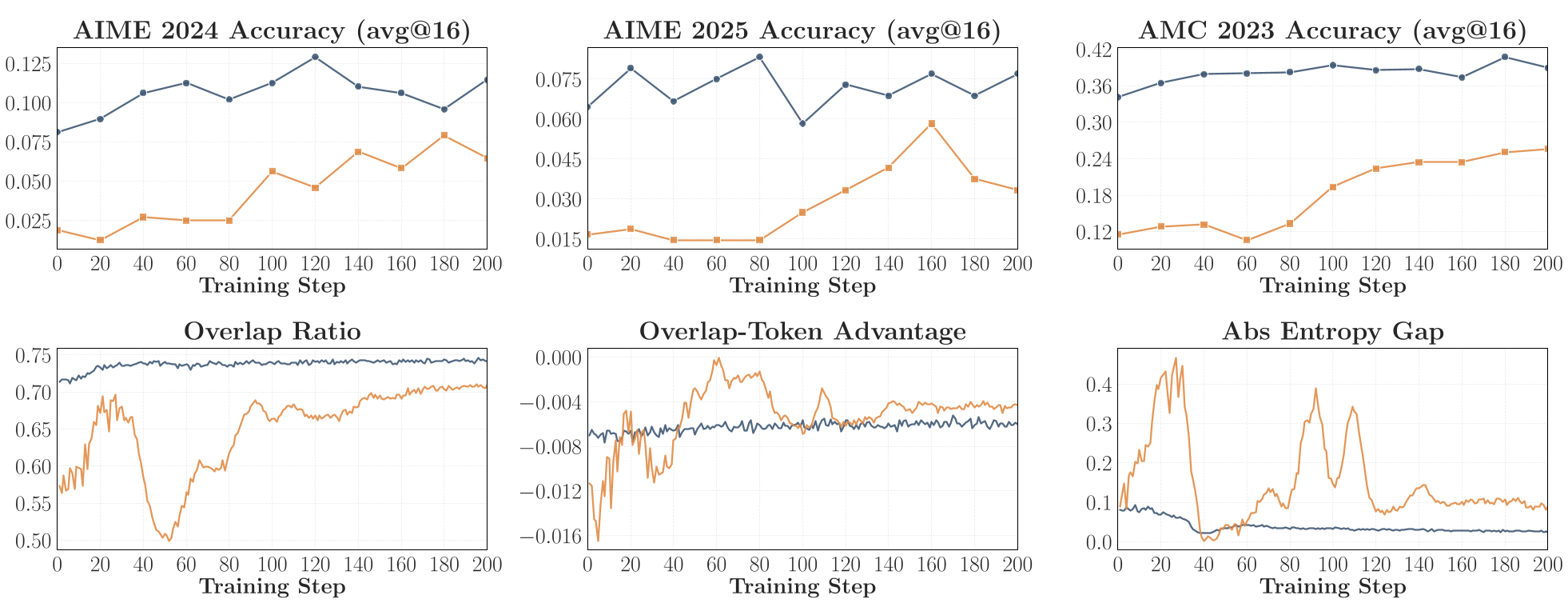 Figure 2: The impact of an off-policy cold start. Initializing with SFT (top curve) provides a higher performance ceiling and more stable training.
The "Trajectory Ceiling": The Limits of OPD
Perhaps the most critical insight is the Trajectory Depth problem. As a student's response grows longer, it drifts further away from states the teacher "understands."
- Reward Degradation: At a prefix length of 1K tokens, the teacher has a massive accuracy advantage. At 16K tokens, that advantage evaporates to near zero.
- Back-to-Front Instability: Noise starts at the end of the response and propagates backward, eventually destabilizing the entire model.
Critical Insight & Conclusion
This paper shifts the paradigm from "Bigger Teacher is Better" to "Compatible Teacher is Better." It proves that OPD is not a universal knowledge transfer tool but a high-precision alignment mechanism.
Takeaway for Practitioners: When selecting a teacher for distillation, don't just look at the MMLU or AIME leaderboard. Look at the Overlap Ratio on your student's rollouts. if the overlap is below 70%, your distillation is likely doomed without a "cold start" or a shift in prompt alignment.
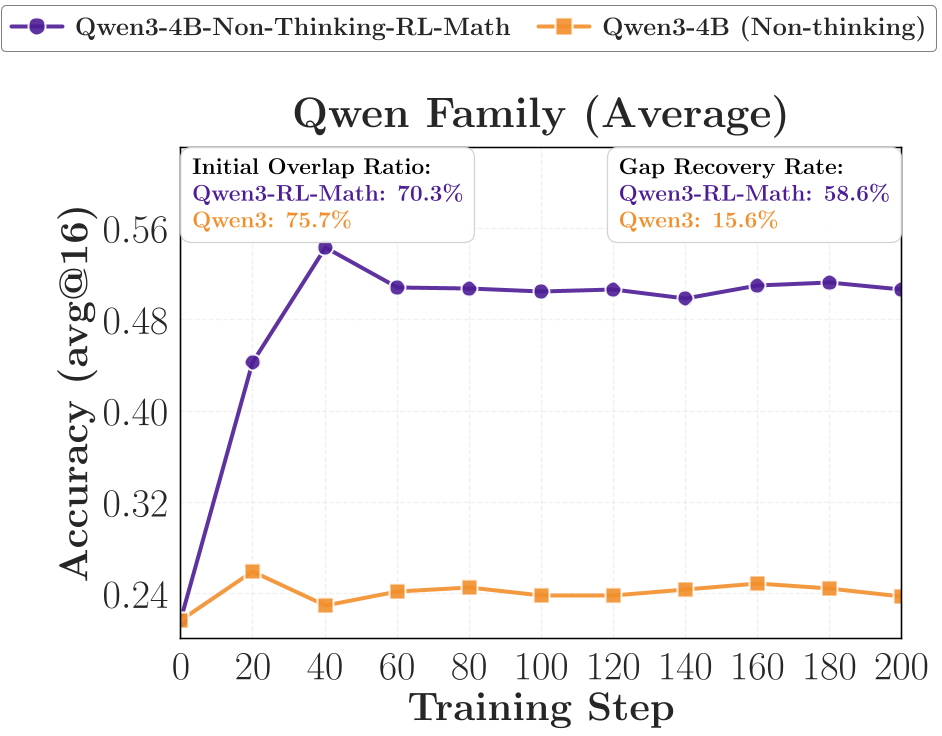 Figure 3: Post-trained teachers (RL) provide more transferable "new knowledge" than simple same-family scale-ups.