
[ICLR 2025] MergeRAG: Beyond Static Selection — Rethinking Retrieval-Augmentation as Dynamic Synthesis
Rethinking Retrieval-Augmentation as Synthesis: A Query-Aware Context Merging Approach
The paper introduces MergeRAG, a novel framework that redefines Retrieval-Augmented Generation (RAG) by shifting from a "retrieve-then-select" paradigm to a "query-aware synthesis" approach. It achieves state-of-the-art results across five benchmarks, notably improving F1 scores by up to 13.7 points.
TL;DR
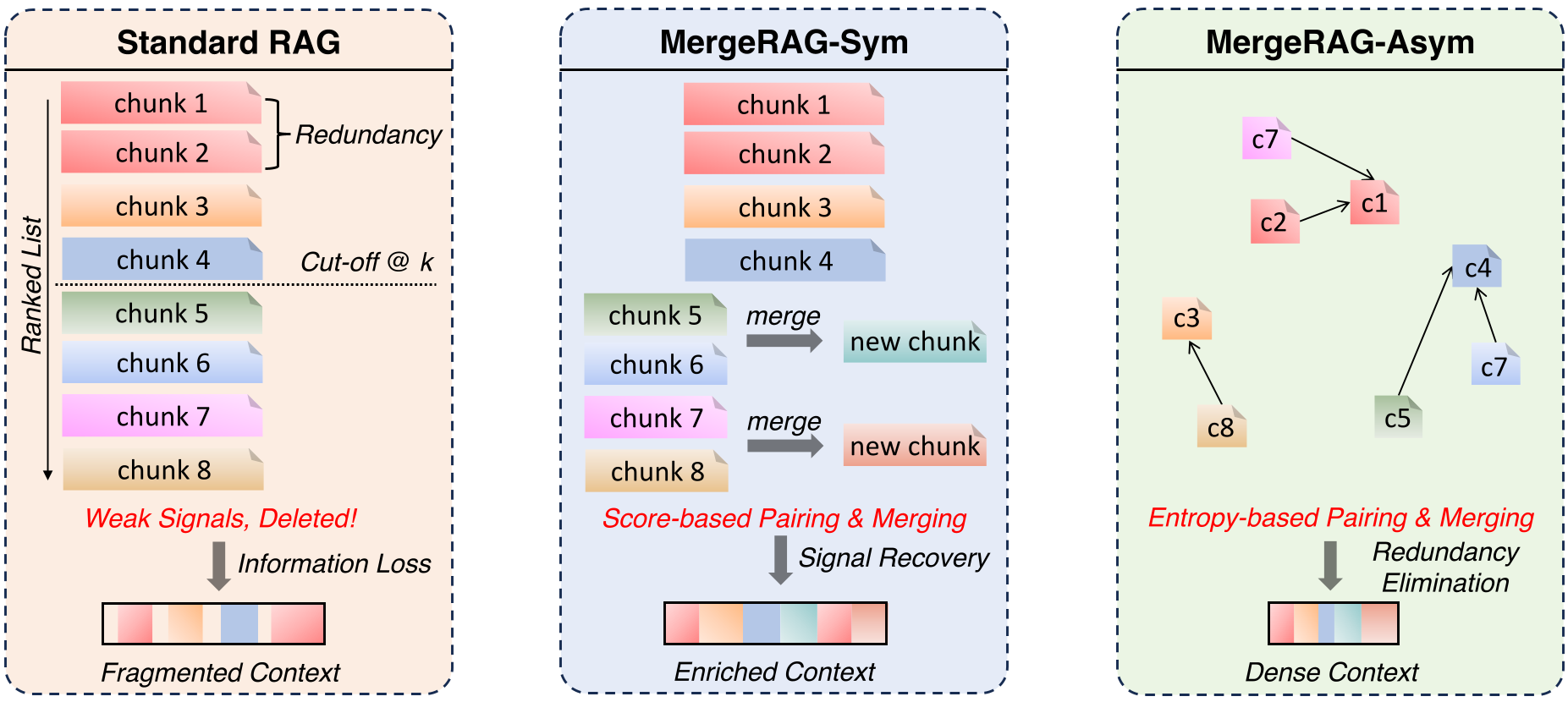
Standard RAG is stuck in a "filter-only" mindset, often throwing away vital clues just because they don't rank in the top-5. MergeRAG breaks this mold by transitioning from Static Selection to Dynamic Synthesis. By merging retrieved chunks in a query-aware manner, it recovers hidden "bridging evidence" while purging redundant tokens, leading to a massive 13.7 point F1 jump in multi-hop reasoning tasks.
Context Fragmentation: The Hidden Cost of Top-K
The current RAG paradigm follows a rigid "Retrieve Rerank Truncate" pipeline. While efficient, this approach suffers from two fatal flaws:
- The Bridging Evidence Problem: In complex multi-hop queries (e.g., "When did military instruction start at the place where Larry Alcala was educated?"), the answer is often fragmented. One chunk mentions Alcala's school; another, lower-ranked chunk mentions the school's history. Truncating at the top-k often kills the link between these two.
- Semantic Redundancy: Top-ranked chunks often repeat the same information, wasting precious token space that could have been used for diverse evidence.
MergeRAG frames this not as a selection task, but as a Rate-Distortion optimization problem, seeking to maximize relevance while minimizing token cost.
Methodology: The Dual-Path Synthesis
MergeRAG employs a scoring agent to restructure retrieved contexts through two innovative pathways:
1. Symmetric Merging (Boosting the Signal)
This strategy targets the "long tail" of retrieval. Instead of discarding low-scoring chunks, MergeRAG pairs them and instructs an LLM to synthesize them into a single, cohesive unit. This process "denoises" the tail, consolidating weak signals into a detectable, query-relevant anchor.
2. Asymmetric Merging (Eliminating Redundancy)
To handle redundancy, the authors use Entropy-Guided Anchoring. They calculate the Negative Log-Likelihood (NLL) of a low-scoring "source" chunk conditioned on a high-scoring "anchor." If the NLL is low, the source is semantically redundant. The system then performs a directional fusion: the anchor assimilates unique details from the source and discards the rest.
3. Hierarchical Parallel Merging
To solve the latency issues of iterative merging, the authors introduce a tree-structured reduction process. By merging disjoint pairs concurrently, they reduce latency from to . This also limits "semantic drift"—the phenomenon where deep recursive regeneration causes the LLM to hallucinate or lose original details.
Experimental Battleground: Multi-Hop Superiority
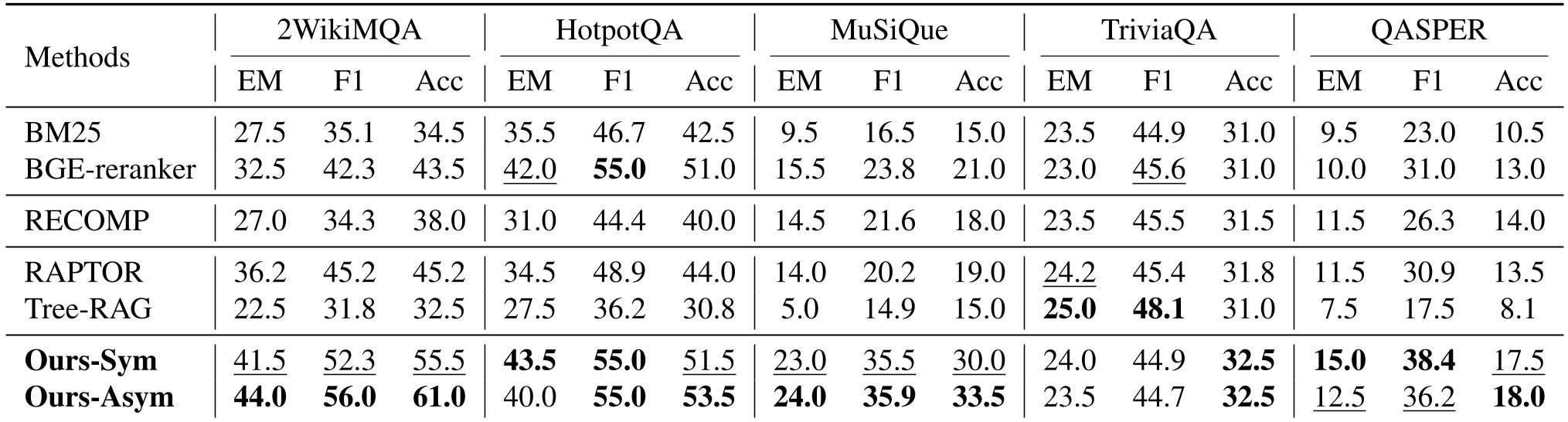
The framework was tested on demanding multi-hop benchmarks like MuSiQue and 2WikiMQA.
- Performance: MergeRAG-Asym outperformed the BGE-reranker by 12.1 points in F1 score on MuSiQue.
- Data Efficiency: Even when restricted to a context length equivalent to one single chunk (), MergeRAG maintained nearly double the F1 score of standard baselines because it synthesized information from multiple sources into that single slot.
Critical Insight: Why This Matters
The breakthrough of MergeRAG lies in its treatment of text chunks as malleable information units rather than atomic blocks.
- Symmetric Merging acts as a "bottom-up" signal recovery.
- Asymmetric Merging acts as a "top-down" compression.
By using NLL as an empirical estimator for conditional entropy, the paper provides a rare, rigorous mathematical grounding (Information Theory) for why we should merge specific documents.
Conclusion and Future Outlook
MergeRAG proves that "Retrieval-as-Synthesis" is the future of high-density RAG.
Limitations: The framework relies on LLM calls for the merging step, which, while parallelized, still incurs a cost. Future work could investigate using smaller, specialized models for the fusion operator to further drive down costs.
For researchers looking to solve "the long-context needle in a haystack" problem, MergeRAG suggests the solution isn't just a bigger haystack—it's a smarter way to weave the hay.
Senior Editor's Note: This work signals a shift from "finding" information to "composing" context. It is a must-read for anyone building production-grade RAG systems for complex domains.