
Rethinking MSN Routing: Is GPS Necessary or is Social Logic Enough?
Rethinking routing information in mobile social networks: Location-based or social-based?
This paper investigates the effectiveness of routing strategies in Mobile Social Networks (MSNs) by comparing location-based and social-based information. It proposes two representative schemes, Soc (social-based) and Loc (location-based), and demonstrates through extensive simulations that both approaches achieve nearly identical performance in terms of delivery ratio, delay, and cost.
Executive Summary
In the world of Mobile Social Networks (MSNs), moving data between intermittently connected devices is a constant challenge. Traditionally, researchers have debated two paths: following the physical footprint (Location-based) or following the social heartbeat (Social-based).
This paper provides a definitive answer: Location information is not essential. By comparing two newly designed representative protocols—Soc and Loc—across real-world traces like MIT Reality and San Francisco taxi movements, the authors prove that social logic performs within 5% of location-based tracking. This finding has massive implications for user privacy, suggesting we can build efficient networks without tracking exactly where users go.
The Great Information Divide: Physical vs. Logical
The fundamental problem in MSNs is determining which "relay" node is most likely to encounter the destination. Prior work generally falls into two camps:
- Location-Based: Uses GPS, coordinates, and physical distance. It assumes geographical proximity leads to encounters.
- Social-Based: Uses "friendship" metrics, centrality, and similarity. It assumes social patterns are the true driver of connectivity.
The authors identify a critical tension: Location data is precise but "toxic"—it requires extra hardware and violates privacy. Social data is abstract and easier to collect but was historically viewed as a "weak" proxy for physical movement.
Methodology: Engineering Soc and Loc
To ensure a fair fight, the authors didn't just compare old algorithms. They built two comprehensive "Gold Standards" for comparison:
1. The Soc Scheme (Social Logic)
Soc doesn't just look at who you know; it looks at when and how centrally you know them. It uses a convolution-based utility function: This formula combines Social Similarity (shared friends) with Social Centrality (how "popular" a node is), weighted by a time-decay factor. The intuition: Recent social interactions are better predictors of future encounters than old ones.
2. The Loc Scheme (Physical Logic)
Loc represents the best of geographical routing. It uses the Hadamard product of two matrices: one representing mobility pattern similarity (do we visit the same places?) and another representing physical distance.
 Figure 1: Comparison of Social layer (logic) vs. Physical layer (location).
Experimental Showdown: The 5% Rule
The authors tested these schemes using the HaggleSim Emulator on traces including MIT students and city buses.
Social-Based Superiority
When Soc was compared against existing social protocols like Bubble Rap and SimBet, it consistently achieved higher delivery ratios (up to 15% better than SimBet) and lower delays.
The Head-to-Head: Soc vs. Loc
This is the paper’s core discovery. In almost every test case—whether measuring delivery ratio, delay, or cost—Soc and Loc were neck-and-neck.
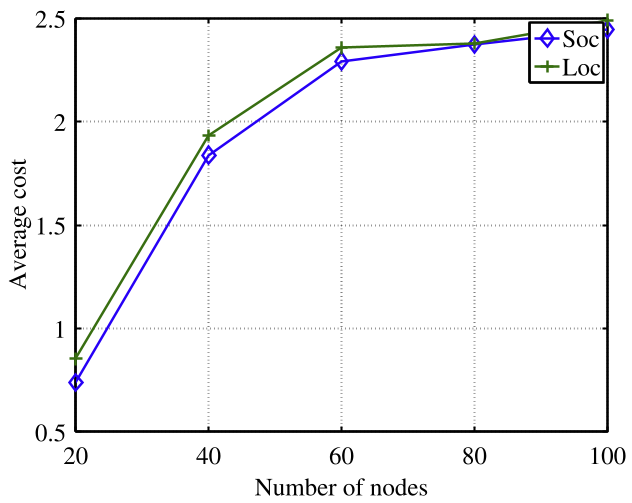 Figure 2: Delivery ratio comparison on synthetic traces showing Soc (Social) slightly outperforming Loc (Location).
Key Findings:
- Delivery Ratio: Soc often slightly outperformed Loc by ~3% in synthetic traces.
- Complexity: Loc requires exchanging large lists of GPS coordinates, making it "heavier" in terms of communication overhead than Soc’s simple friend lists.
- Scalability: As network density increases, social information becomes even more effective at finding destinations than physical distance.
Critical Insight & Conclusion
Why does social information work just as well as (or better than) GPS? The physical world is just a manifestation of social intent. We go to locations because of our social roles (work, school, home).
The Takeaway: We no longer need to risk user privacy by tracking coordinates for the sake of network efficiency. Logical social identifiers—who you meet and how often—are sufficient "anchors" for data routing.
Future Outlook: This work paves the way for "Social-Only" networking protocols that are inherently more private and computationally lighter than their GPS-dependent predecessors.