
Rethinking the Smart Closet: Moving from AI Agents to Social Currency
Rethinking the smart closet as an opportunity to enhance the social currency of clothing
The paper introduces ClosetClique, a smart closet prototype that merges RFID-tagged physical garments with a social networking interface (Facebook). It shifts the focus of ubiquitous computing from automated recommendation agents to supporting the "social currency" of clothing, particularly for young women aged 18-25.
TL;DR
Is your closet "smart" enough to help you maintain your friendships? This paper argues that the next generation of smart closets shouldn't tell you what to wear—instead, it should help you borrow, loan, and share your style with your social circle. By combining RFID-tagged clothing with a Facebook-integrated mirror, the authors move away from "fashion AI" and toward a system that treats clothing as a vital social currency.
Problem & Motivation: The Identity Crisis of Smart Tech
For years, the Ubicomp community has tried to build "Magic Mirrors" and "Fashion Recommenders." These systems typically use machine learning to tell a user if their outfit matches. However, the authors of this paper—drawing from deep ethnographic roots—argue that this misses the point.
Clothing isn't just a utility; it’s an extension of the self. Young women don't necessarily want a computer "chastising" their style. They want to know: “Does this match the level of formality my friends are wearing to the party?” or “Can I get my favorite scarf back from my sister without an awkward confrontation?” Existing work failed because it prioritized algorithmic agency over human social agency.
Methodology: Speed Dating and Material Culture
To bridge the gap between material objects and virtual networks, the team conducted a "Speed Dating" study, presenting 10 provocative scenarios to participants. This wasn't about finding the "best" UI; it was about finding which technologies people actually wanted in their private lives.
The Principles of Design:
- Agency over Automation: Rejecting the "Emperor's New Clothes" paradox, the authors found users preferred human feedback (friends on Facebook) over computer-generated advice.
- Material Culture: Utilizing the theories of Daniel Miller, they viewed the closet as a site of identity construction.
- The Mirror Hardware: A portrait-oriented touch display with a hidden camera and a UHF RFID reader.
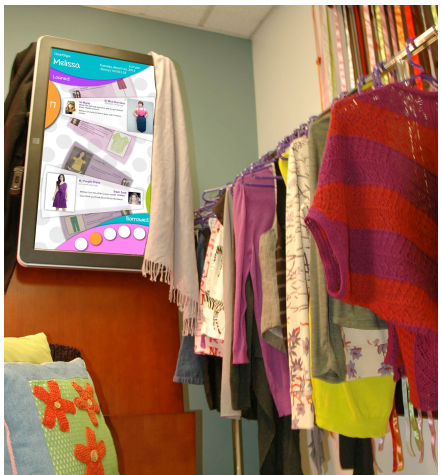 Figure 1: The ClosetClique hardware mirror and its flexible, washable RFID tags.
ClosetClique: How It Works
The system, built on the Adobe Flex framework and the Facebook Graph API, creates a digital twin of a physical wardrobe.
- Garment Tagging: Washable Fujitsu tags are attached to clothes, rated for 3 years or 200 cycles.
- Social Polling: Instead of an AI saying "that looks good," the user posts a photo to a dedicated Facebook album to get "Likes" and comments directly on the mirror interface.
- The "Loan" Mechanism: This is perhaps the most socially innovative feature. The system tracks who has borrowed what. If a return is overdue, the closet acts as the "social agent," sending a nudge to the friend, which removes the awkwardness of the owner having to ask for it back personally.
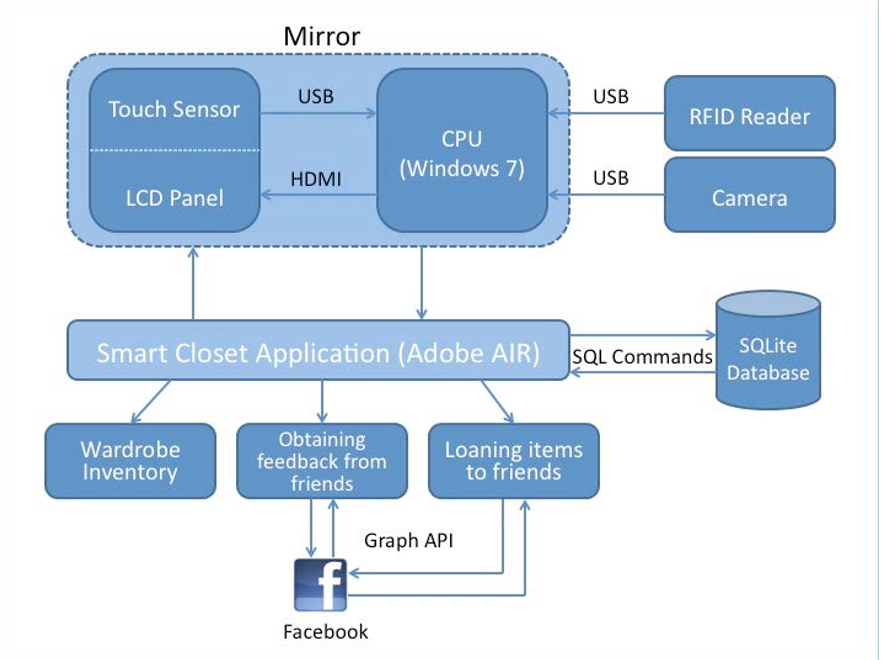 Figure 2: The underlying system diagram connecting the physical mirror to the digital social graph.
Experiments & Social Insights
The qualitative findings were striking. While participants were "creepy-ed out" by long-term data tracking of their habits, they were highly enthusiastic about technology-mediated social interactions.
- Privacy is Contextual: Users wanted absolute control over who saw what. Sharing was seen as "scaling the self" to include friends.
- Aversion to Critique: Participants explicitly stated they didn't want a "smart" closet to take away their creative practice of building an outfit.
 Figure 3: The interface for loaning items and sharing outfits on Facebook.
Critical Insight: The "Social" in Social Computing
The real takeaway from this study is that "Ubiquitous Computing" shouldn't always mean "Smart." Sometimes, it means "Connected." By refusing to build a recommender agent and instead building a communication bridge, the authors respected the users' expert knowledge of their own identities.
Limitations & Future Work
The study focused on a specific demographic (18-25 year old women). Future research must investigate if these same social currencies apply to men or different age groups, and how privacy taboos (like having a camera in one's bedroom) can be balanced against the benefits of a digitally-tracked wardrobe.
Conclusion
ClosetClique demonstrates that the value of the Internet of Things (IoT) isn't just in "things" that talk to us, but in "things" that help us talk to each other. By grounding technical design in Material Culture Theory, we can build technologies that enhance our social lives rather than just automating them.