
Facebook for Retirees: Beyond Socializing to Wellness and Connection
Retirees on Facebook: can online social networking enhance their health and wellness?
This paper presents a nationwide survey analysis investigating whether online social networking sites (SNSs), specifically Facebook, can mitigate social isolation and enhance the well-being of retirees (adults over 55). It identifies family persuasion as the primary driver for adoption and highlights psychological barriers among non-users.
TL;DR
As "aging in place" becomes a global standard, social isolation poses a severe threat to senior health. This study investigates if Facebook can bridge the gap. While adoption is growing, the research reveals that retirees use the platform primarily for family connection, and simply "being on Facebook" isn't enough to boost Quality of Life—how they use it matters more.
Background: The Social Isolation Epidemic
Social isolation isn't just a mental health hurdle; it's a physical one. Weak social ties are linked to higher mortality, increased blood pressure, and cardiovascular risk. For retirees, the abrupt loss of workplace interaction combined with mobility issues creates a "perfect storm" for isolation. Can digital spaces like Facebook serve as a virtual "community center" for those aging at home?
The Research Insight: Why Do Seniors Log On?
The authors posit that unlike younger users who use SNS for identity construction or broad peer networking, seniors are driven by intergenerational maintenance. The survey (N=168) aimed to find the "missing link" between SNS activity and the Life Satisfaction Index (LSI).
Methodological Approach
The study utilized a random national sample of US adults aged 55+, measuring:
- Quality of Life (QoL): 33 items adapted from the Life Satisfaction Index.
- Facebook Intensity: The level of integration of Facebook into daily life.
- Motivations: Qualitative analysis of why non-users stay away.
Methodology & Architecture of Use
The study identified 19 distinct Facebook activities to determine which specific behaviors influenced well-being.
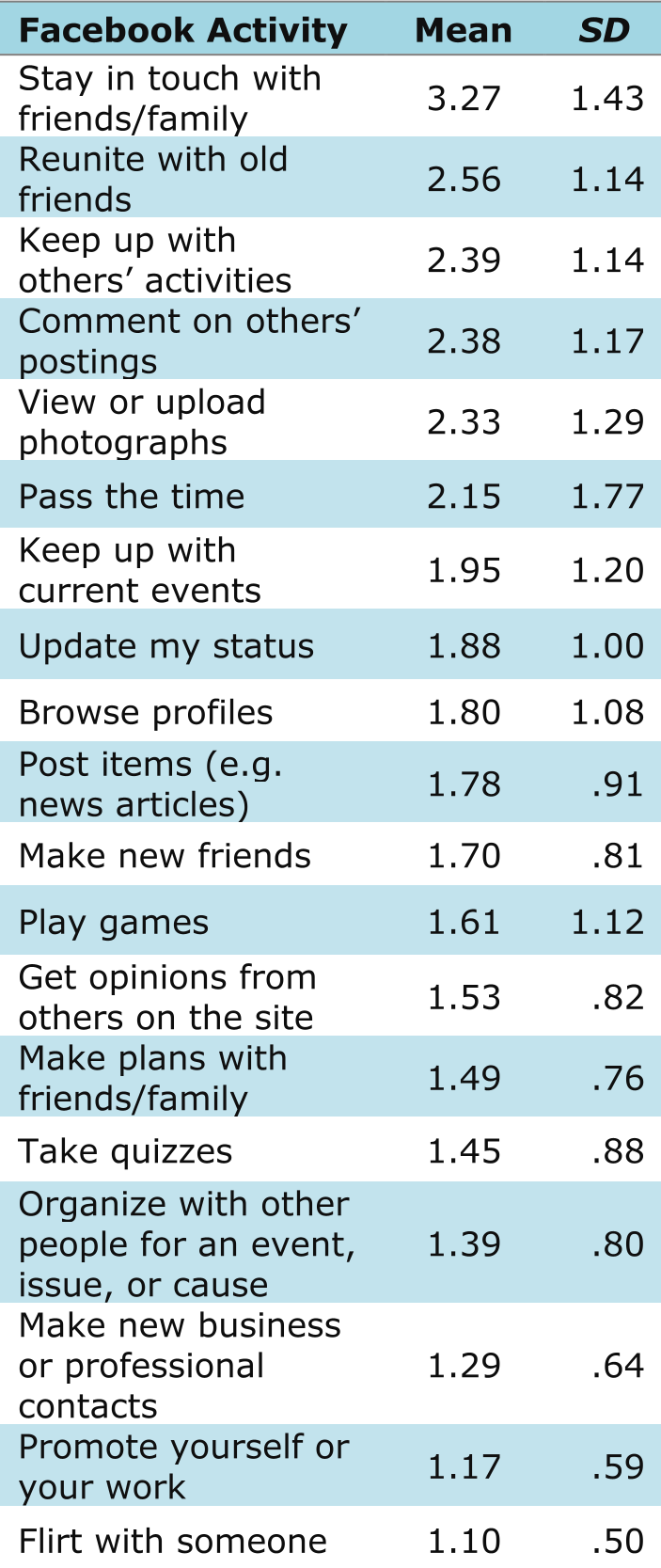
The methodology suggests a divergence from youthful usage: the top activity was "Staying in touch with family" (M=3.27), while "Making new friends" or "Self-promotion" ranked significantly lower.
Experimental Results: A Reality Check
The data provided a nuanced, if somewhat counter-intuitive, look at SNS impact:
- No "Magic Bullet" Effect: General Facebook use, frequency, and intensity showed no statistically significant correlation with overall Quality of Life.
- The Negative Correlation: Interestingly, using Facebook to "Reunite with old friends" (r = -0.47) and "Pass the time" (r = -0.39) were associated with lower QoL. This suggests that using the platform for nostalgia or to fill empty hours may be a symptom of existing loneliness rather than a cure.
- The "Interest" Barrier: 64.4% of non-users cited a "lack of interest" rather than "lack of skill." This indicates that the problem is not a "digital divide" of capability, but a "value divide" of perceived utility.
Critical Analysis: Design for the Family, Not the "Feed"
The most striking finding is the role of family. Non-users stated that only family influence (e.g., a child or grandchild using the platform) would convince them to join.
Limitations & Future Work
The study was limited by the relatively high baseline QoL of its participants and a small sample of active Facebook users (N=34). However, it sets the stage for "Human-Centered Computing" that prioritizes wellness:
- Interface Design: SNS should move away from the "infinite scroll" of news and toward "family hubs."
- Smart Homes: Integrating SNS into the "Smart Home" framework could provide a vital link for those with limited mobility.
Conclusion
For the tech industry, the takeaway is clear: the elderly are not just "slow learners" of existing tech; they are a distinct user group with specific psychosocial needs. To enhance the wellness of retirees, Facebook and its successors must transform from "social networks" into "intergenerational bridges."