
Automated Definitional Content Extraction: Moving Beyond "X is a Y"
Retrieving definitional content for ontology development
This paper introduces an automated machine learning approach to identify "definitional content" within expert scientific writing, specifically molecular biology textbooks. By training a Naive Bayes classifier on sentences mapped to glossary definitions using an Inverse Frequency Similarity Measure (IFSM), the system ranks sentences based on their likelihood of containing defining information for specific terms.
TL;DR
Researcher W.J. Wilbur and colleagues developed a machine learning framework to identify definitional content in expert textbooks. Instead of relying on rigid, hand-coded rules, they used a Naive Bayes classifier to rank sentences by their "definitional probability." By training on existing glossaries, the system learned to recognize the subtle linguistic cues experts use to explain complex concepts.
Background: The Ontology Bottleneck
Building an ontology—a formal specification of a domain's knowledge—requires a deep understanding of terminology. While dictionaries exist, expert writing often contains nuances, new terms, or functional descriptions not found in standard lexicons. The challenge lies in the "Ontology Bottleneck": manually searching through thousands of pages of text to find where a term is best explained is labor-intensive and error-prone.
The Motivation: Why Rules Fail
Previous systems like DEFINDER or DefScriber relied on "Surface Patterns"—essentially "if-then" rules for language. For example, if a sentence follows the pattern [Term] is a type of [Category], it is flagged as a definition.
However, scientific prose is rarely that simple. Experts often define things functionally or through illustrative examples. The authors realized that definitional content is a spectrum, not a binary toggle. They shifted the focus from finding the definition to calculating the probability that a sentence contains valuable explanatory material.
Methodology: Learning the "Shape" of a Definition
The researchers transformed the problem into a supervised learning task using two key innovations:
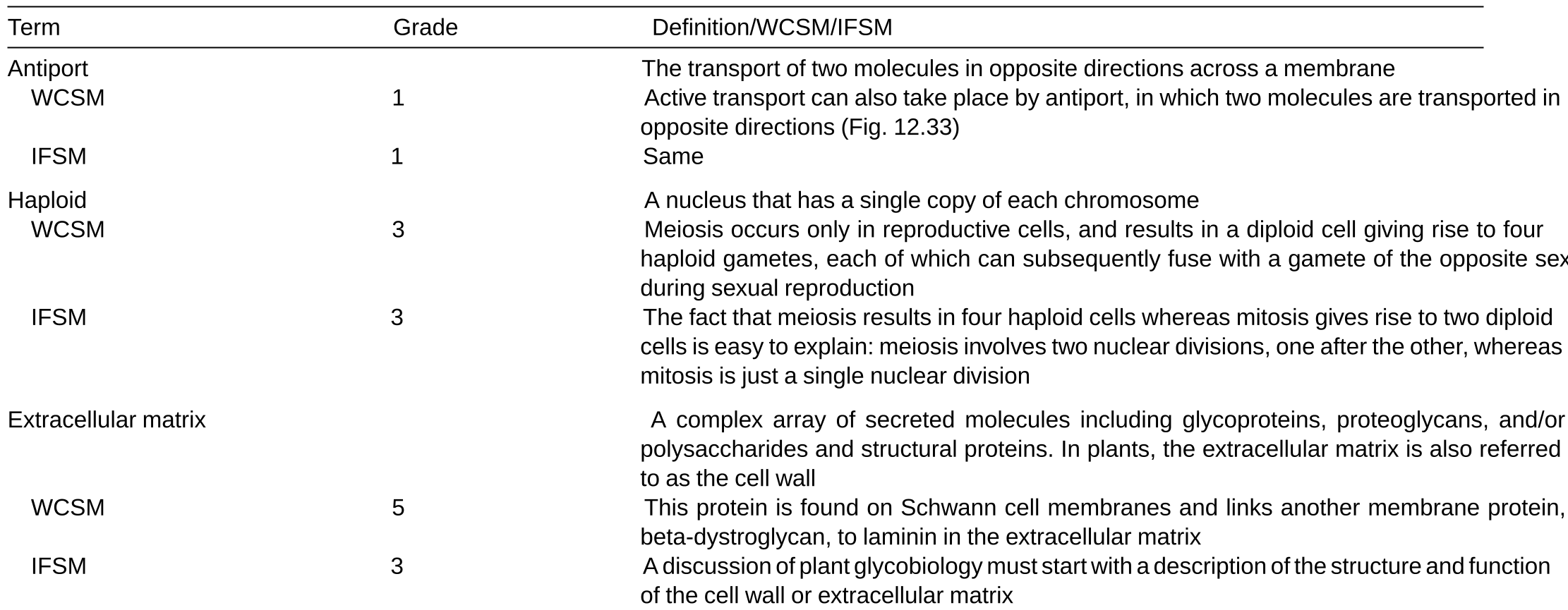
- Automated Silver-Standard Labeling: They used an Inverse Frequency Similarity Measure (IFSM) to automatically match textbook sentences to existing glossary definitions. This created a labeled dataset without requiring experts to manually grade 65,000+ sentences.
- Generic Feature Engineering: To prevent the model from just "memorizing" specific biological terms, they replaced head terms with a placeholder: NPT (Noun Phrase Term). This allowed the model to learn that "NPT is the process of..." is a definitional structure, regardless of whether NPT is "Mitosis" or "Glycolysis."
Analyzing the Results
The system proved highly effective at distinguishing high-value sentences from "noise." In a manual evaluation of 15 different biological terms (like Bicoid, Mendel, and Profilin), the top 10 sentences ranked by the model contained significantly more "definitional nuggets" than the bottom 10.
| Term Category | Top 10 Rank Hits | Bottom 10 Rank Hits |
|---|---|---|
| Total Nuggets | 82 | 41 |
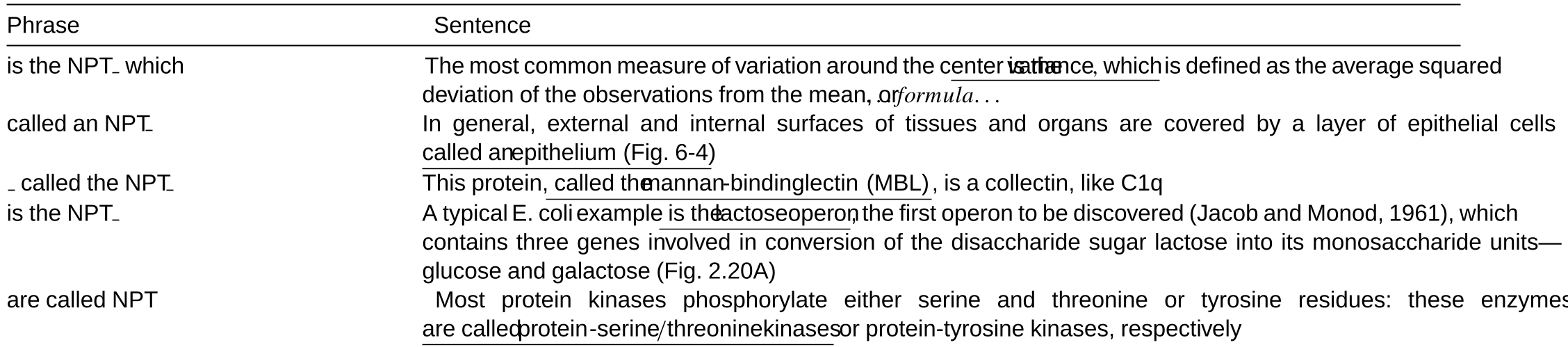
Interestingly, the model identified patterns that go beyond the obvious. While the word "called" remained a strong indicator, phrases like is the NPT_ which and are called NPT were mathematically surfaced as high-weight features for defining content.
Deep Insights & Future Outlook
The "unlabeled" method—ranking sentences without knowing the term beforehand—showed that definitional language has a universal "flavor." Even without specific term labels, the model could identify where definitions were happening in the text.
Limitations:
- Anaphora Resolution: The system struggles when a definition refers back to a term using "it" or "this process" (anaphoric references).
- Granularity: The current unit of analysis is a single sentence, but many great definitions span multiple paragraphs.
Takeaway for the AI Era: This 2004 work mirrors the logic of modern LLM "probabilistic" approaches. It reminds us that for specialized domains (like Medicine or Law), the most valuable knowledge often lies in how experts use words in context, rather than how a dictionary prescribes them.