
Digital Ostension: Why Retweets Are More Than Just Accidental Agreements
Retweeting: its linguistic and epistemic value
This paper provides a systematic linguistic and epistemic analysis of retweeting on social media. It rejects the "endorsement hypothesis" in favor of a "quotation hypothesis," modeling retweets as a form of digital ostension that functions like "quoting by indicating."
TL;DR
Is a retweet an endorsement? While we often treat it as one, philosopher Neri Marsili argues that retweeting is actually a unique form of "quoting by indicating." By leveraging Relevance Theory, the paper explains that retweets are "digital windows" that point to content without necessarily asserting its truth, creating a loophole of plausible deniability that helps misinformation go viral with minimal social cost.
The "Endorsement" Myth vs. Linguistic Reality
The common intuition is the Endorsement Hypothesis: if you retweet it, you believe it. However, the author identifies two major flaws in this logic:
- Negotiability/Cancellability: Unlike saying "I agree," users can (and do) include disclaimers like "RT is not an endorsement" or claim they were just "sparking a conversation." In formal linguistics, if an act were an explicit assertion of agreement, such denials would be Moorean paradoxes (nonsensical), yet in social media, they are common defensive maneuvers.
- Non-Sentential Content: You cannot "agree" with a photo of a kitten or a nonsensical meme (like Trump's famous "covfefe" tweet). Since people retweet these regularly, retweeting must be a broader communicative act than mere endorsement.
Methodology: Retweeting as Quoting by Indicating
The paper proposes a more robust model: The Quotation Hypothesis. Specifically, retweeting is a form of Digital Ostension.
The Architecture of a Retweet
Unlike traditional quotation (which might involve paraphrasing), a retweet is "transparent." You interact with the original through the repost.
- Indicating: It’s like pointing at a billboard. You aren't remaking the billboard; you are directing attention to it.
- Attribution: The platform automatically attributes the content to the Original Poster (OP), but this is often a secondary concern for the retweeter.
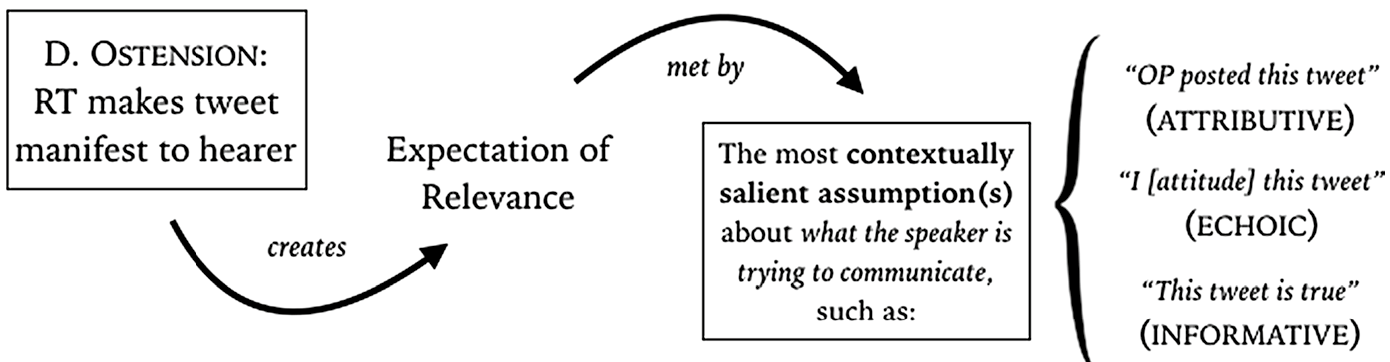 Figure 1: The variety of ways retweets achieve relevance, from mere attribution to echoic uses and implied assertion.
Why Misinformation Loves the Retweet
The paper’s most striking contribution is the analysis of Epistemic Value. Why do fake news stories outperform mainstream news in "cascades"?
- Low Cognitive Cost: Retweeting takes two clicks. It requires no thought, no synthesis, and often, no reading (15% of shared links are never clicked).
- Reputational Safety: Because a retweet is "just a quote," the retweeter enjoys a lower standard of accountability. If the news is fake, they can claim they were just "showing what others are saying."
- The Relevance Guarantee: According to Relevance Theory, every act of communication implies that the content is worth the audience's time. In "informative retweets," the most salient reason for relevance is that the content is true. This creates a dangerous gap: the audience assumes truth, but the speaker can deny intending it.
Critical Insight: The Ghost of the Misleader
Marsili likens the deceptive retweeter to a misleader rather than a liar. A liar says something false; a misleader carefully chooses their words (or reposts) so the audience infers something false. Because the "force" of a retweet is inferential and context-dependent rather than literal, social media platforms have inadvertently built a "misleading machine."
Conclusion: Toward Digital Epistemology
The "fake news pandemic" isn't just about bad actors; it’s about the linguistic architecture of our platforms. By making communication "cheap" (low practical and reputational cost), we have created a environment where unverified rumors behave like pathogens. To fix digital discourse, we must first understand that a retweet is a window—and windows can be used to observe the truth or to distort it.
Takeaway: The next time you see a controversial retweet, remember: the user is not asserting a fact; they are performing an act of ostension. They are pointing a finger, but they are not always standing behind the message.