
RCAM: Decoding the Pulse of Information Diffusion in Social Networks
Retweeting Prediction Using Meta-Paths Aggregated with Follow Model in Online Social Networks
This paper introduces a retweeting prediction framework that utilizes the "Follow Model" and "Relationship Commitment Adjacency Matrix" (RCAM) to model complex user interactions in Online Social Networks (OSNs). By defining three specific meta-paths and employing Conditional Random Fields (CRF), the method achieves a prediction precision of over 61% and recall over 58% on Sina Weibo datasets.
TL;DR
Predicting who will retweet a message is a cornerstone of understanding digital influence. This paper presents a novel framework using the Follow Model and Relationship Commitment Adjacency Matrix (RCAM) to map complex social ties. By applying Conditional Random Fields (CRF) to specific social "meta-paths," the authors achieved significant gains in predicting retweeting behavior on the Sina Weibo platform.
Background Positioning: This work bridges the gap between formal graph theory and behavioral social science, moving from simple connectivity to "relationship commitment" modeling.
The Core Motivation: Beyond Simple Graphs
Traditional graph theory treats nodes and edges as binary entities (connected or not). However, in the ecosystem of Online Social Networks (OSNs) like Weibo or X (Twitter), a connection can mean many things: you might follow someone (followee), they might follow you (follower), or you might be mutual friends (r-friends).
The authors argue that current SOTA methods often overlook the semantic depth of these connections. Their insight is that retweeting is not just a function of who you follow, but a result of three distinct behavioral triggers:
- Concern: Retweeting someone you specifically track.
- Similarity: Retweeting because people similar to you did.
- Reciprocity: Responding to mentions or similar interests.
Methodology: The Architecture of RCAM
The heart of the paper lies in the transformation of the Follow Model into a computational matrix format.
1. Relationship Commitment Adjacency Matrix (RCAM)
Instead of a single matrix, the authors define:
- (Follower Matrix): Represents who follows whom.
- (Followee Matrix): The transpose of , representing the reverse relationship.
- (Mention Matrix): Specifically captures the "mention" (@) activity.
By using matrix operations like , the model can mathematically "hop" through the network to discover 2-step or 3-step relationships (e.g., followers of followers).
2. Meta-Paths: The Behavioral Logic
The authors define three meta-paths to feed into the CRF model:
- Path 1 (Concern): (User retweets because they are directly connected).
- Path 2 (Similarity): (User retweets because their followees/friends did).
- Path 3 (Response): (User retweets because they have a history of retweeting people similar to ).
Experiments and Results
The framework was tested on a massive dataset from Sina Weibo (58.66 million users), specifically focusing on a subset related to the "Steve Jobs" topic to ensure content relevance.
Performance Comparison
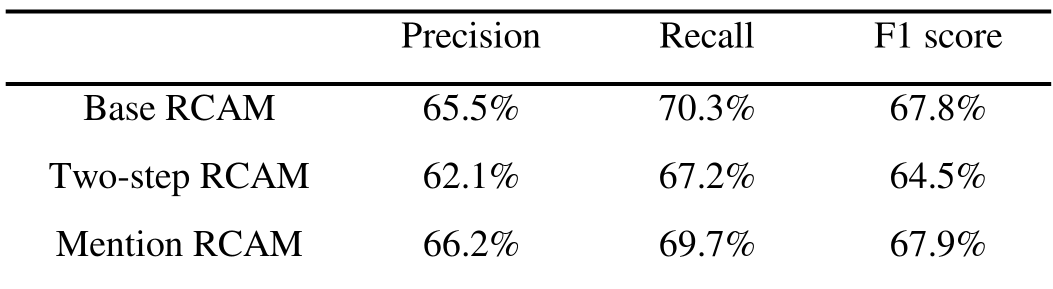
The authors compared three variations of their RCAM approach:
| Method | Precision | Recall | F1 Score |
|---|---|---|---|
| Base RCAM | 65.5% | 70.3% | 67.8% |
| Two-step RCAM | 62.1% | 67.2% | 64.5% |
| Mention RCAM | 66.2% | 69.7% | 67.9% |
Key Discovery: The Mention RCAM outperformed others. This suggests that being "mentioned" in a tweet is one of the strongest social cues for engagement, even stronger than 2-step friend relationships.
Critical Analysis & Conclusion
Takeaway
The RCAM approach successfully formalizes the "Follow Model" into a structure that machine learning algorithms (like CRF) can digest. It proves that social context (who mentioned whom) is more valuable than raw network distance.
Limitations
- Complexity: Matrix multiplication (e.g., ) has a complexity of . While powerful, this is computationally expensive for networks with millions of nodes.
- Data Sparsity: The Two-step RCAM performed slightly worse than the Base model, which the authors attribute to the "incomplete" nature of social graph data where many indirect ties are hidden.
Future Outlook
The authors suggest moving toward Singular Value Decomposition (SVD) and matrix completion to handle missing data and reduce dimensionality. This points toward a future where we can predict information viralness even with highly fragmented social data.