
To Reveal or Not To Reveal: Solving the OSN Privacy-Benefit Paradox with Integer Programming
8134_To reveal or not to reveal balancing user-centric social benefit and privacy in online social networks.
The paper introduces an Integer Programming (IP) based model to optimize Online Social Network (OSN) privacy settings. It balances the trade-off between maximizing social capital (Social Benefit) and minimizing exposures to Identity Theft or Stalking (Privacy Risks) using "Harm Trees."
TL;DR
Navigating privacy settings on platforms like Facebook is a cognitive minefield. This paper presents a formal Integer Programming (IP) model that acts as a "Privacy Consultant." It weighs the Social Benefit (making friends, professional networking) against Privacy Harms (stalking, identity theft) to suggest the mathematically optimal privacy settings for every attribute on your profile.
The Problem: The Cognitive Gap in Privacy
Most users are "privacy-concerned" but not "privacy-experts." We understand that sharing our phone number is risky, but we might not realize that sharing our Birth Year + Education Place + Hometown is often sufficient for an attacker to perform a high-confidence Identity Theft.
Current systems fail because:
- Complexity: Combinatorial explosions of settings are too much for human processing.
- Imbalance: Protective measures often ignore the utility of the platform, leading users to either over-expose themselves or abandon the network (social isolation).
Methodology: The "Harm Tree" Meets Linear Optimization
The researchers built their model on two pillars: Harm Trees and Social Benefit Evaluation.
1. Harm Trees (The "Why" of Risk)
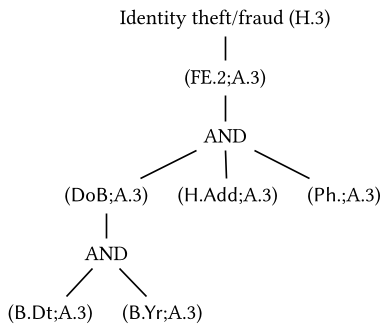
A Harm Tree decomposes a high-level threat (e.g., Stalking) into the specific combinations of attributes required to execute it.
- Logic: If "Stalking" (H.1) requires either [Gender OR Age] AND [Workplace OR Home Address], the model treats this as a logical constraint.
- Conversion: To use these in an IP solver, boolean logic (AND/OR) is converted into linear integer equations.
2. Social Benefit (The "Why" of Sharing)
Sharing isn't just vanity; it builds Social Capital. The authors categorize benefit into four criteria:
- SB.1: Connecting with offline friends (requires public searchability).
- SB.2: Intensifying existing friendships (requires sharing interests/views).
- SB.3/4: Establishing new ties within or outside common circles.
3. The IP Optimization Loop
The objective function is simple but powerful: Subject to:
- Privacy Constraints: (Calculated Risk User's Tolerance Threshold).
- Consistency Constraints: (If a stranger can see it, a friend must also be able to see it).
Experimental Insights: Better Than Human Choice
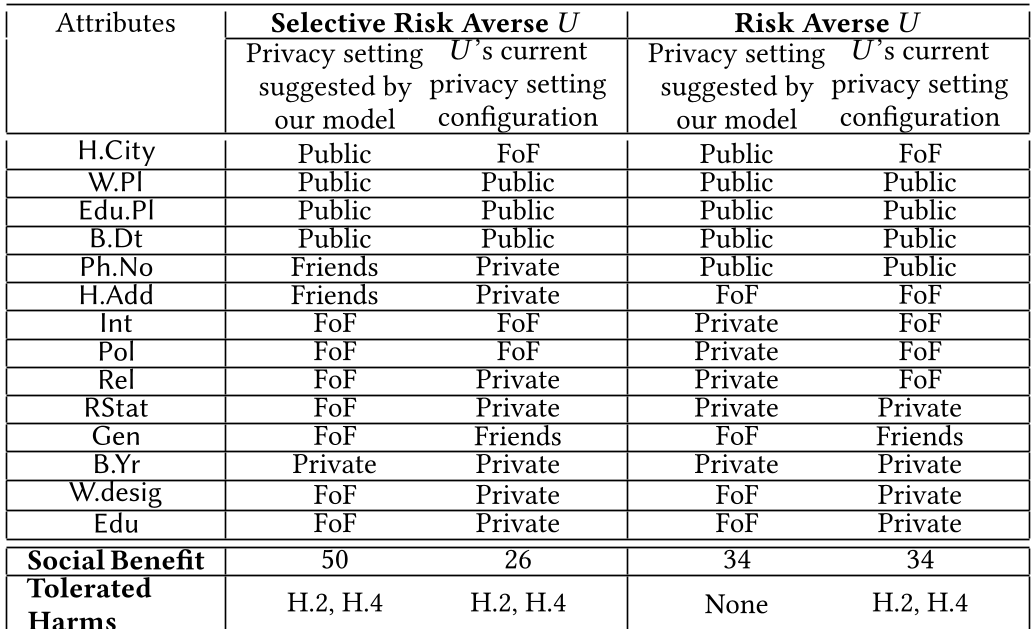
The authors tested the model using the CPLEX Optimizer. They compared a user's "current manual settings" against the "suggested settings."
Key Findings:
- Selective Risk Aversion: The model helped users increase their Social Benefit score from 26 to 50 while maintaining the same level of risk.
- Risk Aversion: For users wanting zero risk, the model found settings that provided a Social Benefit of 34, whereas the user’s original settings had the same benefit but left them exposed to two major harms.
Critical Analysis & Conclusion
This work moves privacy from a "vague feeling" to a "measurable optimization problem." By quantifying the benefit of sharing, it acknowledges the reality of OSN usage.
Limitations:
- Static Scope: It focuses on profile attributes (static data) rather than the dynamic stream of posts and photos where most modern privacy leaks occur.
- Inference Attacks: It relies on pre-defined harm trees; it might not account for "zero-day" inference techniques where AI connects seemingly unrelated dots.
The Takeaway: Future social networks should integrate "Privacy Success Scores" based on this type of IP modeling, moving the burden of security from the user's intuition to the platform's algorithms.