
Unmasking the Syndicate: Revealing Spammer Social Networks via Spectral Clustering
Revealing Social Networks of Spammers Through Spectral Clustering
This paper investigates the social structures of spammers by applying Spectral Clustering to the "harvesting phase" of the spam cycle. By utilizing Project Honey Pot data, the authors identify communities of harvesters based on shared spam server usage and temporal behavioral patterns.
TL;DR
While most anti-spam tools play a game of "cat and mouse" with email content, this research targets the social structure of the adversaries themselves. By applying Spectral Clustering to data from Project Honey Pot, the authors discovered that harvesters (the bots that steal your email) form highly coordinated communities that share infrastructure like IP addresses and spam servers. The result? We can now identify entire syndicates of phishers by their behavioral "fingerprints" rather than just their messages.
Problem & Motivation: The Hidden Phase of Spam
The "Spam Cycle" consists of two main phases:
- Harvesting: Acquiring email addresses (via bots or web scraping).
- Spamming: Sending the actual emails.
Historically, spammers have been incredibly careful to hide their identities during the spamming phase using proxies and compromised relays. However, the authors observed an critical oversight: spammers are much less cautious during the harvesting phase.
Existing SOTA methods focus on filtering IP addresses or analyzing text, but they fail to capture the underlying social network. If Spammer A and Spammer B use the same harvesting bot or the same set of "rogue" servers, they are likely part of the same organization. This paper aims to map these relationships.
Methodology: The Geometry of Spammer Behavior
The researchers treated the collection of harvesters as a graph where nodes are harvesters and edges represent behavioral similarity. To find "communities," they utilized Spectral Clustering.
1. Defining Similarity
The authors proposed two ways to measure if two harvesters are "friends":
- Spam Server Usage: Do Harvester A and Harvester B provide addresses to the same spam servers? The authors normalized this using a coincidence matrix to ensure that sharing a rare server is a "stronger" link than sharing a common one.
- Temporal Similarity: Do the harvesters operate at the same time? By binning email counts into 1-hour intervals, they created a temporal signature for every actor.
2. The Clustering Engine
Spectral clustering was chosen because it excels at finding clusters in non-convex manifolds by solving the Normalized Cut (Ncut) problem. Instead of looking at simple distances, it looks at the "conductance" of the graph—partitioning nodes so that links within a group are maximized while links between groups are minimized.
 Figure 1: The spam path from harvester to recipient.
Experiments & Results: The Phisher Specialization
The authors analyzed data from October 2006, a period of massive spam outbreaks.
Key Finding 1: Phishers are Specialists
The study found that harvesters are rarely "generalists." About 77% send almost no phishing emails, while 14% focus almost exclusively on phishing. Only a tiny 9% do both.
Key Finding 2: Community Isolation
When clustering by server usage, phishers naturally grouped into small, tightly-knit communities. This suggests that phishing operations are smaller, highly professional cells that share expensive or specific infrastructure.
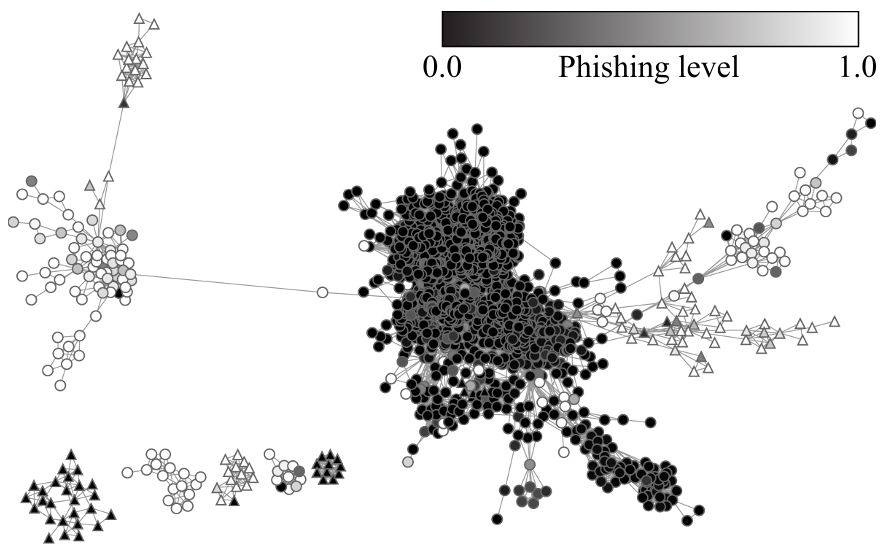 Figure 2: Clustering results showing how phishers (red) separate from non-phishers (blue).
Key Finding 3: The McColo Connection
The temporal analysis revealed a specific cluster of 10 harvesters with a correlation coefficient of 0.988. These actors were all using IPs from McColo Corp, a notorious rogue ISP that was eventually shut down for its role in global spam. This proves the method can identify real-world malicious entities before they are officially blacklisted.
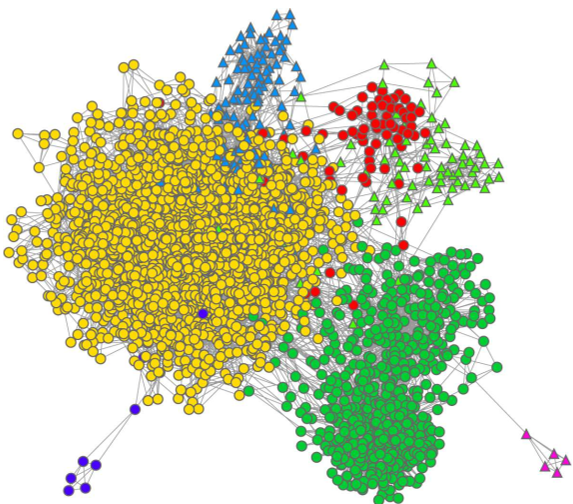 Figure 3: Temporal clustering revealing highly coordinated groups (top right triangles).
Critical Analysis & Conclusion
Takeaway: This work represents a shift from "Content-Centric" to "Actor-Centric" defense. By revealing that spammers share resources in highly predictable ways, the authors provide a framework for preemptive blocking.
Limitations:
- Time-Varying Dynamics: Spammers may change their behavior monthly. The paper analyzes data in monthly bins, but modern adaptive spammers might rotate resources even faster.
- Data Source Dependence: The results rely on Project Honey Pot trap addresses. In a world of social media and API-based data leaks, harvesting methods have significantly evolved beyond simple web crawling.
Future Outlook: The integration of Graph Neural Networks (GNNs) could potentially replace the spectral methods used here, allowing for real-time community detection as new spam data arrives.
Technical Editor's Note: This paper remains a foundational example of how spectral graph theory can be applied to cybersecurity to reveal the "who" behind the "what."