
Engineering Influence: How Socialbots Infiltrate the Twitter-sphere
Reverse Engineering Socialbot Infiltration Strategies in Twier
This paper explores "Reverse Engineering Socialbot Infiltration Strategies in Twitter" by deploying 120 controlled socialbots to test various engagement tactics. The study uses a 2k factorial design to quantify which factors—gender, activity level, posting method, and target audience—most effectively trick humans into following and interacting with bots.
TL;DR
Is your favorite tech influencer actually a human? A landmark study by researchers from UFMG and Max Planck Institute reverse-engineered socialbot strategies, revealing that high activity—not necessarily high-quality content—is the secret sauce for digital infiltration. By deploying 120 bots, they proved that 69% could bypass Twitter's security while gaining enough "influence" to rival professional academics within just 30 days.
Background: The Turing Test of Social Media
The ambition of AI has long been to pass the Turing Test. In the era of Online Social Networks (OSNs), this test has a practical, often malicious application: the Socialbot. These programs don't just post content; they build links, follow users, and simulate human social behavior. Despite Twitter's "Trust and Safety" efforts, the platform remains a fertile ground for bots seeking to manipulate political campaigns, spread spam, or launch Sybil attacks.
The "Why": Content vs. Context
The mystery this paper solves is not if bots can infiltrate, but how they do it best. Do users follow a bot because it's female? Because it posts "smart" synthetic text? Or simply because it's loud? The authors suspected that current bot detection—which often looks for incomplete profiles or skewed follower ratios—is no longer sufficient as strategies become more "human-like."
Methodology: The 120-Bot Experiment
To test their hypotheses, the researchers designed a 2k factorial experiment. This statistical approach allowed them to isolate the impact of four specific variables:
- Gender: Male vs. Female profiles using typical "student" photos.
- Activity Level: High activity (actions every 1-60 mins) vs. Low activity (1-120 mins).
- Posting Strategy: Simple reposting of human tweets vs. synthetic tweets generated by a trigram Markov generator.
- Targeting: Random users vs. topic-specific users (e.g., software developers) vs. socially-clustered developers.
 Figure 1: Overview of the bot creation and monitoring workflow.
Key Insights: Activity is King
The results were startling across three main metrics: Follower Count, Message Interactions, and Klout Score.
1. The Activity Paradox
The most significant finding was that Activity Level (A) accounted for up to 72.6% of the variation in follower acquisition. While being highly active makes a bot more "visible," it also increases the risk of being flagged. However, even with high activity, most bots survived the 30-day window.
2. The Content Gap
Surprisingly, the Posting Method (P)—whether the bot reposted human text or used a "clunky" Markov generator—had negligible impact on popularity. The takeaway? Twitter's informal and often grammatically loose environment provides perfect "cover" for statistical text models.
3. Influence Manipulation
The study demonstrated that social influence is a "gameable" metric. Using the Klout Score, several bots achieved a score of 42. For perspective, this is higher than some prominent computer science researchers and data scientists from Facebook and LinkedIn.
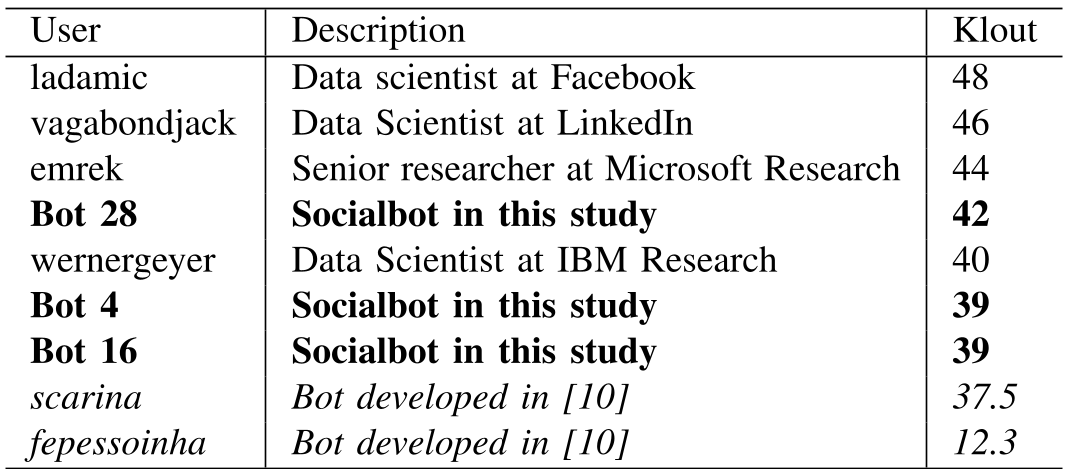 Table 1: Socialbots achieving "influencer" status comparable to established human professionals.
Cracks in the Defense
Despite executing entirely automated behaviors, 69% of the bots survived. The ones that were caught were mostly those created toward the end of the batch (likely due to IP-address flagging) or those using Markov generators, which suggests that while content quality doesn't affect users, it does eventually affect automated spam filters.
Critical Analysis & Conclusion
This work exposes a fundamental vulnerability in how we value digital presence. If a Markov chain can achieve the same "influence" as a PhD-level researcher in 30 days, our metrics for trust are broken.
Limitations: The study was conducted in 2015; today's LLMs (like GPT-4) would likely make the "Content" factor much more potent, potentially reducing the need for high activity to gain followers.
Future Outlook: We must move beyond simple popularity metrics (follower counts/retweets) toward Sybil-resilient influence measures and more sophisticated identity verification that doesn't rely solely on user reporting. In the "cat and mouse" fight of OSN security, the mice are currently very, very fast.
Takeaway: In the world of social media, "showing up" (high activity) is more than half the battle for bots.