
Safeguarding Social Big Data: A Reversible and Keyless Watermarking Approach
A Reversible Watermarking Technique for Social Network Data Sets for Enabling Data Trust in Cyber, Physical, and Social Computing
This paper introduces a novel reversible watermarking technique specifically designed for social network datasets to protect ownership and ensure data integrity. By combining Genetic Algorithms (GA) for numeric features and digram-based hashing and permutations for non-numeric features, the method achieves full data recovery and robust ownership verification.
TL;DR
Social network data is the "new oil," but sharing it risks ownership theft and data degradation. This paper presents a reversible watermarking framework that protects ownership for both numeric and text data without needing a primary key. By leveraging Genetic Algorithms and Digram-based permutations, it achieves 100% data recovery even after massive deletion or insertion attacks.
Background: The Trust Crisis in Social Computing
As social networks grow, organizations like the MIT Human Dynamics Laboratory share massive datasets (e.g., the Reality Commons project) for collaborative research. However, once data is released, two major problems arise:
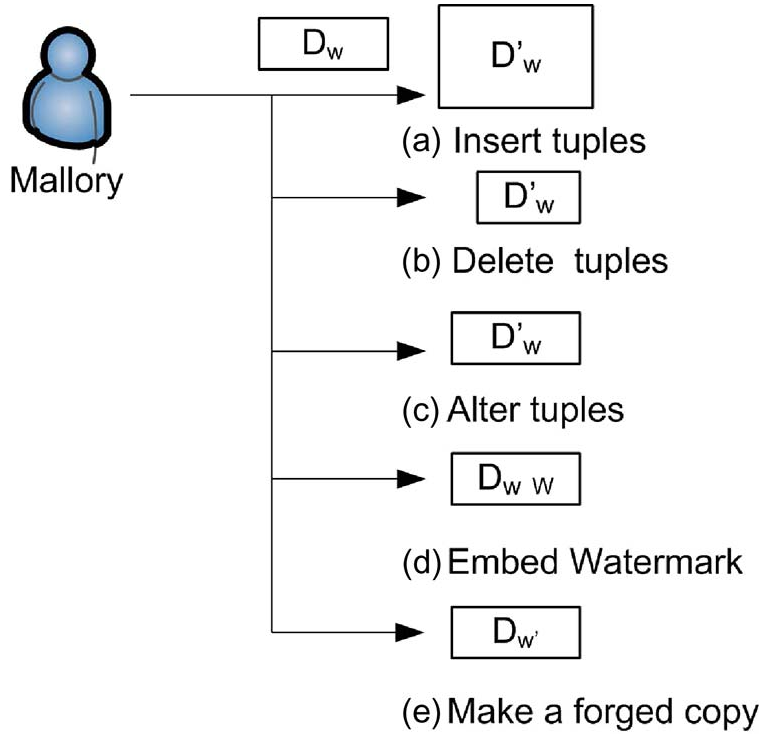
- False Ownership Claims: Malicious actors (Mallory) can claim the data is theirs.
- Information Loss: Existing "robust" watermarks often alter the data permanently, rendering it less useful for precise data mining.
Most prior works were designed for standard relational databases relying on Primary Keys. Social datasets often lack these unique identifiers, making traditional methods inapplicable.
Methodology: The Core Mechanism
The proposed technique introduces a two-pronged approach to handle the diverse data types found in social networks.
1. Numeric Data: Optimization via Genetic Algorithms (GA)
Instead of arbitrary modification, the system uses GA to calculate an optimal embedding value (). This ensures that the watermark is robust enough to survive attacks but subtle enough to be reversible.
- Intuition: The GA searches for a balance where the mathematical "shift" in data values is predictable and detectable.
2. Non-Numeric Data: Hashing and Digram Permutation
For categorical features (like "Role" in a company), the paper uses a Digram Matrix (frequency pairs of characters) and a Permutation Vector ().
- Intuition: By substituting characters based on a secret permutation matrix, the watermark is hidden in the choice of character pairs. Because the owner knows the secret permutation, they can reverse the mapping to get the original text back.
Formal Verification: Mathematically Proven Trust
Unlike many engineering-only papers, the authors include a Z notation-based formal specification. This uses typed set theory and predicate calculus to prove the correctness of the decoding logic and the state transitions of the system, providing a layer of "mathematical proof" for security-critical environments.
Experimental Performance and Resilience
The authors tested the system using the Badge Dataset (tracking organizational behavior). The results are strikingly resilient to "Mallory's" attempts to destroy the watermark.
Analysis of Common Attacks:
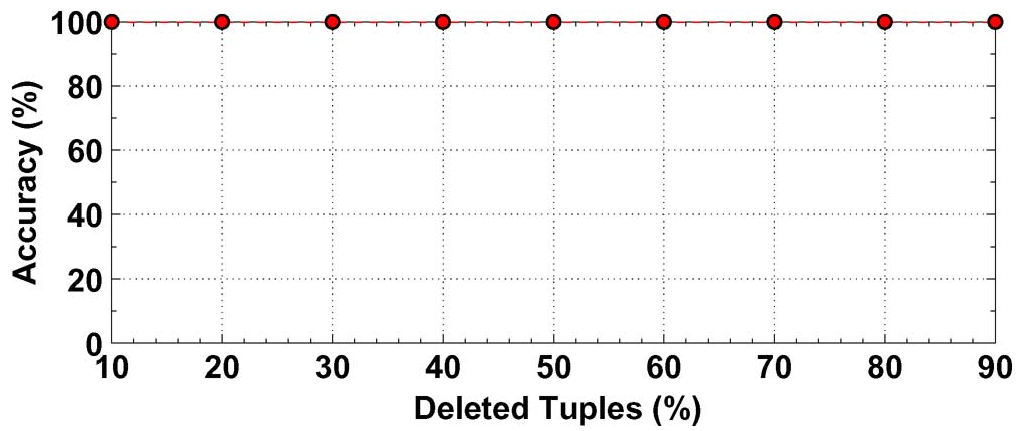
- Deletion Attacks: Even if 90% of the tuples are deleted, the system maintains 100% watermark detection accuracy. This is because the watermark is embedded redundancy across available tuples.
- Insertion Attacks: Adding 100% fake "noise" tuples has zero impact on decoding the original watermark.
- Alteration Attacks: Modifying values of existing tuples showed that original data could still be recovered with high success rates until the majority of the data was corrupted beyond utility.
| Attack Type | Resilience Level | Success Rate (Watermark) | Success Rate (Recovery) |
|---|---|---|---|
| Tuple Deletion | Up to 90% | 100% | High |
| Tuple Insertion | Up to 100% | 100% | 100% |
| Data Alteration | Significant | 100% | > 50% |
Deep Insight: Why This Matters
The real breakthrough here isn't just "robustness"—it's reversibility without identifiers. In a world of Big Data, being able to prove ownership without needing a primary key (which can be easily stripped or changed) is a significant leap for data sovereignty.
Final Takeaways
- For Researchers: The integration of evolutionary computation (GA) with formal verification (Z notation) sets a high bar for methodology.
- For Industry: This provides a path for organizations to share "Big Data" for mining while retaining a "kill switch" or "claim switch" that doesn't ruin the data's scientific value.
Limitations
While highly effective, the computational cost of the GA-based preprocessing means this is best suited for offline watermarking before data release, rather than real-time stream protection.