
Reversible Watermarking: Enabling Perfect Data Trust in Social Computing
A Reversible Watermarking Technique for Social Network Data Sets for Enabling Data Trust in Cyber, Physical, and Social Computing
The paper introduces a novel reversible watermarking technique specifically designed for social network datasets to protect ownership and ensure data integrity. By combining Genetic Algorithms (GA) for numeric data optimization with hashing and permutation for non-numeric features, the method achieves robust ownership verification and 100% data recovery under various attack scenarios.
TL;DR
As social network "Big Data" becomes a primary fuel for modern analytics, protecting ownership without corrupting the data itself has become a critical challenge. This paper presents a reversible watermarking framework that uses Genetic Algorithms and permutation matrices to protect datasets. The result? Owners can prove their rights with 100% accuracy and—crucially—restore the original data to its pristine, pre-watermarked state even after massive malicious attacks.
Background: The Ownership Crisis in Social Mining
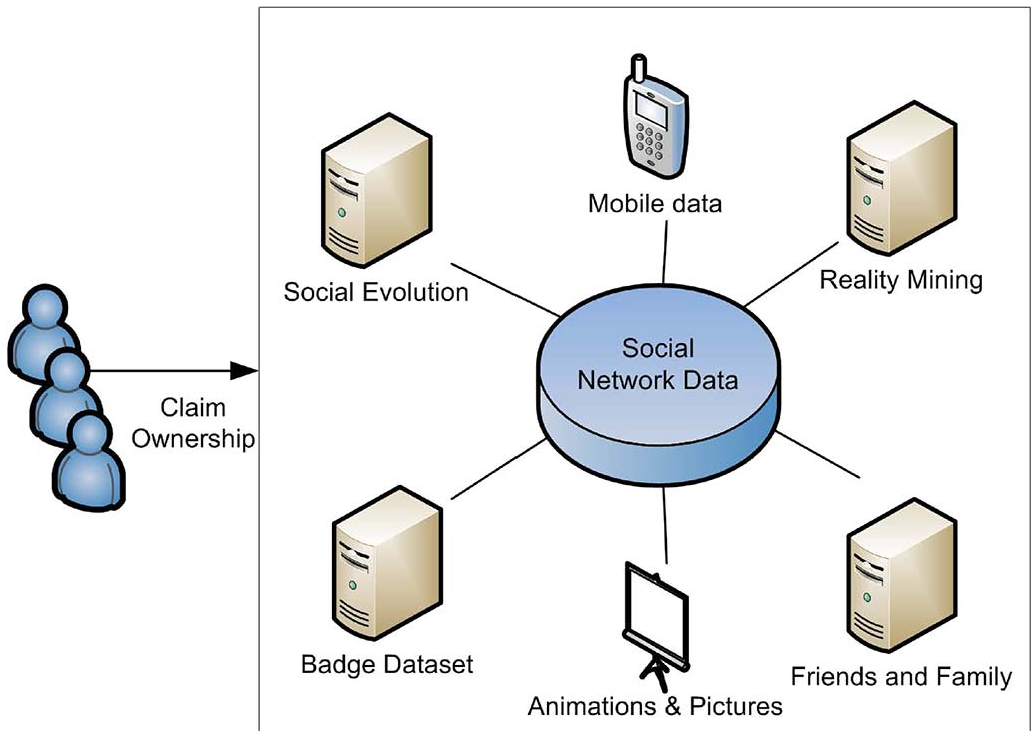
In the ecosystem of Cyber, Physical, and Social Computing (CPSCom), data is the currency. Projects like MIT’s Reality Commons share massive datasets on human behavior, but once this data leaves the owner's server, it is susceptible to "Mallory"—the archetypal adversary who claims false ownership or alters data to sabotage its integrity.
Traditional watermarking is a "one-way street": it injects noise to hide a signature. While effective for images, for sensitive statistical social data, even minor noise can lead to skewed mining results. This paper bridges the gap between Robustness (surviving attacks) and Reversibility (returning to the original state).
Methodology: The Hybrid Approach
The authors break from the reliance on "Primary Keys" (common in SQL database watermarking) and instead use the internal distribution of features. Their architecture is divided into two distinct pipelines:
1. Numeric Data & Genetic Algorithms
For numeric attributes (like GPS coordinates or timestamps), the system employs a Genetic Algorithm (GA). The GA searches for an optimal value () that facilitates robust watermark embedding. By evolving a population of potential embedding parameters, the system finds a "sweet spot" where the watermark is deep enough to survive deletion but light enough to be reversed.
2. Non-Numeric Data & Permutation Matrices
For categorical data (like job roles or locations), a digram matrix () is computed. The technical core involves:
- Hashing: Mapping similar records to consistent logical groups.
- Permutations: Introducing randomness via a secret key and a set number of rounds (). This ensures that an attacker cannot guess where or how the watermark is hidden without the secret parameters.
 The proposed framework: From Preprocessing to the final Data Recovery phase.
Formal Verification with Z Notation
Uniquely, the authors don't just rely on "it works in the lab." They provide a Formal Specification Model using Z notation. By defining the states and operations (like FeatureSelection and WatermarkEncoding) through predicate calculus and set theory, they mathematically prove that the data recovery operation is the true inverse of the encoding operation.
Experimental Results: Stress-Testing Robustness
The technique was tested against the "Badge Dataset." The robustness against "Mallory’s" attacks was remarkably high:
- Insertion Attacks: Even if an attacker doubles the dataset size with fake records, the watermark decoding accuracy remains 100%.
- Deletion Attacks: Mallory can delete up to 90% of the records, and the owner can still prove ownership from the remaining 10%.
- Alteration Attacks: The system handles modifications to over 50% of the tuples while maintaining perfect data recovery.
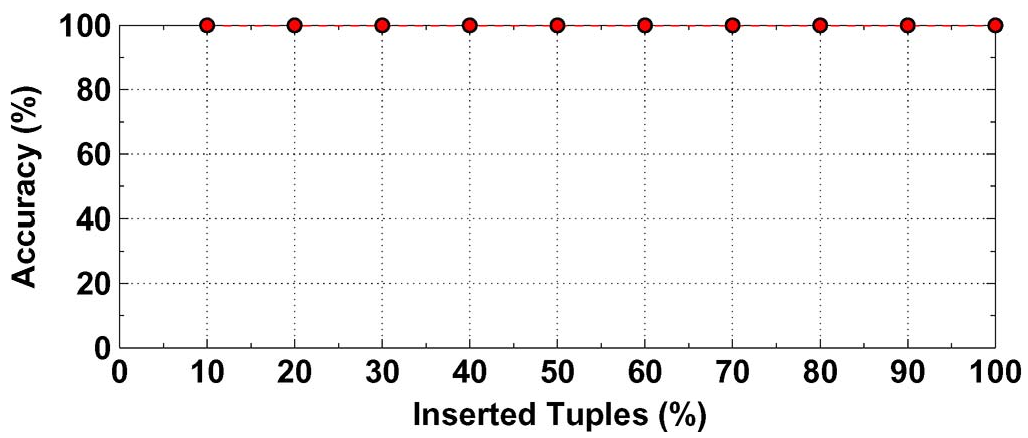 Figure: Watermark decoding accuracy remains stable at 100% despite increasing rates of data insertion.
Critical Insight: Why This Matters
The "Big Data" complexity of this method is , making it scalable for millions of social media records. While the preprocessing (GA optimization) takes time, it is an offline process. Once marked, the data is safe for public distribution.
Limitations: The primary vulnerability remains a "Key Compromise." If the secret parameters (seed value, permutation rounds ) are leaked, the security collapses. Furthermore, while the system is robust against accidental or simplistic malicious changes, "Collusion Attacks" (where multiple users compare different watermarked versions) were not the primary focus of this study.
Conclusion
This work sets a high bar for data trust in CPSCom. By moving away from permanent data distortion and using formal methods to guarantee reversibility, it provides a viable path for open science where data can be shared, protected, and perfectly restored.