
Link Prediction in Social Networks: Decoding the Evolution of Digital Ties
. REVIEW. SCIENCE CHINA Information Sciences
This paper provides a comprehensive review of the state-of-the-art in link prediction within social networks, introducing a systematic taxonomy of techniques. It covers four major categories of methodologies: node-based, topology-based, social-theory-based, and learning-based approaches, while identifying critical challenges like network dynamics and data imbalance.
TL;DR
Link prediction is the "X-factor" behind friend recommendations, collaborator discovery, and network completion. This seminal survey by Wang et al. maps the decade-long evolution of the field, moving from simple neighbor-counting (Common Neighbors) to sophisticated probabilistic models that incorporate social theories like "Weak Ties" and "Structural Balance."
Strategic Position: This work acts as a bridge between the physics of complex networks and the behavioral science of computer-mediated social interactions, setting the stage for modern Graph Machine Learning.
Problem & Motivation: The Dynamic Shadow
Why is link prediction so difficult? The authors pinpoint two primary hurdles:
- Incompletion: We only ever see a fraction of real-world social interactions on a platform.
- Dynamism: Social networks are living organisms. Nodes join, links decay, and "unfollowing" is just as significant as "following."
The research intuition here is that a link isn't just a mathematical edge; it’s a social choice driven by Homophily (similarity), Reciprocity, and Transitivity.
Methodology: From Topology to Social Intelligence
The paper categorizes techniques into a hierarchy of complexity.
1. Local & Path-Based Metrics
At the core are "Neighbor-based" metrics. The intuition is simple: if Alice and Bob share many friends, they are likely to meet.
- Adamic-Adar (AA): Weights common neighbors with fewer connections more heavily (a "niche" mutual friend is a stronger signal than a "celebrity" mutual friend).
- Resource Allocation (RA): A physics-inspired metric that penalizes high-degree common neighbors even more strictly than AA.
2. The Learning-Based Shift
The survey highlights the transition to supervised learning, where link prediction is treated as a binary classification task.
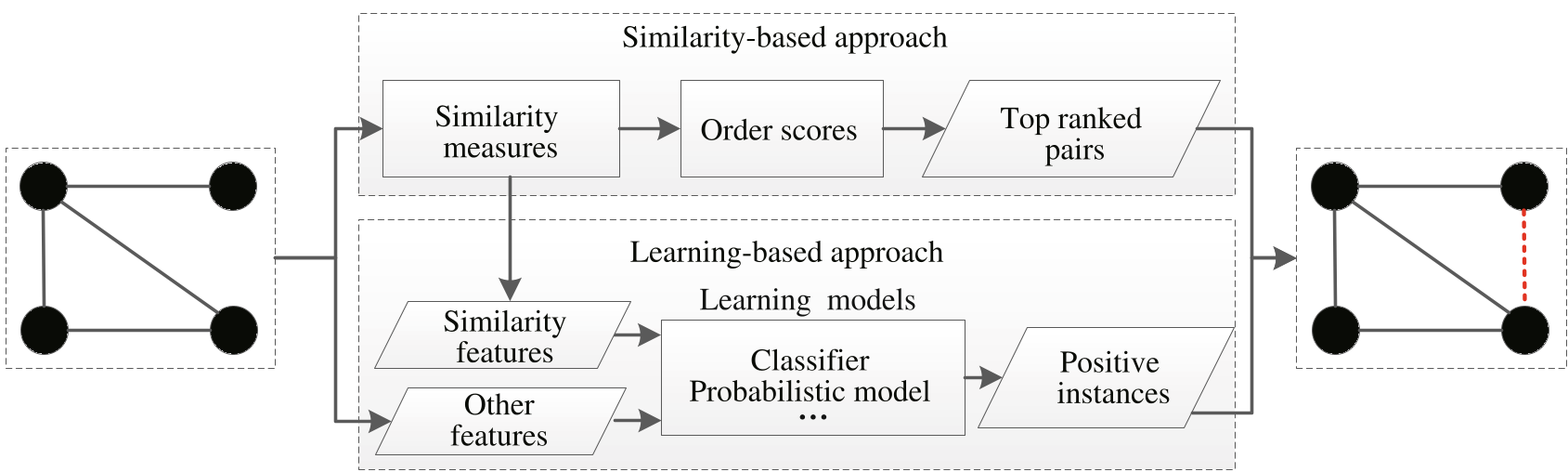
Key models discussed include:
- Ranking Factor Graphs (RankFG): Captures correlations between suggested results.
- Supervised Random Walks: Instead of equal transition probabilities, the model learns edge strengths based on user attributes.
3. Incorporating Social Theory
This is where the paper adds significant value. It argues that purely topological metrics ignore the "why." By injecting Heider’s Balance Theory (a friend of a friend is a friend) and Burt’s Structural Holes, models can better predict links in signed networks (positive/negative ties).
Experiments & Results: Navigating the Trade-offs
The authors contrast various algorithms across dimensions of time complexity and accuracy.
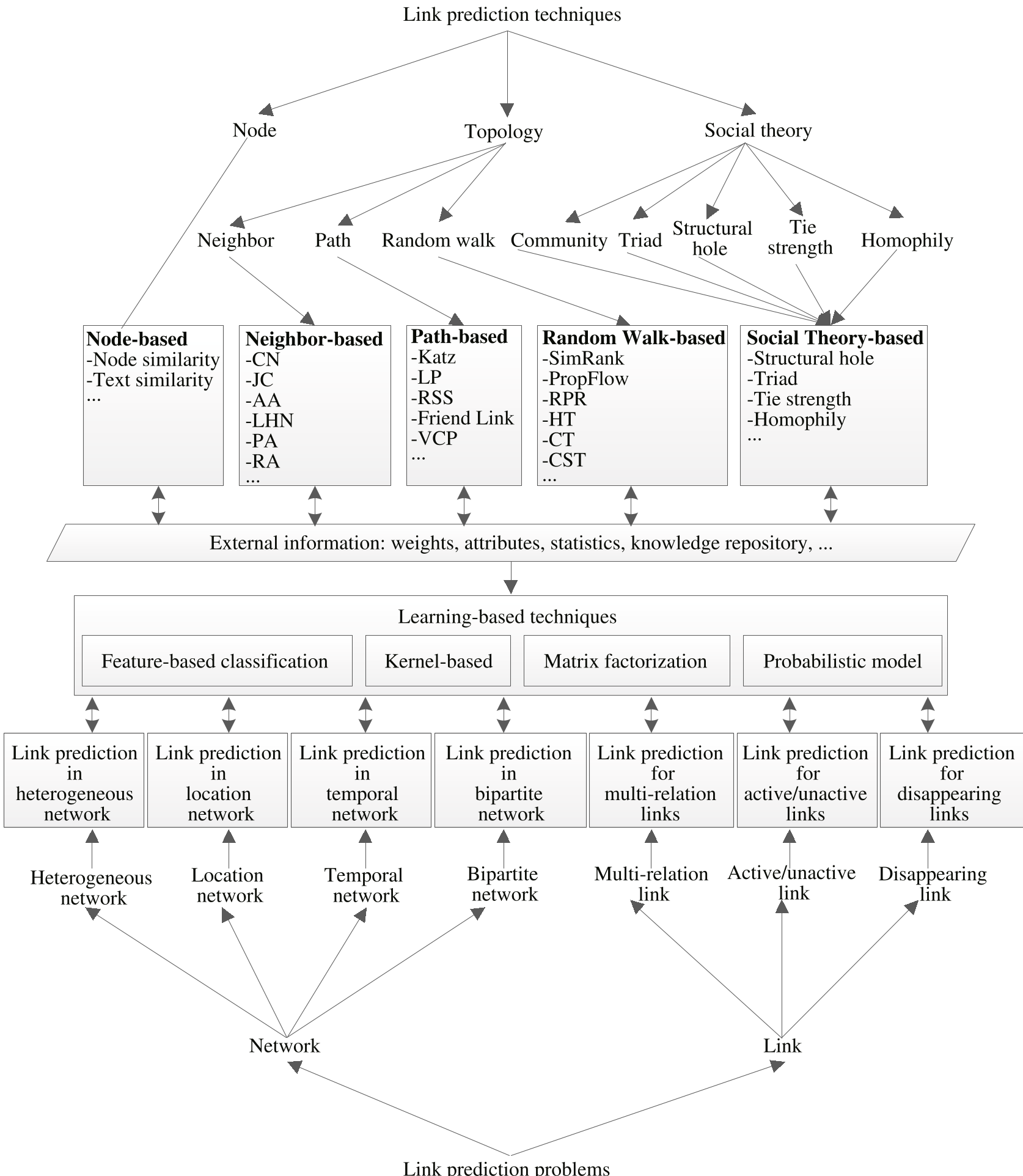
- Global vs. Local: Global metrics like Katz and SimRank provide high accuracy for missing links but suffer from or complexity, making them unusable for platforms like Facebook.
- Temporal Prediction: Using Tensor Factorization, researchers can predict not just that a link will occur, but when (e.g., predicting the next co-authorship at a specific conference).
Critical Analysis & Future Horizons
Takeaway
The most effective link prediction doesn't just look at the graph; it looks at the behavioral evolution of nodes. The integration of "Time Scores" and "Link Activeness" represents a pivot toward real-time social intelligence.
Limitations
- Data Imbalance: Positive links (actual connections) are a drop in the ocean compared to the billions of non-connections. This makes "Precision" a very punishing metric.
- Dynamic Nodes: Most models assume a static set of players, which fails when thousands of new users join a network daily.
Future Work
The "Dark Matter" of social networks is Disappearing Links. While we are great at predicting who you will meet, we are still poor at predicting who you will "unfollow." Solving link dissolution will be the next frontier for sustainable online ecosystems.
Editor's Note: This survey is a foundational roadmap for anyone entering Graph ML or Social Data Science.