
Decoding the Human Mesh: A Deep Dive into Developer Social Networks (DSNs)
. REVIEW. SCIENCE CHINA Information Sciences
This paper provides a comprehensive survey of Developer Social Networks (DSNs) in software engineering, categorizing the field into construction, analysis, and applications. It identifies key methodologies for mining software repositories to build DSNs and demonstrates their effectiveness in tasks like defect prediction and bug triage.
TL;DR
Modern software is built by people, not just machines. This paper surveys the evolution of Developer Social Networks (DSNs)—a paradigm that treats software development as a social graph rather than just a series of code commits. By mining communications and coordination patterns, researchers can predict bugs, identify "hero" developers, and streamline bug triaging with unprecedented accuracy.
The "Brooks's Law" Motivation
For decades, software engineering management was haunted by Brooks's Law: "Adding manpower to a late software project makes it later." The bottleneck wasn't the code; it was the communication overhead.
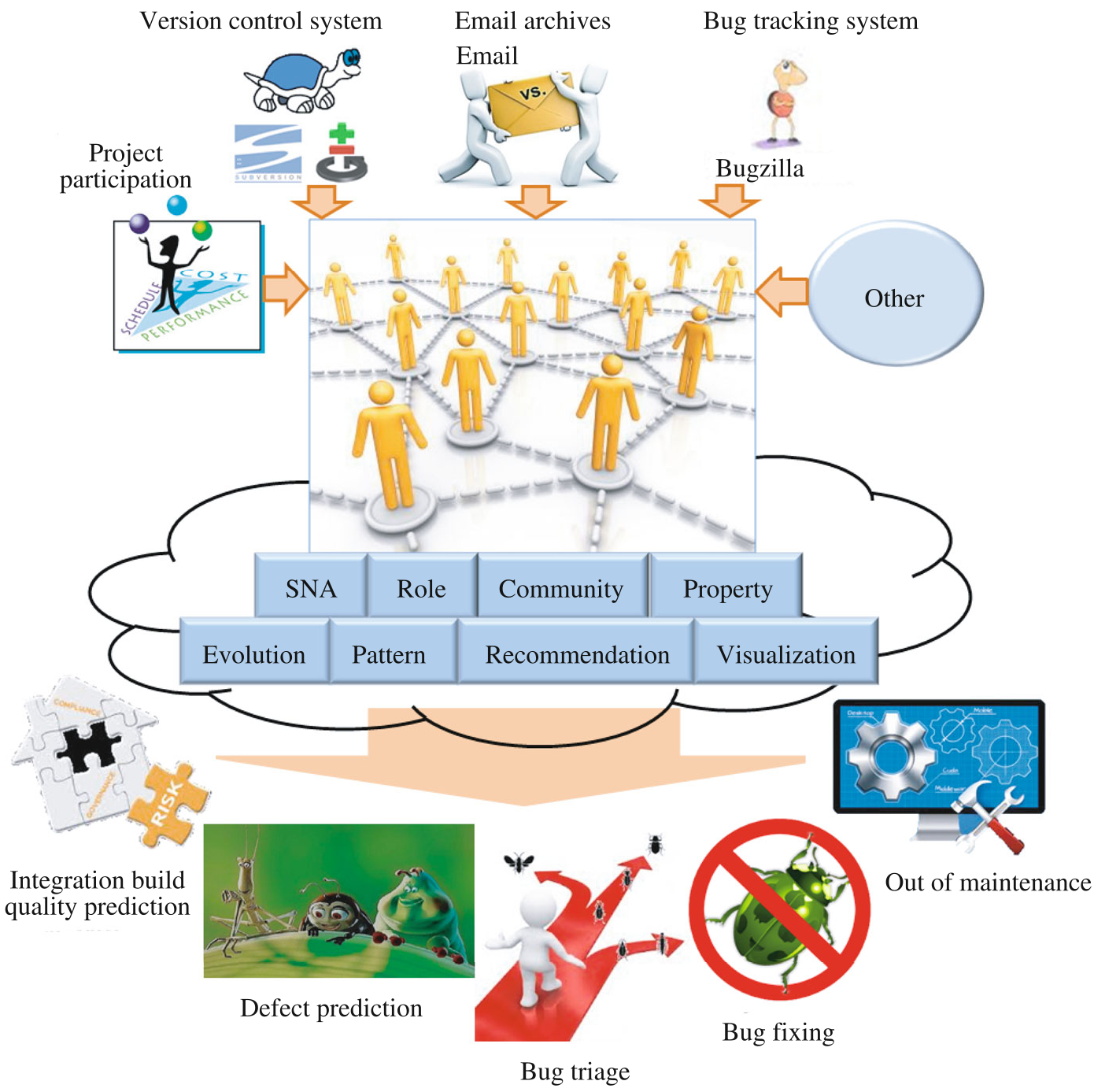
However, the authors argue that in the era of Open Source and Distributed Development, this communication is no longer a "hidden cost"—it is a data goldmine. By extracting the latent social structures from Email archives, Git logs, and Bugzilla, we can transform "messy" human interaction into a predictive tool for software quality.
Methodology: Building the Social Blueprint
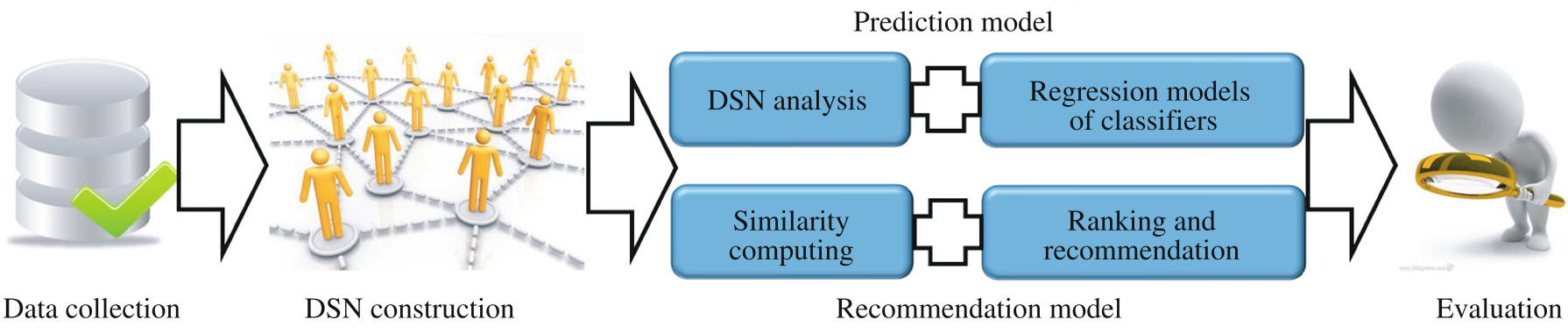
The paper deconstructs the DSN lifecycle into a rigorous three-act structure:
1. Construction (The Data Layer)
How do you define a "link" between developers? The authors categorize four primary data sources:
- VCS-DSNs: Links formed by developers modifying the same file or module.
- EA-DSNs: Directions of information flow identified via email replies.
- BTS-DSNs: Collaboration patterns found in bug report comments.
- Hybrid Networks: The most advanced form, linking developers directly to the software artifacts (Socio-Technical Networks).
2. Analysis (The Wisdom Layer)
Once the graph is built, Social Network Analysis (SNA) metrics are applied:
- Centrality (Degree, Betweenness, Closeness): Used to identify "Hub" developers who hold the project together or "Brokers" who facilitate info-flow across teams.
- Community Detection: Reveals the actual organizational structure versus the official one.
- Small World Phenomenon: The paper confirms that most DSNs follow the "six degrees of separation" rule, where information travels surprisingly fast.
High-Impact Applications
The real power of DSNs lies in their predictive capability.
Defect Prediction & Build Quality
The paper highlights that Network Metrics (e.g., Centrality) are often better indicators of software failure than Complexity Metrics (e.g., Lines of Code). If a central, "load-bearing" developer leaves a project or if two developers who never talk modify the same critical module (low socio-technical congruence), the probability of a build failure or a bug spike increases dramatically.
Automated Bug Triage
Traditional bug triage relies on text matching. DSNs introduce Tossing Graphs, which track how bugs are reassigned between developers. By identifying the "sinks" (experts who actually resolve bugs) in a social graph, systems can automatically route new issues to the most capable hands.
Critical Insight: Why Does It Work?
The effectiveness of DSNs stems from their ability to capture Social Conformity and Ownership. A developer's "Betweenness Centrality" isn't just a number; it is a proxy for their domain knowledge and influence. When these social signals mismatch the technical requirements of the code, bugs happen.
Future Outlook and Limitations
While the survey is exhaustive, it acknowledges a few "elephant in the room" issues:
- Data Quality: Developers use multiple emails; mapping "John Doe" across GitHub, Jira, and Slack remains a technical hurdle.
- Privacy: As DSNs become more common, the risk of "surveillance management" grows.
- The AI Shift: With AI-assisted coding (Copilot/LLMs), the definition of a "Developer" in a DSN might soon need to include non-human entities.
Conclusion
This paper serves as a seminal roadmap for anyone looking to understand the "Human Infrastructure" of software. It proves that the most successful projects are not just those with the best algorithms, but those with the most resilient social networks.