
The Demanding Lord: An Analytic Approach to Concept Drift and Window Optimization
Revisiting the effect of history on learning performance: the problem of the demanding lord
2012-10-13
Summary
Problem
Method
Results
Takeaways
Abstract
The paper introduces an analytic model to determine the optimal memory window size in online learning systems facing abrupt concept drift. By formulating "The Problem of the Demanding Lord," it presents a methodology to estimate average system performance using a Signal-to-Noise ratio approach, achieving high correlation with actual outcomes across diverse learners like SVM, Naive Bayes, and Decision Trees.
## TL;DR
Researchers George Giannakopoulos and Themis Palpanas have developed a theoretical framework to solve one of the most persistent headaches in stream mining: **How much history should a model remember?** By treating a learner's performance as a "Characteristic Transfer Function" (CTF) of the signal-to-noise ratio, they provide a mathematical way to predict average performance and optimize window sizes without endless trial-and-error.
## The Problem: The Mystery of the Optimal Window
In real-world data streams—from stock markets to spam filters—the "target concept" (what the model is trying to predict) often shifts abruptly. This is known as **concept drift**. To adapt, many systems use a *sliding window*, discarding old data to focus on the new.
However, selecting the window size $r$ is usually done via heuristics. If $r$ is too small, the model lacks enough data to learn (high variance). If $r$ is too large, it retains obsolete data that acts as noise, poisoning the new model (high bias). Historically, we lacked a general formula to define this trade-off across different algorithms.
## Methodology: The "Demanding Lord" Logic
The authors frame this as a servant (the learner) trying to please a demanding lord (the user/context) who changes his mind every $T_s$ days. The core of their breakthrough lies in two components:
### 1. The Characteristic Transfer Function (CTF)
They argue that every machine learning algorithm has an inherent "reaction" to noise. This can be modeled as a sigmoid curve:
$$ \overline{f}(Z) = \underline{m} + (\overline{M} - \underline{m}) \frac{1}{1 + b \cdot \exp(-c \cdot Z)} $$
Where $Z$ is the signal-to-noise ratio. This function captures the intuition that a model's performance plateaus once it has high-quality data and craters when noise dominates.
### 2. Modeling Signal vs. Noise
By defining $\rho = r / T_s$ (the ratio of window size to drift period), the authors analytically calculate the expected $Z$ at any point in time.
- **Short-memory ($\rho \le 1$):** The window is smaller than the change period; the model eventually clears out all "old" noise.
- **Long-memory ($\rho > 1$):** The window is so large that even at peak "knowledge," the model is still looking at data from a previous, now-invalid concept.
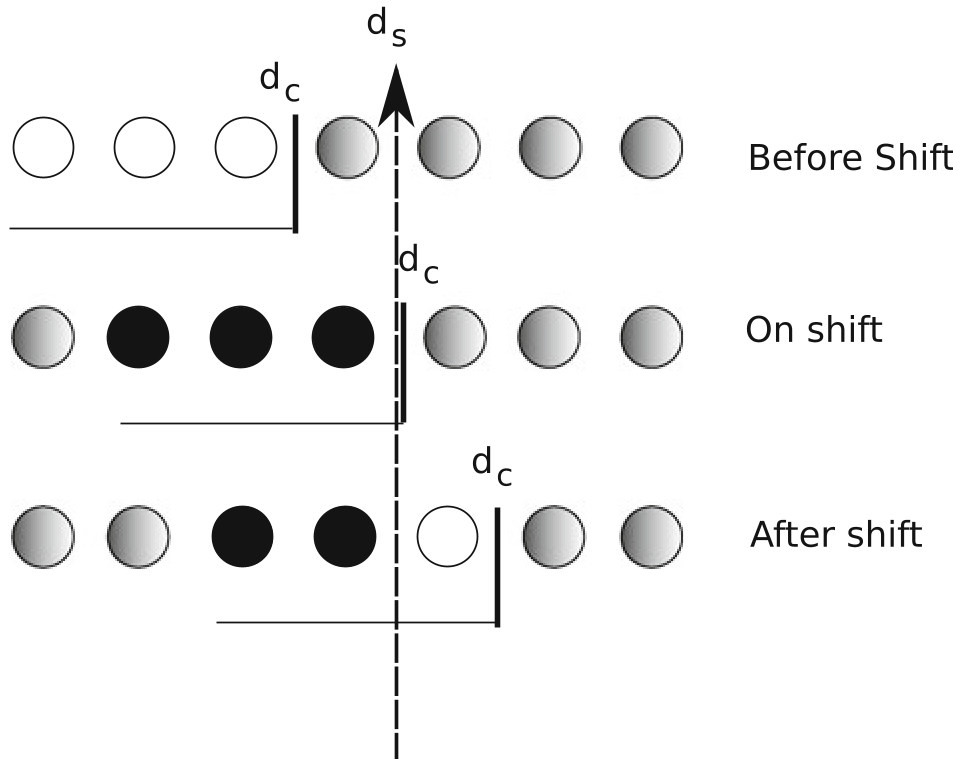
*Figure: The validity of training data over time. Black circles represent noise (old concept), white circles represent signal (current concept).*
## Experimental Validation
The theory was tested against Support Vector Machines (SVM), Naive Bayes, and Decision Trees across several datasets:
* **Synthetic (ENS, STAGGER, SEA):** High-control environments where drift periods were strictly defined.
* **Real-world (German Market, Electricity, Chess):** Messy environments where drift is random and prerequisites are not strictly met.
### Key Findings:
- **Strong Collinearity:** The estimated CTF consistently showed a Pearson correlation > 0.85 with actual performance, proving the sigmoid model's validity.
- **The $\rho = 1$ Limit:** Performance generally peaks near $\rho = 1$. Inverting this, if you know your drift frequency, you know your optimal window.
- **Algorithm Independence:** Whether the task was regression (predicting airline delays) or classification (spam detection), the analytic framework held steady.
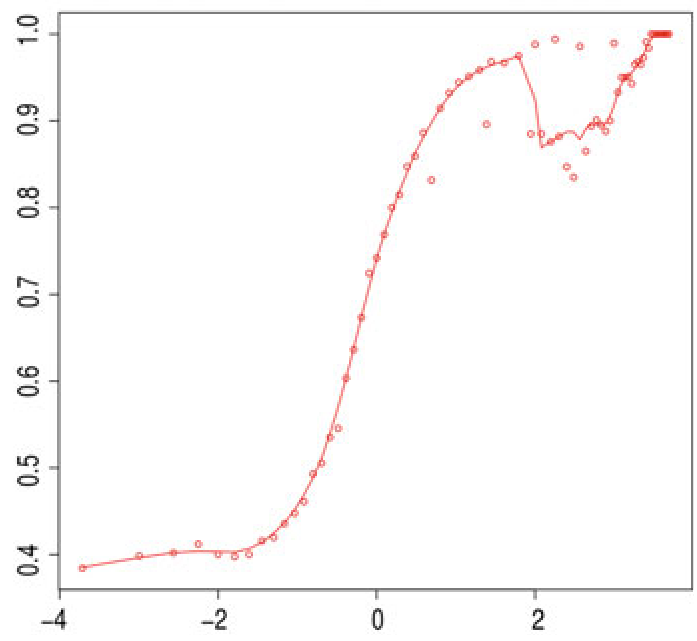
*Figure: The Sigmoid relationship between Log Signal-to-Noise (Z) and Mean Performance.*
## Deep Insight: Beyond Heuristics
The most significant takeaway is that **learning algorithms can be profiled**. Just as an electronic component has a transfer function, an ML model has a CTF for a given domain.
By calculating the CTF on a small sample of data with injected synthetic noise, engineers can predict how the model will behave in a high-velocity stream for the next 10,000 iterations. This removes the "black box" nature of window selection and allows for **proactive** rather than **reactive** system design.
## Limitations and Future Outlook
While the model is robust, it assumes "abrupt" shifts. Future work is needed to adapt the CTF for *gradual* drift, where the old concept slowly fades rather than vanishing instantly. Additionally, applying this to **ensemble methods**—where multiple learners with different window sizes vote—could lead to "Auto-ML" systems that self-optimize their memory in real-time.
In the era of massive streaming data, the "Demanding Lord" framework provides the mathematical compass needed to navigate the treacherous waters of non-stationary environments.