
This study revisits the excess of bar-like structures in Early-Type Galaxies (ETGs) within the TNG50 cosmological simulation. By providing a morphology-agnostic census, the authors demonstrate that these structures are nearly ubiquitous (75-80%) in dispersion-dominated systems and represent secularly evolved, slow-rotating fossil remnants of high-redshift bars.
TL;DR
A new study of the TNG50 simulation reveals that 80% of massive Early-Type Galaxies (ETGs) host elongated, bar-like structures. These are not numerical glitches; they are "fossilized" bars—slow-rotating, physically long remnants of high-redshift spiral discs that survived the quenching process. This suggests a potential misclassification in real-world observations where these dynamic triaxial structures are simplified as featureless spheroids.
Problem: The "Forbidden" Region of the $\lambda_R - \epsilon$ Diagram
In the world of galaxy evolution, bars are usually the domain of "cold," rotationally-supported discs (Late-Type Galaxies). When cosmological simulations like IllustrisTNG began producing red, "hot," dispersion-dominated galaxies with massive central bars, the community was skeptical.
These galaxies often fall into a "forbidden" zone: they have high ellipticity (stretched shape) but very low rotational support. Observational pipelines (like those used in SDSS) typically classify these as Ellipticals (E) or S0s and stop looking for bars. The authors of this paper ask: Is TNG50 simply broken, or are we visually biased against detecting bars in hot stellar systems?
Methodology: Looking for the "Tumble"
To distinguish a genuine bar from a static, squashed ellipsoid, the researchers didn't just look at the shape—they looked at the Pattern Speed ($\Omega_p$).
Using a morphology-agnostic Fourier identification pipeline, they analyzed the stellar mass surface density:
- Fourier Decomposition: Measuring the $m=2$ bisymmetric mode amplitude ($A_2$).
- Local Pattern Speed: A rigorous kinematic check to see if the elongated structure rotates as a coherent, solid-body density wave.
- Mock Observations: Using SKIRT radiative transfer to see how these galaxies would look to the LSST telescope.
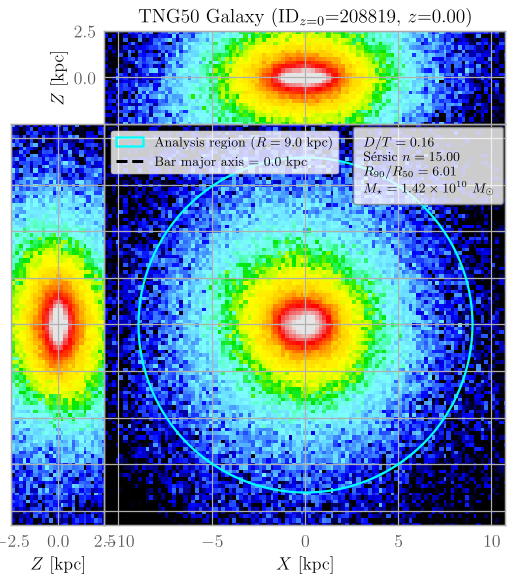 Figure 1: Comparison between a canonical barred spiral (Top) and a "bar-like" ETG (Middle). Despite the ETG being dispersion-dominated (grey points below circular frequency), it hosts a coherent, slow-rotating pattern.
The Life Cycle of a Fossil Bar
The core revelation of the paper is the evolutionary link. The authors traced the "odd" ETGs back in time. At $z=0.2$ (about 2.4 billion years ago), these galaxies were typical gas-rich barred spirals.
As the galaxies quenched—likely due to AGN feedback or gas exhaustion—the discs "heated up" (random motions dominated over rotation). However, the bars didn't dissolve. Instead, they underwent Secular Braking:
- Angular Momentum Loss: Bars transferred their spin to the Dark Matter halo.
- Deceleration: Their rotation slowed down significantly (from $\sim$40 to $\sim$20 km s$^{-1}$ kpc$^{-1}$).
- Growth: As they slowed, they grew physically longer ($\gtrsim 3$ kpc).
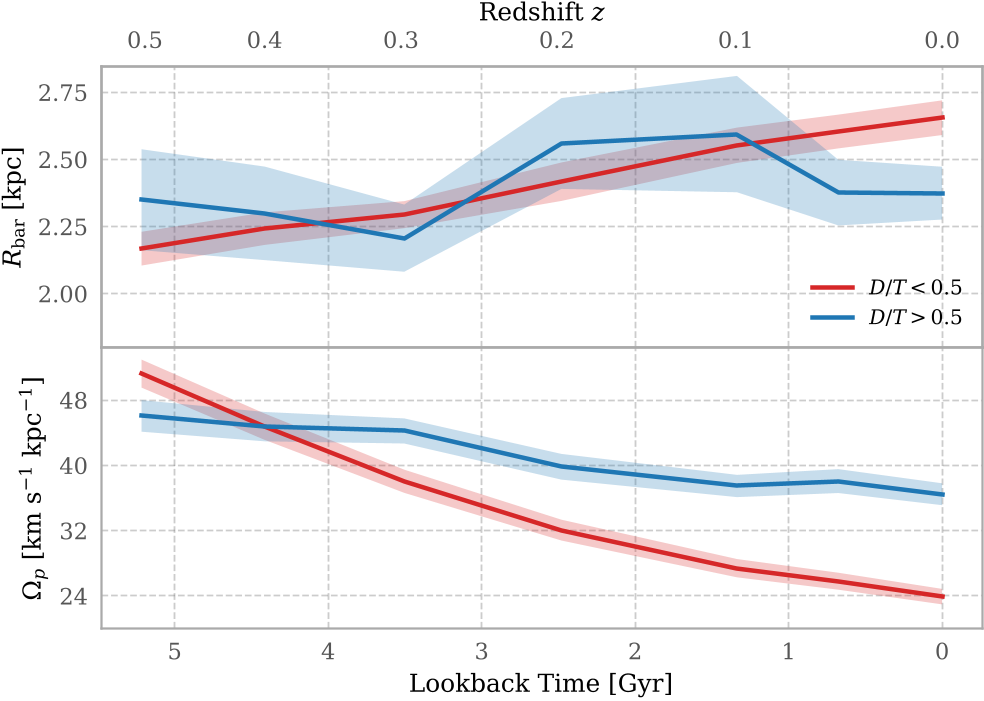 Figure 2: Statistical evolution showing that low $D/T$ systems (red) host bars that were much faster in the past, confirming they are evolved remnants.
Why the Tension with Observations?
If these bars exist, why don't we see them in surveys like MaNGA? The authors suggest a few reasons:
- Classification Bias: Most automated pipelines assume ETGs don't have bars. If a galaxy is very red and concentrated, it is labeled "Elliptical" and excluded from bar searches.
- Low Contrast: ETG bars are "camouflaged" within a thick, hot stellar bulge, making them harder to spot in optical light compared to a thin disc.
- The "Green Valley Dip": TNG50 predicts a monotonic increase of bars with color, whereas observations show a "dip" in the Green Valley. This suggests TNG50 may be too efficient at preserving bars during quenching.
Deep Insight & Conclusion
This work reframes ETGs not as "dead" systems, but as repositories of galactic history. The "excess" of bars in TNG50 acts as a fossil record of their past as active spirals.
Key Takeaways:
- Low Spin Drives Instability: Counter-intuitively, high specific angular momentum stabilizes a galaxy. When spin is low (as in ETGs), the system is actually more susceptible to bar-like instabilities.
- Indestructible Structures: Once a bar forms, it is remarkably durable. It can survive major morphological changes in the host galaxy.
- A Call for New Taxonomy: We need classification systems (like the VRHS system) that treat "Hubble Type" and "Bar Presence" as independent variables.
The "Bar Problem" in simulations has shifted from "Why are there no bars?" to "Are these bars a prediction of a future universe where secular evolution has run its course?"