
LBSN2Vec: Bridging the Gap Between Who You Know and Where You Go
10221_Revisiting User Mobility and Social Relationships in LBSNs A Hypergraph Embedding Approach.
The paper introduces LBSN2Vec, a specialized hypergraph embedding framework for Location-Based Social Networks (LBSNs) that jointly models user mobility and social relationships. By representing check-ins as 4-node hyperedges (User-Time-POI-Semantic) and friendships as 2-node edges, it achieves new SOTA performance in friendship and location prediction.
TL;DR
LBSN2Vec is a hypergraph embedding approach that automates feature learning for Location-Based Social Networks. By treating check-ins as high-order hyperedges and social ties as standard edges, it avoids the pitfalls of manual feature engineering and significantly beats traditional graph embeddings (DeepWalk, Node2vec) in predicting future friends and your next favorite spot.
Back to Basics: The Problem with Hand-Crafted Features
For years, researchers have known that if two people visit the same coffee shop at 8 AM every Monday, they are likely to be friends. This is mobility homophily. Conversely, your friends often influence where you eat—social proximity.
Previous SOTA methods relied on "hand-crafted" features to measure this. They used metrics like the Katz Index for social distance or Jaccard Similarity for co-location. While intuitive, these features are brittle: what works for a dense city like Tokyo might fail in a sprawling city like Sao Paulo. Moreover, they often simplify complex check-in data (User, POI, Time, Activity) into mere pairs, losing the rich "contextual" glue that binds them.
The Methodology: Hypergraphs and Best-Fit-Lines
The core insight of this paper is that an LBSN is not a simple graph; it is a Hypergraph.
- Social Edge: A simple connection between two users ().
- Check-in Hyperedge: A single event linking a User, a specific Time-slot, a POI, and a Semantic Category ().
1. Random-Walk-with-Stay
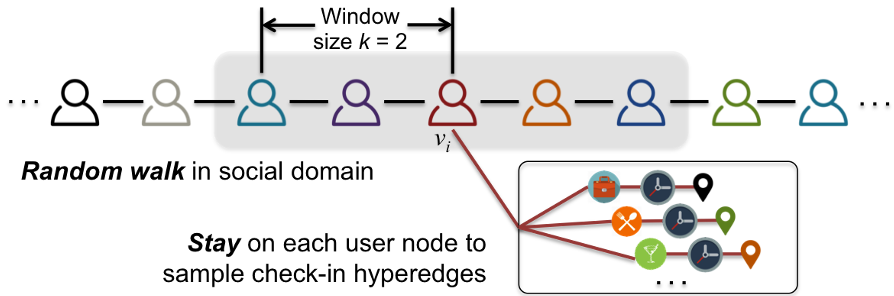
To sample this complex structure, the authors developed a "Random-Walk-with-Stay" strategy. The walker moves through the social network but "pauses" at each user to sample their check-in history. A tunable parameter allows the model to balance the influence of social ties versus mobility habits.
2. Learning in Cosine Space
Unlike standard embeddings that use dot products, LBSN2Vec optimizes for -wise proximity. It calculates a "best-fit-line" (the mean vector direction) for all nodes in a hyperedge and pulls them toward this center in cosine space. This ensures that a user's embedding is pushed not just toward a "POI," but toward the specific "POI+Time+Category" combination.
Experimental Battleground
The model was tested across six diverse cities (NYC, TKY, IST, JK, KL, SP).
Friendship Prediction
LBSN2Vec achieved a staggering 32.95% average improvement over baselines. Interestingly, the study found that adding too much mobility data actually hurt performance in standard baselines, whereas LBSN2Vec’s balanced approach captured the subtle signals needed to predict future links.
Location Prediction
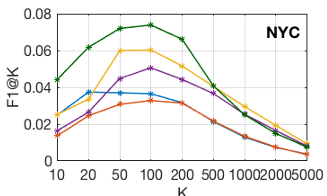
The challenge here was predicting "New POI" visits—places a user has never been. LBSN2Vec improved accuracy by over 50% in this category. This suggests the model successfully learns the "vibe" of a user and a location independently, allowing it to match them even without a prior visit.
Deep Insight: The Asymmetry of Influence
One of the most profound takeaways is the Asymmetric Impact (parameter ):
- To predict Friends: You need a lot of social data (80%) and a little mobility data (20%).
- To predict Location: You actually need more social data (60%) than mobility data (40%).
This suggests that our social circles are actually more predictive of our future movements than our own past habits are of our future friendships.
Conclusion
LBSN2Vec marks a shift from manual feature engineering to automatic, high-order representation learning in LBSNs. By respecting the "hyper-structure" of human activity, it provides a more robust framework for urban computing and personalized recommendation. The future of this work lies in integrating sequential patterns—recognizing that the order of our visits is just as important as the locations themselves.