
Reward or Penalty: Aligning the "Tri-Stakeholder" Incentives in Crowdsourcing
Reward or Penalty: Aligning Incentives of Stakeholders in Crowdsourcing
This paper introduces a novel crowdsourcing incentive mechanism that aligns the interests of requesters, workers, and platforms by incorporating both rewards and penalties. Utilizing reporting tuples of "type" and "belief," the method achieves SOTA-level improvements in quality, cost control, and latency reduction through a weighted majority rule and personal order values.
TL;DR
Crowdsourcing is often a tug-of-war between the requester (who wants quality for cheap), the worker (who wants maximum pay for minimum effort), and the platform (which wants long-term growth). This paper breaks the deadlock by introducing a Reward-Penalty Mechanism. By requiring workers to report both their answer and their belief (confidence), and introducing financial penalties for wrong answers, the system naturally filters out "bad actors" while maintaining high quality and low latency.
The Conflict: Why Crowdsourcing is "Broken"
Most platforms like Amazon Mechanical Turk (MTurk) operate on a simple "pay-per-task" basis. This creates three critical failures:
- Low Quality: Workers rush through tasks they aren't good at.
- High Latency: Difficult tasks are skipped by professional workers to protect their "approval rate," leaving hard problems unsolved.
- Platform Decay: "Badly-behaved" workers flood the system because there is no real downside to being wrong—you just don't get paid.
The Insight: Beliefs and Symmetric Incentives
The authors argue that a worker always has an internal "belief" about how likely they are to be right. The core innovation here is forcing workers to "put their money where their mouth is."
1. The Reporting Tuple
Instead of just reporting an answer (e.g., "Yes/No"), workers report a tuple: <type, belief>.
- Type: The answer.
- Belief (): The confidence level (ranging from 0.5 to 1.0).
2. The Judgement Rule
The platform calculates a Benchmark Solution using a simple majority vote.
- Match: If your answer matches the benchmark, you get a Reward .
- Mismatch: If it doesn't, you pay a Penalty .
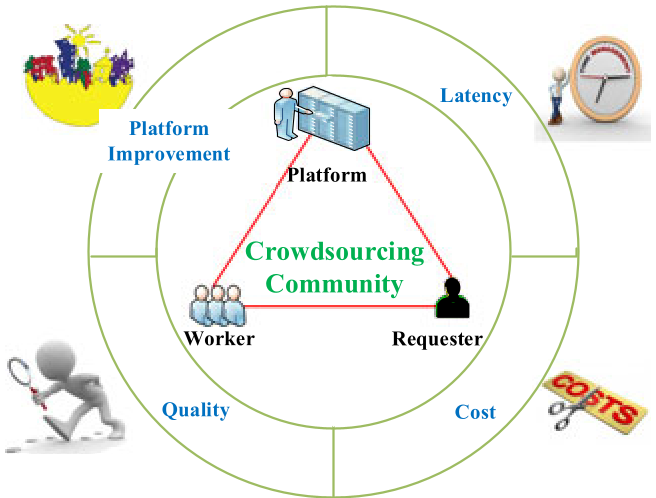 Figure 1: The interplay between Quality, Cost, Latency, and Platform Improvement.
Methodology: The Math of "Truth-Telling"
The paper derives a family of polynomial functions for and that are Incentive Compatible. This means a worker mathematically maximizes their expected income only if they report their true confidence.
The "k" in this equation is the Personal Order Value. High-performing workers get a value that yields higher rewards, while low-performing workers are gradually pushed out by a value that makes penalties more expensive.
Results: Efficiency and Quality
The mechanism was tested against existing SOTA baselines. The results were clear:
- Latency: In traditional systems, hard tasks (low belief) are skipped, causing completion time to spike. In this system, workers provide answers with low belief, allowing the task to finish without stalling.
- Accuracy: The Weighted Majority Rule (using expected gain as weight) consistently outperforms simple majority voting.
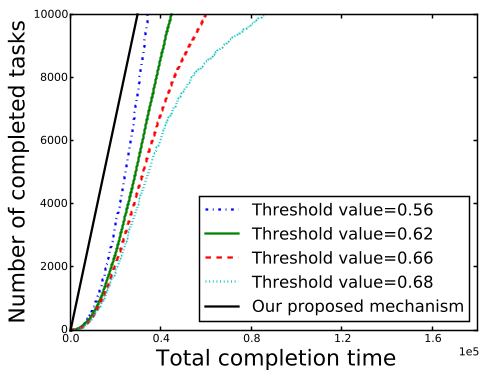 Figure 2: Completion time comparison showing the proposed mechanism (dotted line) remains stable even as difficulty thresholds increase.
Critical Analysis: The "Deposit" Hurdle
While the math is elegant, the practical implementation requires workers to provide a refundable deposit to cover potential penalties. This is a significant shift in the "Gig Economy" UX. However, the authors argue this is no different from "security deposits" in rentals or "prepaid" services, which act as a necessary filter for professional quality.
Final Takeaway
This research moves crowdsourcing from a "best effort" model to a "high-stakes" professional ecosystem. By aligning the incentives of the requester and the worker through symmetric rewards and penalties, platforms can finally solve the "quality vs. latency" trade-off that has plagued the industry for decades.