
RFPCog: Bridging the Semantic Gap in IT Service Procurement with Cognitive NLP
RFPCog: Linguistic-Based Identification and Mapping of Service Requirements in Request for Proposals (RFPs) to IT Service Solutions
The paper introduces RFPCog, a cognitive computing solution designed to automate the extraction of business and IT service requirements from complex Request for Proposal (RFP) documents. By combining linguistic rules with a multi-stage machine learning pipeline, it maps natural language requirements to standardized service provider taxonomies (like ITIL) and visualizes the results through an interactive dashboard.
TL;DR
Preparing responses to massive IT Request for Proposals (RFPs) typically takes weeks of manual labor. RFPCog is a system developed by IBM Research that uses linguistic-based machine learning to automatically extract "asks" from these documents and map them directly to a service provider’s catalog. It achieves over 95% F-Measure in topic identification by looking beyond keywords and analyzing the "responsibility physics" of a sentence.
Problem & Motivation: The RFP Bottleneck
In the corporate world, an RFP is a giant haystack of documents (often 100+ files) where service providers must find the "needles"—the specific requirements they are legally obligated to fulfill.
The difficulty lies in Linguistic Variation:
- Explicit: "Service provider shall provide onsite Desktop Services." (Easy to find)
- Implicit: A bulleted list under a header "Provider Responsibilities" where the subject is missing. (Hard to find)
- Structural: Requirements buried inside tables where the row defines the task and the column defines the SLA. (Very hard to find)
Existing tools often fail because they treat text as a "bag of words," ignoring the hierarchical structure of the document and the dependency between the actor (Provider) and the action (Provide).
Methodology: The Hierarchical Approach
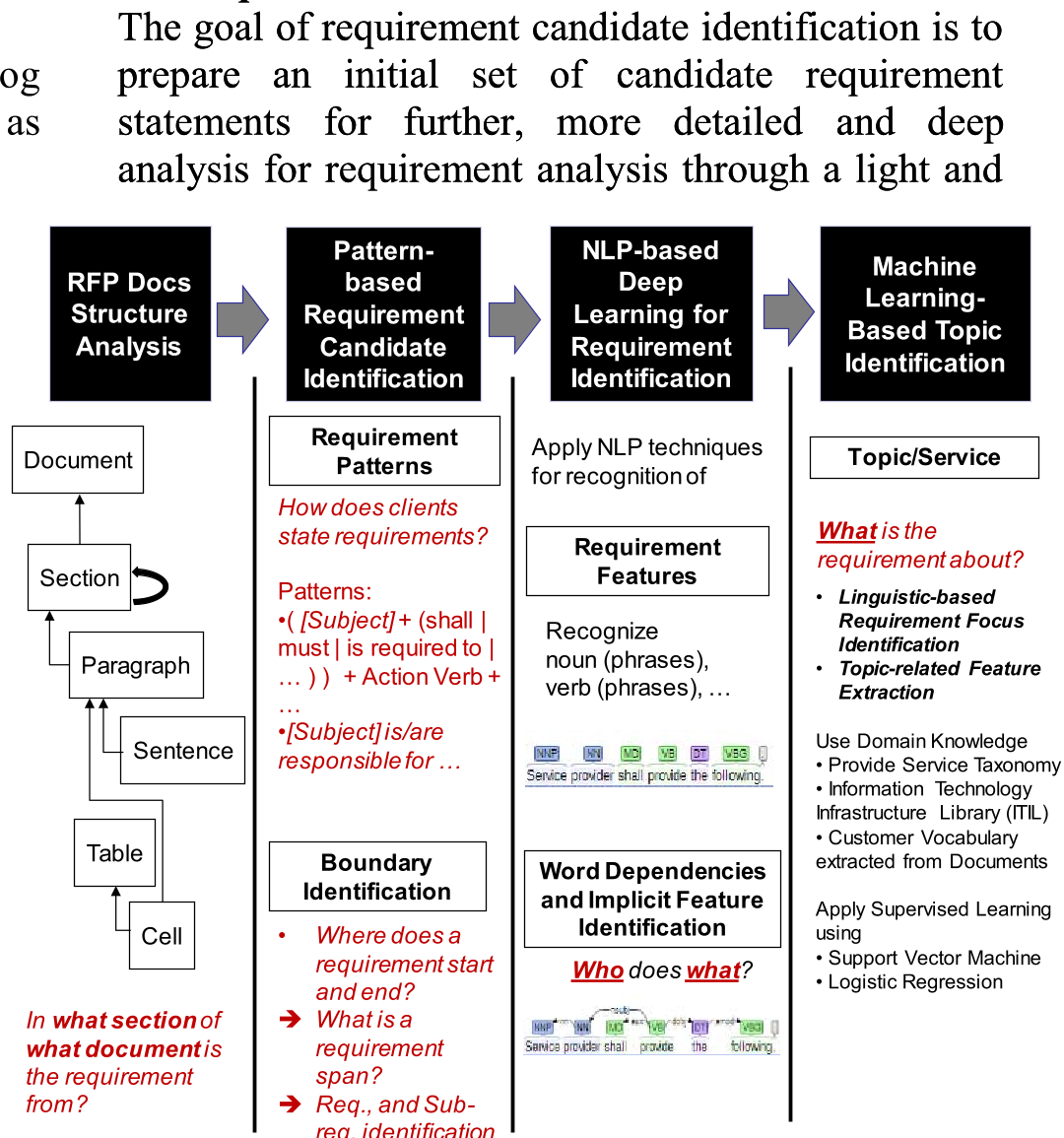
RFPCog doesn't just look for words; it follows a three-stage cognitive pipeline.
1. Document Structure Analysis
The system first builds a "holistic model" of the RFP package. It links sections, paragraphs, and tables, identifying which sections (like "Statement of Work") are more likely to contain high-weight requirements.
2. Deep Requirement Identification
Instead of simple regex, the system uses a weighted function across three linguistic evidences:
- Subject (Responsible Party): Who is doing the work?
- Verb (Responsibility): Is it an obligation (must, shall) or a suggestion?
- Object (Topic): What is the service being discussed?
3. Context-Aware Offering Mapping
This is where the "intelligence" happens. Once a requirement is found, the system maps it to a Service Taxonomy (like ITIL). The authors use a Modified Longest Common Sequence (LCS) matcher. Unlike Jaccard similarity (which ignores order), the LCS ensures that "Project Management" is treated differently than "Management Project." It also penalizes the distance between tokens, ensuring that if terms are scattered across a long sentence, the confidence score drops.
Experiments & Results: Precision matters
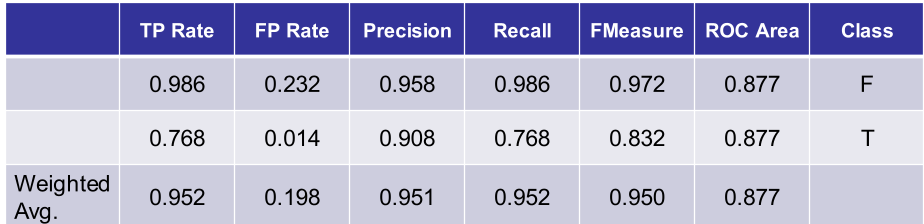
The authors tested several classifiers for Topic Identification, including Naive Bayes and Logistic Regression, but Support Vector Machines (SVM) emerged as the winner.
Key Performance Metrics:
- Precision: 0.908 (for identifying the "True" topic)
- F-Measure: 0.950 (weighted average)
In a field study with IT practitioners, the tool found nearly 90% of all requirements and even flagged several requirements that the human engagement teams had completely overlooked during their manual read-through.
Deep Insight: Beyond Text Matching
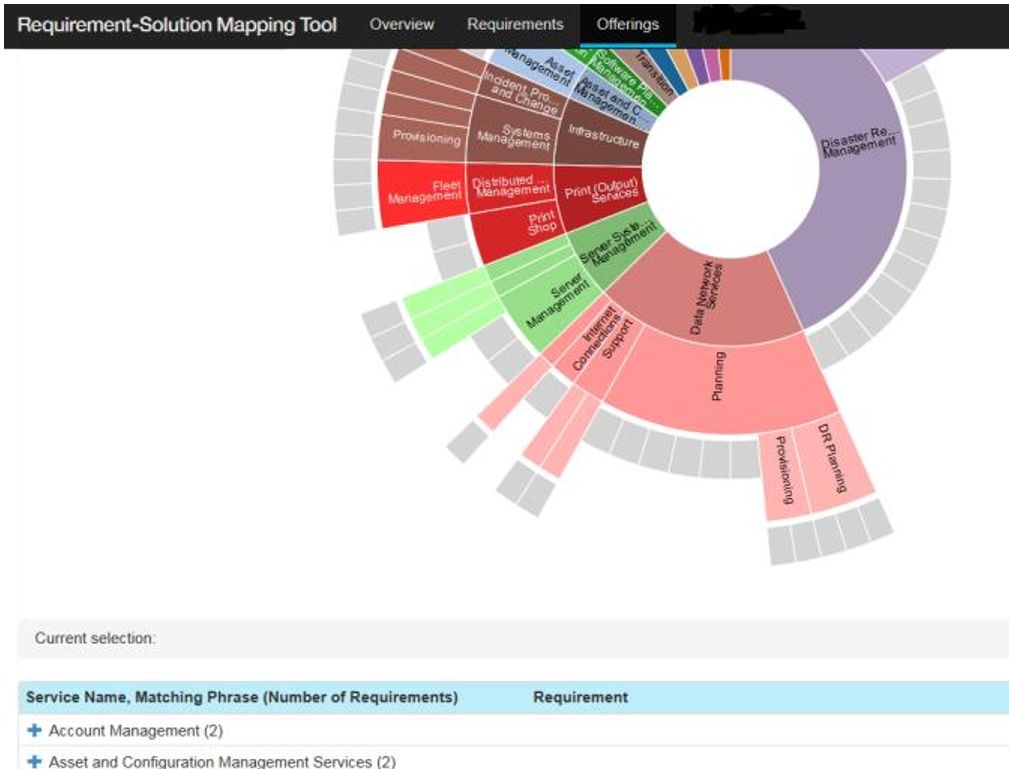
The brilliance of RFPCog is its feedback loop. The tool provides a "Sunburst Chart" (layered circular visualization) where consultants can see which parts of their service catalog are heavily requested and which requirements have "Gaps" (no matching internal offering).
Critical Analysis & Conclusion
While RFPCog was a pioneer in using linguistic patterns for RFPs, it does have limitations:
- Dependency on Templates: It relies heavily on recognizing document structures, which might struggle with highly unorthodox RFP formats.
- Semantic Depth: While LCS is better than keyword matching, it doesn't reach the level of semantic understanding found in modern Transformer models (though, at the time of writing, it was SOTA for efficiency).
Future Outlook: The next evolution of this tech involves Generative AI (RAG), where the system doesn't just extract requirements but drafts the initial response based on the mapped service catalog. RFPCog laid the critical groundwork for the "Knowledge Graph" that such modern AI systems require to be accurate.