
Structured Legal Summarization: Decoding Rhetorical Roles with CRFs
Identification of Rhetorical Roles for Segmentation and Summarization of a Legal Judgment
This paper introduces a specialized framework for the automatic segmentation and summarization of Indian legal judgments using Conditional Random Fields (CRFs) for rhetorical role identification. The methodology labels sentences with seven distinct roles (e.g., Ratio Decidendi, Final Decision) and utilizes a K-mixture term distribution model to extract key sentences, achieving significantly higher alignment with expert human headnotes compared to standard summarizers.
Executive Summary
TL;DR: This research tackles the "black box" of legal judgment summarization by shifting the focus from simple keyword extraction to structural role identification. By employing Conditional Random Fields (CRFs), the system identifies the "why" behind a judge's decision—the Ratio Decidendi—and uses it to build a structured "headnote" that rivals human expert quality.
Contextual Positioning: Published in the intersection of NLP and Law, this work acts as a bridge between classical rule-based legal expert systems and modern probabilistic sequence modeling. It establishes a "Gold Standard" for Indian legal document segmentation.
The Problem: The Incoherence of General Summarizers
Legal judgments are not just text; they are a sequence of rhetorical moves. A standard summarizer might pick a "fact" sentence and a "final decision" sentence but miss the logic connecting them.
The authors identify two fatal flaws in prior work:
- Lack of Coherence: Automatically generated summaries often fail to convey the relative relevance of different components.
- Term Distribution Neglect: Simple TF-IDF weighting fails to account for the mathematical variability of legal terminology across different case types (Rent Control vs. Income Tax).
Methodology: The CRF Advantage
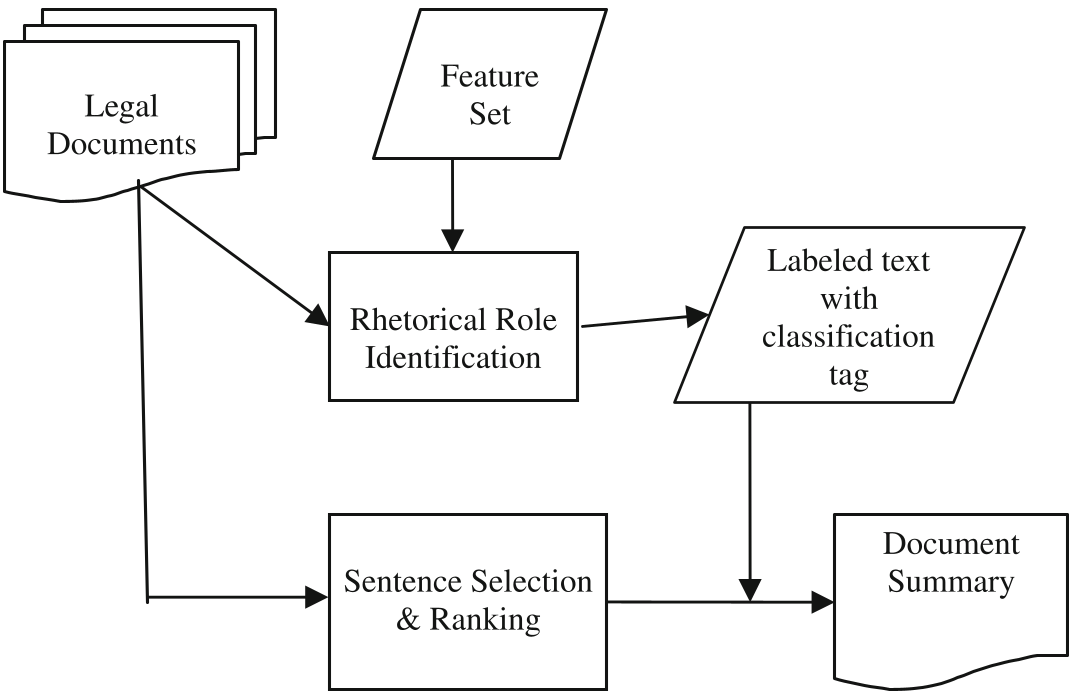
The core innovation lies in treating a legal judgment as a sequence where the label of one sentence depends on the context of the others.
1. Rhetorical Role Labeling
The system categorizes every sentence into one of seven roles:
- Identifying the Case: Issues to be decided.
- Establishing Facts: Proved/unproved details.
- History: Event chronology.
- Arguments: Contending parties' views.
- Arguing the Case: Application of law to facts.
- Ratio Decidendi: The crucial "reason for the decision."
- Final Decision: The ultimate disposal.
2. Overcoming Label Bias
While Maximum Entropy Markov Models (MEMMs) suffer from the "label bias problem," CRFs use an undirected graphical model to define a joint probability over the entire sequence. This allows the model to "look ahead" and "look back" to ensure the sequence of roles (e.g., Facts leading into Arguments) makes logical sense.
3. The K-Mixture Model for Summarization
Instead of simple frequency counts, the authors use the K-mixture model to characterize how informative a word is based on its clustering behavior.
This formula helps normalize term occurrences, ensuring that "summary-worthy" words—those that cluster in specific legal contexts—are prioritized.
Experiments: Beating the Baselines
The system was tested on 200 documents across Indian Rent Control, Income Tax, and Sales Tax domains.
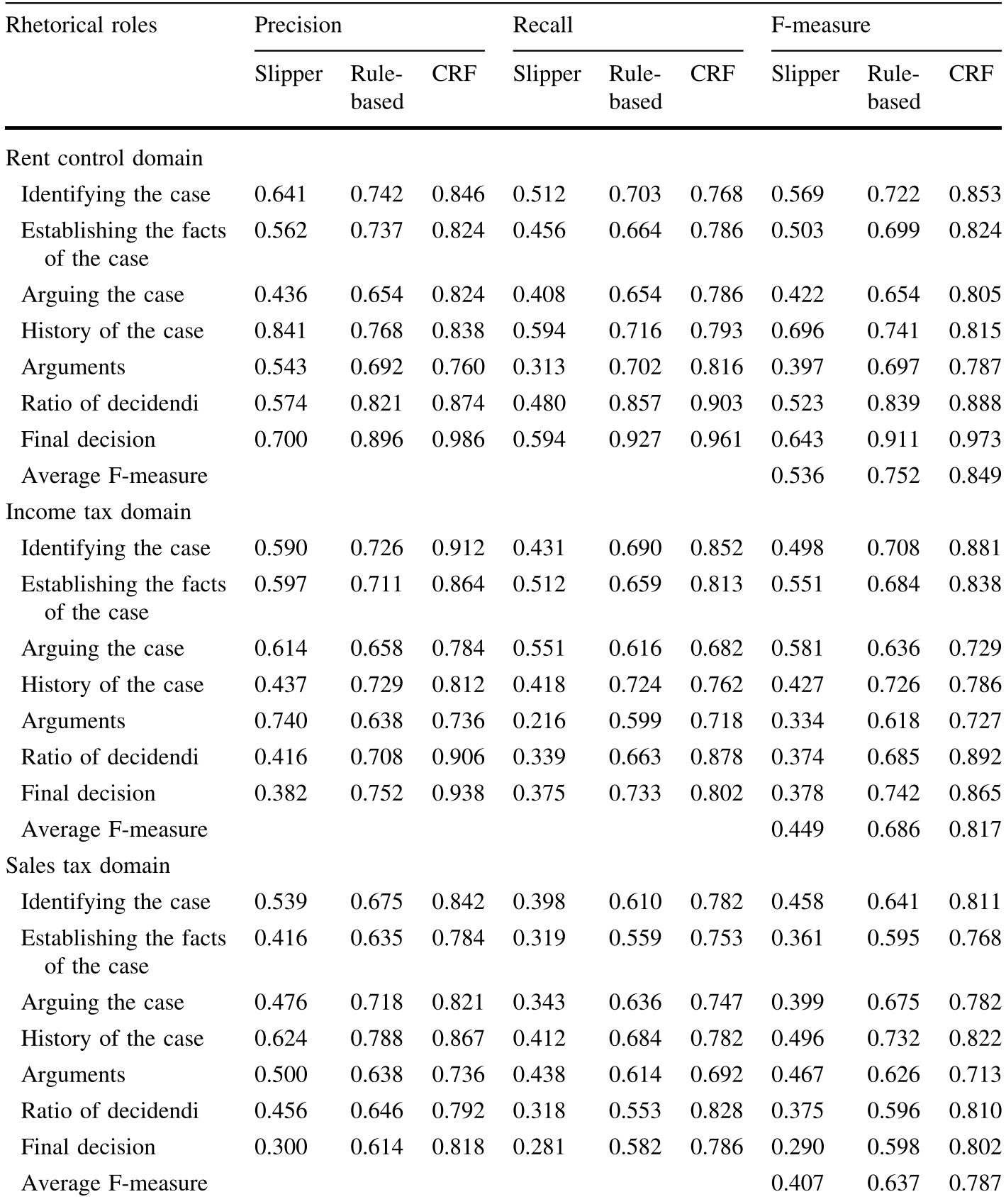
Segmentation Accuracy: The CRF model significantly outperformed SLIPPER (a standard rule-learner). For "Final Decision" identification, the CRF achieved a staggering 0.986 Precision.
Summarization Quality: When compared against MEAD and MS Word's built-in summarizers, the proposed system showed a massive leap in ROUGE-2 scores, proving that capturing the "Ratio Decidendi" is the key to meaningful legal summaries.
Critical Insight & Conclusion
The true brilliance of this work is the Re-ranking Stage. The authors observed that human experts don't just pick the "best" sentences; they maintain a specific balance of roles. By re-ranking sentences to ensure the Ratio Decidendi and Facts are appropriately represented, the system generates "user-friendly" headnotes that look like they were written by a lawyer.
Limitations: The model still struggles to distinguish between "Arguments" and "Arguing the Case" due to linguistic similarities. Future iterations would likely benefit from Deep Learning embeddings (like BERT) to capture deeper semantic nuances.
Takeaway: In domain-specific NLP, structure is as important as content. For the legal sector, an AI that doesn't understand the "rhetoric" of a judgment is merely a word-counter; this paper provides the blueprint for an AI that understands "law."